
There is a curious paradox in the way people engage with sacred texts: the deeper the meaning, the fewer words seem necessary. Surah Ya-Sin, often called the heart of the Quran, opens with two mysterious letters that defy translation. And it is precisely in that untranslatable, elusive quality that a truth resides which any Freemason will recognize — some insights cannot be explained, only experienced.
The Mystery of the Opening Letters
Anyone reading Surah Ya-Sin for the first time encounters an immediate riddle. The surah opens with the Arabic letters ya and sin, offered without explanation. Islamic scholars across the centuries have proposed countless interpretations, yet none is definitive. Some see a reference to the Prophet Muhammad; others view the letters as a reminder of the limits of human understanding. This is not a weakness of the text — it is its very strength. It compels the reader toward humility.
For the Freemason, this evokes a deeply familiar attitude. The Masonic tradition likewise contains symbols that can never be fully deciphered. The rough ashlar, the compasses, the square — they all point beyond themselves toward meanings that emerge only in the silence of personal contemplation. As the Persian poet Rumi once wrote: “Silence is the language of God; all else is poor translation.” Surah Ya-Sin invites us into precisely that silence.
The Core Message: Resurrection and Accountability
At its heart, Ya-Sin revolves around several grand themes: the oneness of God, the truth of the prophetic message, and above all, the resurrection of the dead. The surah paints vivid images of a day when every soul must give account. The bones will speak, the earth will bear witness, and nothing remains hidden. This is not a threat in any modern sense — it is an invitation to moral awareness. Every action matters; every gesture leaves its mark.
Freemasonry carries a kindred conviction, though expressed in different language. The teachings of the Third Degree confront the Brother with his own mortality — not to discourage him, but to remind him of the urgency of living a good life. Just as Hiram Abiff dies and is symbolically raised, so too does Ya-Sin speak of bones brought back to life. In both traditions, death is not an endpoint but a gateway to deeper understanding.
The confrontation with mortality is not an ending — it is the beginning of true moral consciousness.
Signs in Creation: Light That Guides the Way
A remarkable passage in Ya-Sin describes the signs of God in the natural world: the orbits of the sun and moon, the fruits the earth brings forth, the ships that sail across the seas. These verses are not scientific explanations — they are spiritual invitations. They ask the reader: do you see what there is to see? Do you recognize in the order of the universe a wisdom greater than yourself?
The Freemason will hear the echo of his own search for light. The lodge is oriented toward the east, where the sun rises. In Masonic tradition, light is never merely physical — it refers to knowledge, to insight, to the gradual illumination of consciousness. Johann Wolfgang von Goethe, himself a Freemason, is said to have captured this in his final words: “More light.” Surah Ya-Sin speaks the same language when it calls the faithful to perceive the signs that are present everywhere around them.
The Parable of the Village: Receptivity and Rejection
In the middle of the surah, we find a story about a village that receives messengers. The inhabitants refuse to listen, until a man from the outskirts of town implores them: “Follow those who ask no reward from you, follow those who are rightly guided.” This passage touches on a universal theme — the tension between truth and receptivity. The message may be pure, but if the heart remains closed, it reaches no one.
This is also the challenge facing the Freemason. The rituals and symbols of the lodge are not magic formulas that work automatically. They require an open disposition, a willingness to be moved. Voltaire, in his philosophical writings, emphasized that prejudice is the greatest enemy of enlightenment. Surah Ya-Sin illustrates the same truth: whoever refuses to hear will not understand, no matter how loudly the voice calls out.
The Word “Be” and the Creative Power of Speech
One verse stands out with particular force: when He wills a thing, He merely says “Be” — and it is. This divine word, kun in Arabic, represents absolute creative power. Here the Quranic vision touches an idea that also lives within Western esoteric traditions: the word as the origin of reality. In the Gospel of John we read: “In the beginning was the Word.” The power to speak, to name, to create — this is a divine gift that humanity shares in modest measure.
Freemasonry understands the significance of the word in ritual context. The Lost Word, the search for the True Word — these themes point toward a reality that lies beyond everyday speech. Surah Ya-Sin reminds us that words are never innocent. They create, they destroy, they transform. The Freemason who grasps this truth learns to speak with greater care and intention.
What does it mean to regard a text as the heart of a tradition? Perhaps this: that it does not contain the most information, but offers the most space for transformation. Surah Ya-Sin speaks of death and resurrection, of signs and blindness, of the word that brings reality into being. For the Freemason, these are not foreign sounds — they resonate with the familiar journey from darkness to light, from rough stone to polished whole. The question that lingers may be this: if the heart of the Quran begins with letters that no one fully comprehends, what does that tell us about the nature of spiritual wisdom itself? Perhaps that the heart asks not for explanation, but for presence.
Copyright text & image: devrijmetselaar.nl
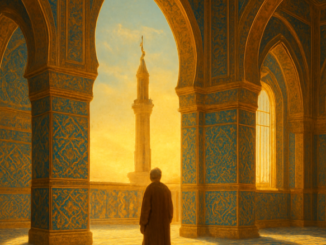
Texts are based on the ideas and content of the author of devrijmetselaar.nl, reviewed, corrected, and supplemented with the assistance of OpenAI. Images are created based on the ideas of the author of devrijmetselaar.nl using OpenAI/DALL-E.



Be the first to comment