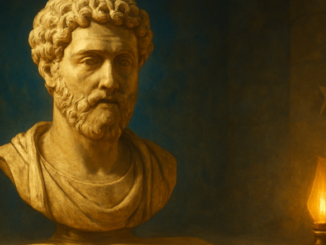
Vrijmetselarij - Marcus Aurelius Boek VIII: De ware aard van de mens onthuld
Marcus Aurelius – Content & Summary

Marcus Aurelius Book VIII: The True Nature of Man Revealed

What makes a person who they truly are? Is it our position in the world, our deeds, or something deeper that lies beneath the surface? In Book VIII of his Meditations, the Roman Emperor Marcus Aurelius wrestles with precisely this question. He wrote these personal reflections not for publication, but as an inner dialogue with himself — a mirror in which he sought to know his own soul. Let us walk through this book together and explore what these Stoic insights still have to say to us today. What Is the Central Theme of Book VIII? At the heart of Book VIII lies a fundamental question: what is the true nature of man, and how can we live in harmony with that nature? Marcus Aurelius examines the relationship between individual consciousness and the greater whole of the cosmos. He does not see human beings as isolated creatures, but as inseparable threads in a universal fabric. The emperor emphasizes again and again that our true essence does not reside in our bodies or our possessions, but in what the Stoics called the hegemonikon — the ruling part of the soul that has the power to choose how it responds to the […]
Vrijmetselarij - Marcus Aurelius over de ware aard: filosofische bronnen
Marcus Aurelius – Meditations

Marcus Aurelius on True Nature: Philosophical Sources

A stone is more than mere matter. In the hands of a mason, it becomes a building block, a bearer of structure, a symbol of something greater than itself. Marcus Aurelius viewed the human soul in much the same way — not as an isolated phenomenon, but as part of a cosmic whole. In the eighth book of his Meditations, the Roman emperor examined what a person truly is, beyond the roles and masks of daily existence. To fully grasp his insights, we must understand the philosophical sources from which he drew. The Stoic Tradition as Foundation Marcus Aurelius did not write in a vacuum. He was the last great representative of a philosophical movement that had originated in Athens five centuries earlier. Zeno of Citium, the founder of Stoicism, taught that the cosmos was a living, rational whole. The human soul, he argued, was a spark of that same cosmic reason — the logos. This concept reverberates throughout Book VIII, where Marcus Aurelius repeatedly points to the connection between individual reason and the universal mind. The early Stoics — Cleanthes and Chrysippus — laid the theoretical groundwork. They developed a natural philosophy in which everything that exists forms part […]

Ancient Roman bust of Marcus Aurelius representing Stoic philosophy and wisdom
Marcus Aurelius – Content & Summary

Marcus Aurelius Book III: The Good and Nature Summarized

In the year 170 AD, somewhere along the northern frontier of the Roman Empire, an emperor wrote words that still resonate almost two millennia later. Marcus Aurelius — the philosopher on the throne — was not keeping a diary for posterity. He was writing for himself, as an exercise in self-discipline and wisdom. Book III of his Meditations offers a profound exploration of what it means to live well according to the laws of nature. This text provides not only a window into the mind of a Stoic emperor, but also a mirror for anyone searching for meaning and inner peace. The Historical Context of Book III Marcus Aurelius composed his Meditations during one of the most turbulent periods of his reign. The Marcomannic Wars raged along the empire’s borders, plague devastated the population, and the emperor found himself far from Rome, stationed at the Danube frontier. It was precisely amid this chaos and uncertainty that Book III came into being — a collection of reflections on the transience of life and the urgency of living each moment with full awareness. The Meditations were originally titled Ta eis heauton, which translates literally as “to himself.” This deeply personal character is […]