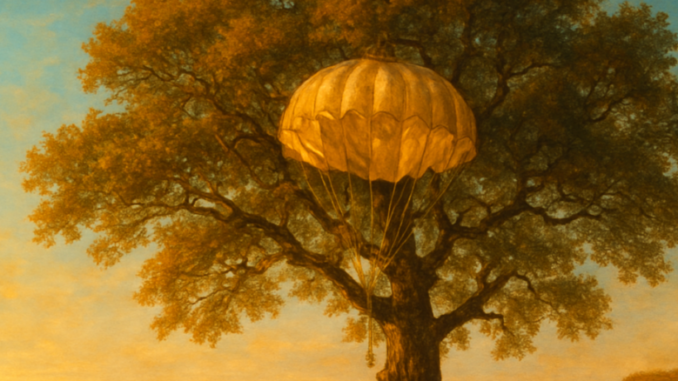
Somewhere above the heathlands of the Netherlands, a military parachutist spent over an hour tangled in the branches of a tree. His jump had been calculated; his landing was not. While emergency services gathered below and the minutes crawled by, this soldier did something that has been considered one of the most difficult human skills for centuries: he waited. This seemingly mundane news story touches on a theme deeply rooted in Freemasonry and the arts — the noble art of patience and the surrender to what lies beyond our control.
The Historical Roots of Patience as a Craft
In the seventeenth century, when the first Grand Lodges were being formed in England and Scotland, patience was not an abstract virtue — it was a practical necessity. The operative masons who built the great cathedrals understood that haste was the enemy of craftsmanship. James Anderson, who compiled the Constitutions of Freemasonry in 1723, repeatedly stressed that true mastery could only be achieved through years of dedication. The Entered Apprentice had to wait before becoming a Fellow Craft; the Fellow Craft had to wait before being raised to Master Mason. This waiting was never a punishment. It was an education.
The Renaissance artists — many of whom had ties to the guilds that would later evolve into speculative lodges — understood this principle equally well. Leonardo da Vinci spent sixteen years on The Last Supper, not out of slowness but out of reverence for the process. Michelangelo lay on his back for four years beneath the ceiling of the Sistine Chapel. Their masterpieces were not created despite the waiting, but because of it.
The Tree as a Symbolic Working Tool
It is no coincidence that a tree held the parachutist in place. In Masonic symbolism, the tree represents growth, steadfastness, and the connection between heaven and earth. The acacia, which plays a central role in the Master Mason degree, reminds Freemasons of immortality and resurrection. But there is a more practical lesson here as well: trees bend with the wind without breaking. They do not resist the elements — they adapt.
The true art of waiting is not passive endurance, but the active acceptance of what the moment demands.
Goethe, himself both a Freemason and an artist, wrote extensively about the tree as a metaphor for human development. In his botanical studies and in works such as Wilhelm Meister’s Apprenticeship, he returned again and again to the image of organic growth. A tree cannot be hurried. Neither can a person force their own development. The parachutist caught in his tree had become — perhaps without realizing it — part of an ancient tableau.
Art and the Acceptance of the Uncontrollable
The Japanese artistic tradition has a concept called ma — the meaningful emptiness or pause. In Western music, we speak of rests: the moments of silence that give the notes their depth. Wolfgang Amadeus Mozart, a Freemason and member of the Viennese lodge Zur Wohltätigkeit, composed with as much attention to the silences as to the notes themselves. His opera The Magic Flute, steeped in Masonic themes, contains moments of deliberate delay where the listener is compelled to wait for the resolution.
This principle extends into life itself. The soldier in his tree could not descend when he wanted. He had to trust others, trust the process, trust time. This runs counter to our modern culture of instant gratification and constant control. Yet it is precisely this surrender that artists and philosophers have advocated throughout the ages.
The Masonic Lodge as a Training Ground
Within Freemasonry, patience is not merely discussed — it is practiced. The ritual compels us to slow down. Words are spoken deliberately, movements are stylized, and silences are honored. This is not theatrical affectation; it is intentional training. Just as a painter learns not to lunge immediately at the canvas, the Freemason learns not to react impulsively to every stimulus.
The Entered Apprentice degree teaches us to observe without judgment. The Fellow Craft degree teaches us to work without haste. The Master Mason degree teaches us to accept without resistance.
The Stoic philosopher Marcus Aurelius wrote that we cannot choose what happens to us, but we can choose how we respond. The parachutist did not choose his predicament, but his reaction — his calm composure during that hour among the branches — was entirely his own creation. In that sense, his waiting was a form of art.
From the Treetop to Daily Life
What can we take from this? First, that unforeseen circumstances are not enemies but teachers. Second, that waiting is not wasted time but an investment in inner peace. And finally, that the art of living — like every other art — requires practice in exactly those things we would rather avoid.
Freemasonry offers no ready-made solutions, but it does offer a method. By contemplating symbols, by living through rituals, by reflecting on the human condition in the fellowship of the lodge, the Freemason gradually develops the ability to be where he is. Not to live in fear of what is coming, not to mourn what has passed, but to be fully present in the moment — even when that moment is uncomfortable.
A parachutist stuck in a tree is not lofty mysticism. It is a man in a difficult situation who had to wait for help. But within that waiting lies a universal lesson that artists, philosophers, and Freemasons have recognized for centuries: that surrender is not weakness but a skill, that patience is not passivity but an art, and that we humans sometimes grow the most when we are stuck and forced to simply be.
Copyright text & image: devrijmetselaar.nl
Texts are based on the ideas and content of the author of devrijmetselaar.nl, reviewed, corrected, and supplemented with the assistance of OpenAI. Images are created based on the ideas of the author of devrijmetselaar.nl using OpenAI/DALL-E.

Be the first to comment