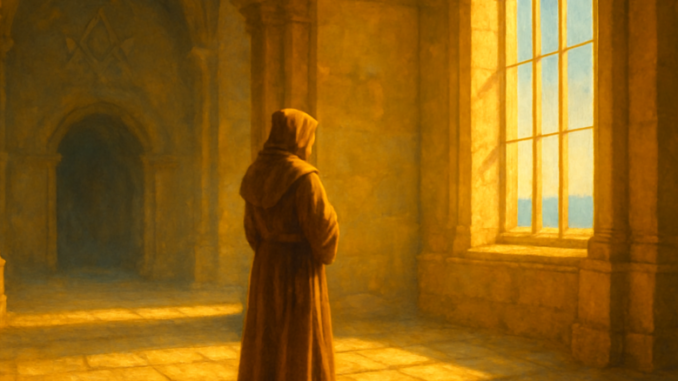
When Dan Brown published The Da Vinci Code in 2003, it became an international phenomenon almost overnight. Central to its plot was a centuries-old secret society called the Priory of Sion, allegedly founded in 1099 and led by grand masters including Leonardo da Vinci and Isaac Newton. The novel even opened with a page titled “Facts,” lending an air of historical authority to these claims. Millions of readers took them at face value. But what do historians and archivists actually have to say? It is time for a thorough fact-check.
The Origin: Not Medieval, but Twentieth Century
The real history of the Priory of Sion does not begin in 1099. It begins in 1956. That year, a Frenchman named Pierre Plantard registered an organization called the Prieuré de Sion with the French registry of associations. According to the official filing, its purpose was remarkably modest: a local civic group focused on housing improvement in the Annemasse region. There was no mention of crusaders, Knights Templar, or guardians of a sacred bloodline.
Plantard himself turned out to be a figure with a deeply troubled past. French researchers have established that during the 1940s he was involved with antisemitic organizations under the Vichy regime and was convicted of fraud on multiple occasions. In the decades following 1956, he developed increasingly elaborate claims about his organization, eventually presenting himself as a descendant of the Merovingian kings of France.
The Secret Dossiers: Fabricated Evidence
The supposed evidence for an ancient Priory of Sion rests largely on the Dossiers Secrets — documents that surfaced in the Bibliothèque Nationale de France during the 1960s. These dossiers contained genealogies purporting to link the Merovingian bloodline to Plantard, along with lists of alleged grand masters including Leonardo da Vinci, Isaac Newton, and Victor Hugo.
Investigations by French journalists and historians have conclusively demonstrated that these documents were forgeries, fabricated by Plantard and his associate Philippe de Chérisey. In 1993, when French police questioned Plantard in connection with a separate investigation, he admitted under oath that he had manufactured the documents. Archivists at the Bibliothèque Nationale have confirmed that the Dossiers Secrets are not authentic medieval sources but twentieth-century creations that were surreptitiously planted in the collection.
In short, the Priory of Sion as described in The Da Vinci Code never existed. It is a twentieth-century fabrication that was presented as historical fact.
Leonardo da Vinci and the Grand Master List
In The Da Vinci Code, Dan Brown names several prominent historical figures as grand masters of the Priory: Leonardo da Vinci, Sandro Botticelli, Isaac Newton, Victor Hugo, and Jean Cocteau. No historical evidence for any of these claims exists outside the forged Dossiers Secrets. There are no letters, diaries, contracts, or any other contemporary sources that even hint these individuals were members of a secret organization by that name.
Consider the chronology: Leonardo da Vinci died in 1519, more than four centuries before Plantard first coined the term Prieuré de Sion. The idea that he served as grand master of an organization that was not conceived until the twentieth century is a chronological impossibility. Art historians have found no evidence whatsoever that Leonardo was involved in any secret society, let alone one that would not be invented until long after his death.
Confusion with Real Historical Organizations
The popularity of The Da Vinci Code has led to widespread confusion between the fictional Priory of Sion and organizations that genuinely existed. The Knights Templar, founded around 1119, was a real military order active during the Crusades. Freemasonry emerged in the seventeenth and eighteenth centuries as a fraternity with verifiable archives, lodges, and membership records.
The critical difference is that these organizations left behind tangible historical traces — charters, minutes, correspondence, and official recognitions. The Priory of Sion as Dan Brown described it has not a single authentic document from the nine centuries of its supposed existence. This is not because the organization was exceptionally secretive; it is because it simply did not exist.
For Freemasons and students of fraternal history, this distinction matters. Real fraternal organizations have rich, documented histories that deserve to be studied on their own merits, not conflated with modern fabrications dressed up as ancient mysteries.
Why This Myth Continues to Resonate
The enduring appeal of the Priory story draws on the same human needs that genuine brotherhoods have always addressed: the longing for hidden knowledge, for connection to something larger than oneself, for a world in which mysteries still exist. The notion that great geniuses like Leonardo da Vinci and Isaac Newton were secretly guarding an earth-shattering truth is undeniably captivating.
But there is a meaningful difference between fiction that inspires and historical falsification that misleads. Dan Brown explicitly presented his novel as grounded in fact. Since its publication, historians — including experts affiliated with Oxford, Cambridge, and other leading institutions — have repeatedly highlighted the inaccuracies in the book.
The Fact-Check Verdict
The verdict is clear. Here is what the evidence tells us:
Claim: The Priory of Sion was founded in 1099.
Verdict: Demonstrably false. The organization was registered in 1956.
Claim: Leonardo da Vinci, Isaac Newton, and others served as grand masters.
Verdict: Based entirely on forged documents, acknowledged as fraud by their own creator.
Claim: The Priory guarded a bloodline of Christ.
Verdict: No historical evidence whatsoever. A purely fictional element.
To summarize the spectrum of truth: the 1956 founding by Pierre Plantard is historically verifiable. The suggestion that documents planted in the Bibliothèque Nationale were authentic was a deliberate deception. And the medieval origin story, the grand master list, and the sacred bloodline are pure fiction.
The Da Vinci Code remains a gripping thriller that captivated millions of readers worldwide, and as a work of literature it deserves recognition for its suspense and inventiveness. However, its historical claims about the Priory of Sion do not withstand scrutiny. For those of us with a genuine interest in Freemasonry and the real history of fraternal organizations, the lesson is a valuable one: the truth about brotherhoods, lodges, and secret societies is often far more fascinating than fiction — but only when we take the time to separate verifiable history from compelling myth.
Copyright text & image: devrijmetselaar.nl
Texts are based on the ideas and content of the author of devrijmetselaar.nl, reviewed, corrected, and supplemented with the assistance of OpenAI. Images are created based on the ideas of the author of devrijmetselaar.nl using OpenAI/DALL-E.




Be the first to comment