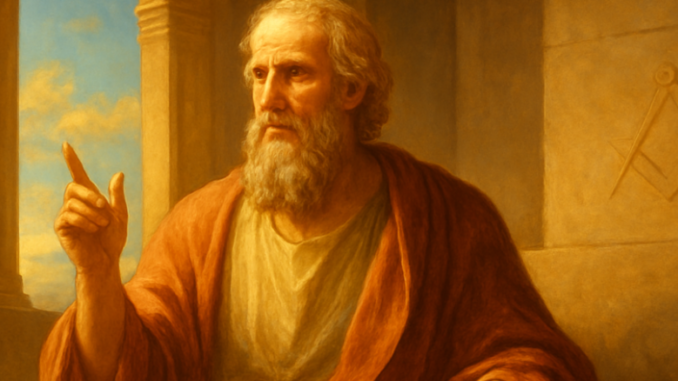
In the fourth book of The Republic, Plato presents a vision of the human soul that has inspired thinkers for more than two thousand years. Written around 375 BCE in an Athens torn by political upheaval and the haunting memory of Socrates’ execution, this dialogue sought to answer a deceptively simple question: what is justice? Plato’s answer — that the soul is composed of three distinct parts, each with its own function and virtue — became a cornerstone of Western philosophy. But its resonance extends far beyond academic circles. Traditions devoted to inner growth and self-knowledge, including Freemasonry, continue to draw deeply from this well of ancient wisdom.
The Historical Context of Book IV
Plato wrote The Republic during a period of profound political crisis. Athens had suffered a devastating defeat in the Peloponnesian War, its democracy had been temporarily overthrown by oligarchs, and the city had condemned Socrates — Plato’s beloved teacher — to death. Against this backdrop of chaos and disillusionment, Plato searched for a foundation upon which a truly just society could be built.
In Book IV, the dialogue takes a decisive turn. Socrates, the central figure of the conversation, argues that justice in the state can only be understood once we understand justice within the individual soul. This shift from the collective to the personal marks a pivotal moment in the history of Western thought — and one that holds particular significance for anyone engaged in the inner work that Freemasonry encourages.
The Three Parts of the Soul
At the heart of Book IV lies Plato’s argument that the human psyche has a tripartite structure. He identifies three distinct elements: the rational part (logistikon), which seeks truth and wisdom; the spirited part (thymoeides), which strives for honor and defends what is good; and the appetitive part (epithymētikon), which is oriented toward bodily needs and pleasure.
Socrates illustrates this with a vivid example. Imagine someone who is desperately thirsty but chooses not to drink for reasons of health. The very fact that we can act against our desires proves, Plato argues, that different forces are at work within us. Desire pulls in one direction; reason pulls in another. They cannot be the same thing.
A second example involves anger. Plato describes how a person can become furious with himself when he gives in to a base desire. This anger originates in the spirited part of the soul, which allies itself with reason against appetite. The three parts are not only distinct — they exist in a dynamic, sometimes contentious relationship with one another.
Justice as Inner Harmony
For Plato, justice in the soul is not a matter of following external rules. It is a state of inner order. A just soul is one in which each part performs its proper function without dominating the others. Reason governs, spirit supports and enforces, and appetite obeys. Plato calls this balanced state sophrosyne — often translated as temperance or moderation — but it is more than mere restraint. It is the right ordering of inner forces so that each contributes to the well-being of the whole.
Justice in the soul is the harmony in which reason, courage, and desire each occupy their rightful place and together serve the good.
This insight carried direct political implications for Plato. In his ideal state, the three parts of the soul corresponded to three classes of citizens: rulers guided by wisdom, guardians driven by courage, and producers focused on providing for material needs. But the true power of the argument lies in its personal application. Anyone who wishes to know himself must examine the inner relationships between these forces — a theme that will sound deeply familiar to every Freemason.
Parallels with Masonic Wisdom
Plato’s tripartite soul finds a striking echo in the symbolism and structure of Freemasonry. The three degrees of the Craft — Entered Apprentice, Fellow Craft, and Master Mason — can be understood as stages of inner development that correspond to the taming and refinement of the soul’s different powers.
The Entered Apprentice learns to govern raw appetites and desires — the foundational work of self-discipline. The Fellow Craft develops moral courage and strength of character, cultivating the spirited part of the soul. The Master Mason aspires to wisdom and the comprehensive understanding that allows him to bring all inner forces into proper alignment.
The working tools of Freemasonry carry this symbolism as well. The square, which measures right angles, represents justice and the discipline of keeping one’s actions upright. The compasses, which draw circles, symbolize the boundaries that reason sets upon unchecked desires. Together, they embody precisely what Plato articulates in Book IV: the necessity of inner order and the governance of the higher faculties over the lower.
From Ancient Athens to the Modern Lodge
The question Plato posed in the fourth century BCE remains urgently relevant today. How do we bring our inner forces into balance? Modern consumer culture relentlessly appeals to the appetitive part of the soul, while political polarization inflames the spirited part without giving it direction or purpose. Plato’s answer was education — not in the narrow sense of formal schooling, but as a lifelong process of self-examination and character formation.
Freemasonry offers a practical framework for exactly this kind of work. Through ritual, reflection, and brotherly dialogue, Brethren are invited to examine their own inner lives. The symbols encountered in the Lodge room serve as mirrors in which each Mason can recognize the state of his own soul. The rough ashlar that must be shaped into a perfect stone is not merely a metaphor — it is a daily challenge.
In this way, the ancient wisdom of Plato becomes not a museum piece but a living practice. The philosopher’s insight that justice begins within — that a just world can only be built by individuals who have first established order in their own souls — is renewed every time a Lodge opens its work.
Key Takeaways from Book IV
Plato’s analysis offers several enduring principles worth reflecting on:
- The soul consists of three parts: reason, spirit, and appetite.
- Justice is the harmony among these three parts.
- Reason must govern, supported by spirit.
- Inner order is the prerequisite for a good and meaningful life.
- Self-knowledge requires honest examination of one’s own inner dynamics.
Plato’s analysis of the tripartite soul in Republic Book IV offers a timeless framework for self-knowledge. His insight that justice is a matter of inner harmony rather than outward compliance remains remarkably relevant. For the Freemason, the symbols and rituals of the Lodge provide a living path to deepen this understanding. Just as in Plato’s Athens, building a just world begins with building an ordered soul. That rough stone we labor to shape — that is ourselves.
Copyright text & image: devrijmetselaar.nl
Texts are based on the ideas and content of the author of devrijmetselaar.nl, reviewed, corrected, and supplemented with the assistance of OpenAI. Images are created based on the ideas of the author of devrijmetselaar.nl using OpenAI/DALL-E.



Be the first to comment