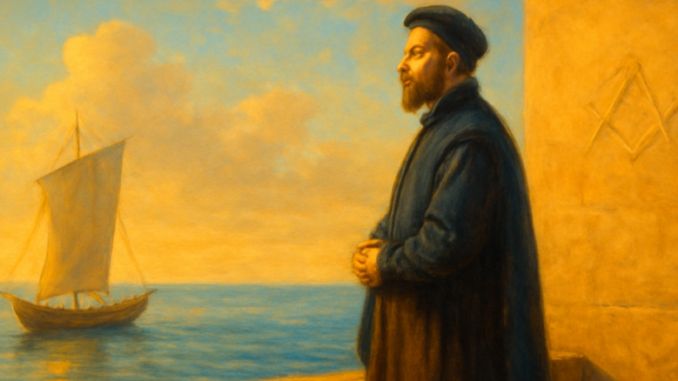
Can friendship truly exist without two souls dissolving into one another? Michel de Montaigne argued in his celebrated essay On Friendship that genuine connection reaches far beyond companionship, utility, or even love. It is a merging in which the boundaries between “I” and “you” cease to exist. This idea raises an uncomfortable question for anyone who reflects on the meaning of brotherhood: is true friendship even possible with more than one person at a time?
The Paradox of a Singular Bond
Montaigne describes his friendship with Étienne de La Boétie as something that transcended every other relationship in his life. When asked why this bond was so extraordinary, he offered his famous reply: “Because it was he, because it was I.” No explanation, no reason, no utility could justify this friendship. It simply was. The formulation suggests that authentic friendship cannot be reproduced or multiplied. By its very nature, it is singular and unrepeatable.
This is where a tension emerges with the Masonic ideal of brotherhood. The Lodge presents itself as a community of brethren who meet as equals, regardless of social standing. But how does this collective ideal relate to Montaigne’s conviction that the deepest friendship is inherently exclusive? Can a brotherhood of many achieve the same intensity as the bond between two souls so “completely intertwined” that the seam becomes invisible?
Friendship as a Mirror of the Self
Montaigne saw in La Boétie not merely a companion but a mirror through which he came to know himself more clearly. The friend functions as another consciousness that reflects back who we truly are — including our flaws and blind spots. This mirroring effect is not a side benefit of friendship; it is its very essence. Without the honest gaze of the other, we remain trapped in self-deception.
Freemasonry operates on a remarkably similar principle. In the Lodge, brethren meet with candor and purpose — not to judge, but to grow together. The rough ashlar that every Freemason symbolically works upon does not become smooth through individual effort alone. It is the brethren who serve as mirrors, confronting us with the imperfections we cannot see in ourselves. Self-reflection, one of the pillars of Masonic practice, is therefore never a solitary exercise. It requires the other.
True friendship is not the choice of pleasant company — it is the choice to be seen in all your imperfection.
Beyond Friendships of Convenience
Montaigne draws a sharp distinction between the friendship he shared with La Boétie and other forms of human connection. Relationships built on utility, pleasure, or habit he refuses to call friendships in the truest sense. They are fragile, dependent on circumstances beyond our control. The moment the utility disappears, the bond evaporates. True friendship, by contrast, endures because it rests on nothing other than itself.
This raises pointed questions for any organization that claims brotherhood — Freemasonry included. Do members gather out of conviction or out of habit? Do they genuinely seek connection, or merely the comfort of like-minded company? Montaigne would likely have been skeptical of any institutional form of friendship. Yet he also acknowledged that most people will never experience the extraordinary bond he knew. Perhaps the brotherhood of a Lodge is not a substitute for Montaigne’s ideal but a preparation for it — a training ground where one learns what it truly means to be open to another human being.
The Shared Pursuit of Truth
What united Montaigne and La Boétie was not affection alone but a shared intellectual hunger. Both were seekers, thinkers who interrogated life without settling for easy answers. Their conversations were not idle pastimes but joint expeditions toward insight. In that common pursuit of truth, they found each other.
Freemasonry defines itself in strikingly similar terms — as a search not for dogmatic answers but for light and knowledge. The ritual, the symbols, the discussions in Lodge all serve this purpose. Brethren do not necessarily share the same beliefs, but they share the same willingness to question, to doubt, to inquire. In that sense, Montaigne might well have recognized something of himself in the Masonic tradition: not as an organization, but as an attitude toward existence itself.
Loss and the Impossibility of Replacement
After La Boétie’s death, Montaigne was left with a void that would never be filled. He wrote that from that day forward, he lived only half a life. The intensity of his grief testifies to the depth of the bond. No new friendship, however valuable, could take the place of what had been lost. This awareness permeates the essay with an undercurrent of melancholy that contrasts poignantly with the celebration of friendship at its outset.
For Freemasons who hold brotherhood as a guiding ideal, this carries a sobering lesson. The Lodge can offer a home, a place of connection and growth. But it cannot guarantee that one will find the kindred spirit Montaigne writes about. Perhaps the wisdom lies in cherishing both forms of connection: the broad brotherhood of fellow seekers and the openness to that one rare encounter that changes everything.
Montaigne’s essay on friendship leaves us with a question that resists any definitive answer. Can we, within a community of brethren, reach the depth he describes? Or must we accept that brotherhood is a different form of connection — valuable in its own right, but not to be confused with that singular merging of souls? Perhaps it is enough to know that both exist, and that one does not exclude the other but enriches it. The Lodge may not be where you find your La Boétie — but it may be precisely where you learn to recognize him when he arrives.
Copyright text & image: devrijmetselaar.nl
Texts are based on the ideas and content of the author of devrijmetselaar.nl, reviewed, corrected, and supplemented with the assistance of OpenAI. Images are created based on the ideas of the author of devrijmetselaar.nl using OpenAI/DALL-E.



Be the first to comment