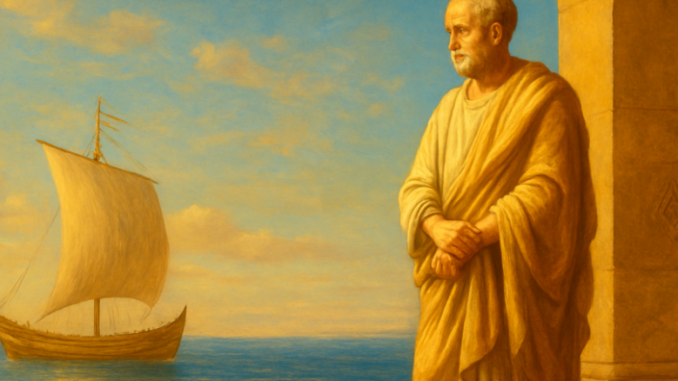
Can we escape our inner turmoil simply by changing our surroundings? In his twenty-eighth letter to Lucilius, the Stoic philosopher Seneca presents a paradox that still challenges us today: whoever travels to flee from themselves inevitably carries along the very thing they are trying to leave behind. This is not an argument against travel — it is a philosophical exploration of where true peace of mind can actually be found. For Freemasons, who regard the inner temple as their most essential workshop, Seneca’s analysis offers a remarkably familiar perspective.
The Core Idea: You Cannot Leave Yourself Behind
Seneca opens his letter with a blunt observation: Lucilius has been traveling from one place to another, yet his restlessness has not diminished in the slightest. This comes as no surprise to Seneca. He articulates what becomes the central thesis of the entire letter: it is not the location that needs to change, but the mind. Those who are restless on the inside carry that restlessness to every new destination. The journey becomes a flight without a final stop.
This insight is not new within the Stoic tradition. Socrates is said to have observed that travel holds little value for those who have not first made peace with themselves. Seneca consciously places himself in this lineage, but adds his characteristic sharpness. He compares the restless traveler to a sick person who keeps switching beds in the hope of reducing a fever. But the fever, of course, is not in the bed.
The Image of the Sick Mind
Seneca employs a powerful metaphor that carries the weight of his entire argument. The mind that cannot find rest is like a patient who constantly shifts position — first lying on his back, then on his side, then standing up, then lying down again. Nothing helps, because the ailment is within. The same is true of the person who perpetually embarks on new journeys, visits new cities, and seeks out unfamiliar landscapes. The distraction works temporarily, but as soon as the novelty fades, the old dissatisfaction returns.
Whoever flees from themselves travels without ever arriving.
This image of the sick mind is not a condemnation. Seneca writes with compassion, as someone who recognizes this tendency in himself and in all of us. He points out that the solution does not lie in standing still, but in a different kind of movement: the inward journey. Those who learn to pause and look within, who summon the courage to turn inward, ultimately discover what no landscape on earth can provide.
Echoes from the Ancient World
In this letter, Seneca references the poet Horace, who also wrote about the impossibility of outrunning one’s worries. Horace used the image of a horseman whose cares ride along with him, even on the fastest horse. This intertextual reference strengthens Seneca’s argument: this insight is not a Stoic monopoly — it is a wisdom recognized across centuries and traditions.
The figure of Socrates also looms in the background. When someone once asked Socrates why he did not travel more, he reportedly answered that he took himself along everywhere, and therefore did not need to go anywhere in particular to know himself. This response breathes the same spirit as Seneca’s letter: the real voyage of discovery takes place within one’s own interior life.
A Masonic Reading: The Inner Temple
For Freemasons, Seneca’s words resonate with particular depth. Freemasonry embraces the concept of the inner temple — the idea that each person is a rough stone, shaped through self-reflection and dedicated inner work toward a more perfected state. This labor does not take place through geographical displacement but through spiritual effort. The lodge is a symbolic workshop, but the actual building happens in the heart of every brother and sister.
The symbol of the rough ashlar being shaped into a perfect cube illustrates precisely what Seneca means. A stone does not change by being transported to a different quarry. Transformation comes through the patient work of the chisel — through the careful removal of everything that is superfluous. So it is with us: it is not the outward journey but the inward one that brings about real change.
This parallel between Stoic philosophy and Masonic practice is no coincidence. Both traditions insist that lasting growth is an inside job. The tools of the Mason — the square, the compass, the gavel — are ultimately metaphors for the virtues and disciplines required to do the difficult work of self-improvement. Seneca would have understood this language perfectly.
What Seneca Still Has to Tell Us
In an age when travel is more accessible than ever, when an escape to a distant destination is just a click away, Seneca’s question remains strikingly relevant. How many of our trips are genuine voyages of discovery, and how many are attempts to flee from something we would rather not face? The philosopher invites us to look honestly at our motivations — not to reject travel, but to examine what we are actually searching for.
The letter offers no easy formula. Seneca provides no step-by-step plan for achieving inner peace. What he does offer is a mirror. That mirror shows us that the key to tranquility does not lie somewhere far away — it has been with us all along. The question is whether we have the courage to use it.
The Paradox of Movement and Stillness
Seneca’s letter leaves a paradox unresolved, and perhaps that is precisely its strength. Movement is not inherently flight, and stillness is not inherently wisdom. The question is not whether we travel, but how we travel. Those who are balanced within can journey without fleeing. Those who are restless inside will find no peace, not even at home. Geographic position is ultimately irrelevant; what matters is the condition of the soul.
This nuance makes Seneca’s letter far richer than a simple warning against wanderlust. It is an invitation to self-examination — to ask the question that may feel uncomfortable: What am I truly searching for? And am I willing to find it right where I already stand?
Letter 28 remains a timeless meditation on the human tendency to project inner unrest onto external circumstances. Seneca reminds us that a change of place rarely amounts to a change of mind. For those familiar with Freemasonry, this is a well-known truth: the inner temple demands labor that no journey can replace. What remains is the question Seneca deliberately leaves unanswered — a question each of us must answer for ourselves.
Copyright text & image: devrijmetselaar.nl
Texts are based on the ideas and content of the author of devrijmetselaar.nl, reviewed, corrected, and supplemented with the assistance of OpenAI. Images are created based on the ideas of the author of devrijmetselaar.nl using OpenAI/DALL-E.

Be the first to comment