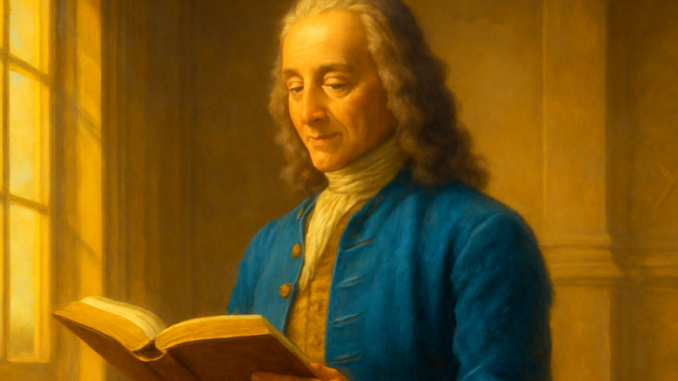
What does it truly mean to be free? This seemingly simple question unfolds in Voltaire’s hands into a philosophical labyrinth where every exit leads to new questions. In his celebrated Philosophical Dictionary, the great Enlightenment thinker devotes a penetrating entry to the concept of liberty — and what he writes there continues to resonate in lodge rooms where brothers gather to reflect on human nature and its possibilities.
The Paradox of Free Will
Voltaire opens his inquiry into freedom with a deceptively straightforward question: can a person truly do what they want? The answer he offers is unsettlingly nuanced. Yes, a person can act according to their desires — but those desires themselves are not freely chosen. They arise from temperament, upbringing, circumstances, and countless other factors over which the individual has no control. Freedom thus becomes a relative concept, dependent on perspective and definition.
This line of thought places Voltaire in a tradition stretching back to the Stoics and later developed by Spinoza. We experience ourselves as free, but that experience may well be an illusion. Yet Voltaire is no strict determinist who dismisses all human responsibility. On the contrary: precisely because the boundaries of our freedom remain unclear, it becomes all the more important to carefully cultivate whatever freedom we do possess.
Concrete Examples from Everyday Life
Voltaire was never one to hide behind abstractions. He illustrated his ideas with vivid, concrete examples that his contemporaries immediately recognized. In his entry on freedom, he describes how a man may decide to go for a walk but cannot decide not to feel hungry. He can choose to read a book but cannot choose to understand its contents instantly. The will has limits that the will itself cannot overcome.
Another example involves the statesman who believes he is freely deciding on matters of war and peace, while in reality he is driven by advisors, public opinion, and economic necessity. Voltaire unmasks the pretension of absolute autonomy without becoming cynical. His tone remains that of an inquirer, never an accuser. It is this measured approach that gives his observations their lasting power.
Freedom as a Process of Awareness
What makes Voltaire’s treatment of freedom particularly compelling is his emphasis on growing awareness. For him, freedom is not a state one either possesses or lacks — it is a process of deepening insight. The more a person understands about their own motivations and limitations, the better equipped they are to act with genuine deliberation. This transforms freedom from a purely philosophical puzzle into an ethical responsibility.
Freedom is not the absence of limitations, but the capacity to choose consciously within them.
This idea connects Voltaire to the very heart of the Enlightenment project: human beings can liberate themselves through reason and reflection, not through fantasies of unlimited autonomy. It is a humble yet hopeful vision of humanity — one that allows room for growth without denying the complexity of existence.
The Symbolic Dimension: Freedom and Freemasonry
For Freemasons, Voltaire’s concept of freedom resonates with particular depth. The lodge is, after all, a space where brothers work toward self-knowledge and moral refinement — precisely the process of growing awareness that Voltaire describes. The symbolism of the rough ashlar being shaped into a perfect cube mirrors this ideal: freedom is not something given, but something earned through persistent inner labor.
Voltaire himself maintained connections with Masonic lodges and was initiated shortly before his death. His vision of freedom as a quality to be cultivated aligns seamlessly with Masonic practice. The square and compasses — symbols of boundary and order — are the very tools with which the Freemason learns to work within limits, and through that discipline, arrives at a greater form of freedom.
A Critique of Religious Determinism
A considerable portion of Voltaire’s entry is devoted to criticizing certain religious interpretations of predestination. He does not attack religion as such, but rather those currents of thought that completely undermine human responsibility by attributing everything to divine caprice. For Voltaire, this is a dangerous doctrine — one that justifies passivity and discourages moral effort.
His critique, however, is never disrespectful. Voltaire acknowledges that the question of freedom and predestination has occupied theologians and philosophers for millennia, from Augustine to Leibniz. He positions himself within this conversation as a voice advocating practical wisdom over metaphysical certainty — a stance that remains refreshingly relevant today.
Why Voltaire’s Ideas Still Matter
What makes an eighteenth-century dictionary entry relevant to modern readers? Voltaire’s insights anticipate contemporary discussions in neuroscience, psychology, and social determinism. His refusal to choose between absolute freedom and total determinism offers a middle path that does justice to lived human experience. We feel free, we act as though we are free, and that experience has value — even if its philosophical foundations remain uncertain.
Consider the key principles that emerge from Voltaire’s reflection:
- Freedom as a relative concept, never absolute
- Growing awareness as the key to greater freedom of choice
- A critique of fatalism without rejecting religion outright
- Practical wisdom valued above metaphysical certainty
Voltaire’s entry on freedom in the Philosophical Dictionary is not an answer — it is an invitation to inquiry. It reminds us that the question of freedom cannot be resolved through definitions alone but demands ongoing reflection and honest self-examination. For those who walk the Masonic path, this work offers a mirror: the freedom we seek does not lie in escaping our limitations, but in learning to work skillfully with the tools we have been given. What might it mean to sit with that very question in silence tonight?
Copyright text & image: devrijmetselaar.nl
Texts are based on the ideas and content of the author of devrijmetselaar.nl, reviewed, corrected, and supplemented with the assistance of OpenAI. Images are created based on the ideas of the author of devrijmetselaar.nl using OpenAI/DALL-E.

Be the first to comment