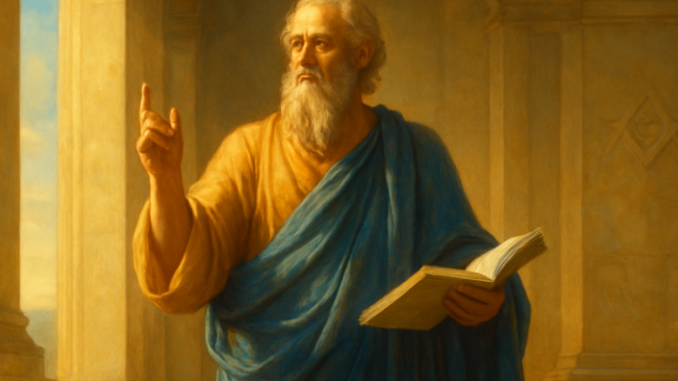
Before dawn, young Hippocrates pounds on the door of Socrates, his eyes blazing with excitement. The famous sophist Protagoras has arrived in Athens, and Hippocrates is desperate to become his student. But Socrates asks a question that changes everything: what exactly do you expect to learn? This moment launches one of Plato’s most vivid dialogues — a work that wrestles with a question as urgent today as it was in ancient Athens: is virtue something that can be taught, or is it an innate quality that some simply possess and others do not?
The Encounter Between Socrates and Protagoras
In the luxurious home of the wealthy Callias, Socrates meets the renowned sophist Protagoras, surrounded by admiring students and other celebrated thinkers such as Hippias and Prodicus. Protagoras is no ordinary teacher — he charges substantial fees for his instruction and claims he can train young men to become better citizens. Socrates, ever the critical questioner, issues a challenge: if virtue can truly be taught, why do great statesmen consistently fail to make their own sons as virtuous as themselves?
This is no mere academic exercise. It strikes at the heart of what it means to be a good person and how societies can shape their citizens. For Protagoras, his entire life’s work hangs in the balance — because if virtue cannot be taught, what exactly is he selling?
The Myth of Prometheus and Epimetheus
Protagoras responds to Socrates’ challenge with a captivating myth. He tells how the gods Prometheus and Epimetheus were tasked with equipping all living creatures with their abilities. Epimetheus — whose name ironically means “afterthought” — distributed every quality among the animals: speed to the hare, strength to the lion, wings to the birds. But when he reached humanity, he had nothing left to give.
Prometheus saved the day by stealing fire and technical skill from the gods and gifting them to mankind. Yet even with these extraordinary gifts, humans could not live together peacefully — they destroyed one another for lack of political virtue. And so Zeus sent Hermes to distribute a sense of shame and a sense of justice to all people, not merely to a select few.
This is Protagoras’ central argument: political virtue is universally distributed and can be further developed through education and upbringing. It is not the exclusive province of a privileged elite.
The Unity of Virtue: Five Names, One Essence?
The debate shifts to a deeper question: are the various virtues — wisdom, justice, temperance, courage, and piety — fundamentally one unified whole, or are they separate qualities that can exist independently of one another? Protagoras defends the latter position. A person can be courageous without being wise, or just without being temperate.
Socrates dismantles this view step by step. He demonstrates that someone who is truly courageous must also know what is dangerous and what is safe — which presupposes wisdom. Someone who acts justly also acts with a measure of temperance. The virtues turn out to be interwoven like facets of the same diamond — different perspectives on the same good life.
Virtue, Socrates suggests, is not a collection of separate traits but the unity of character that emerges when knowledge and action converge.
Knowledge as the Foundation of Virtuous Action
Here we encounter Socrates’ famous intellectualism: no one does wrong willingly. When someone acts badly, it stems from ignorance rather than a deliberate choice of evil. This seems counterintuitive — we all know people who knew better but chose poorly. Yet Socrates means something more subtle. Someone who truly understands what is good, in the full depth of that insight, will act accordingly. Superficial knowledge is not enough.
The dialogue includes an extended discussion of pleasure, pain, and the art of measurement. People make poor choices because they overvalue short-term pleasure relative to long-term well-being. The solution, Socrates proposes, is a kind of “measuring art of life” — the ability to weigh the true value of choices beyond the distortions of the present moment.
Relevance for the Freemason
The question of whether virtue can be taught resonates profoundly with the practice of Freemasonry. The lodge functions as a school of character where Brethren work upon their rough ashlar — that enduring symbol of the unrefined personality that is shaped through study, reflection, and ritual into a more perfect cube. This presupposes exactly what Protagoras argues: that character is not fixed but can be formed and improved.
At the same time, Freemasonry acknowledges the Socratic truth that this is not a simple transfer of facts. The symbols and rituals do not work through explanation alone but through lived experience and inner transformation. It is a change from within, not the imposition of rules from without.
Consider the parallels: the rough ashlar symbolizes the unworked character that must be shaped and refined. The degree system reflects the gradual growth in insight and virtue. The ritual functions as the very “measuring art” that offers perspective on the good life. And Brotherhood provides the community in which virtue is practiced collectively — not as abstract theory, but as a daily discipline.
An Unexpected Reversal
The dialogue ends with a remarkable twist. Socrates, who initially doubted whether virtue could be taught, has argued that virtue is knowledge — which implies it can indeed be taught. Protagoras, who began by claiming he could teach virtue, has taken positions that actually undermine that claim. Both speakers have shifted ground, and neither has definitively won.
This is characteristic of Plato’s early dialogues: the goal is not to provide a definitive answer but to set the reader thinking. The question remains open, inviting further reflection. Perhaps that is the deepest lesson of all — learning virtue begins with the honest admission that we do not yet fully understand what virtue truly is.
Plato’s Protagoras is far more than a historical curiosity. It is a permanently relevant exploration of the questions that drive Freemasonry at its core: Can we become better people? How does knowledge relate to moral action? And what role does community play in the lifelong pursuit of virtue? The dialogue does not hand us easy answers — but like the best Masonic teachings, it equips us with better questions. And in the end, it is the willingness to keep asking those questions that marks the beginning of true moral growth.
Copyright text & image: devrijmetselaar.nl
Texts are based on the ideas and content of the author of devrijmetselaar.nl, reviewed, corrected, and supplemented with the assistance of OpenAI. Images are created based on the ideas of the author of devrijmetselaar.nl using OpenAI/DALL-E.
Frequently Asked Questions
What is the main question explored in Plato's Protagoras dialogue?
The central question is whether virtue can be taught or if it is an innate quality that some people naturally possess. This debate is framed through Socrates' challenge to the sophist Protagoras, who claims he can teach young men to become better citizens, versus Socrates' observation that great statesmen often fail to make their own sons virtuous.
What does Protagoras' myth of Prometheus and Epimetheus argue about virtue?
Protagoras uses the myth to argue that political virtue is universally distributed among all humans by Zeus through Hermes, who gave everyone a sense of shame and justice. Unlike other qualities that were given selectively to different creatures, virtue is not the exclusive privilege of an elite few but can be developed further through education and upbringing.
Why does Socrates challenge Protagoras about the sons of great statesmen?
Socrates points out that if virtue can truly be taught, great statesmen should be able to make their own sons virtuous just as they have become virtuous themselves. The fact that they consistently fail to do so suggests that virtue may not be teachable in the way Protagoras claims, and this challenge strikes at the very foundation of Protagoras' professional reputation and livelihood as a teacher.


Be the first to comment