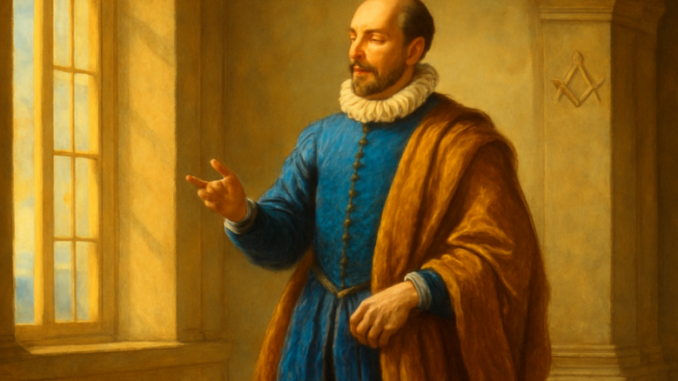
In the sixteenth century, a French thinker penned a brief but striking essay on the art of speaking. His observations about eloquence and the speed with which people choose their words touch on something timeless. Centuries later, we can hear in his thoughts an echo of values that also stand at the heart of Freemasonry: the search for truth, the importance of self-reflection, and the understanding that true wisdom often resides in what we choose not to say.
A Renaissance Thinker Speaks
Michel de Montaigne lived from 1533 to 1592. After an active career in public life, he withdrew to his estate to write and to think. His collection of essays — written in an intensely personal, searching style — ranks among the most influential works in Western literature. In the tenth essay of his first book, he turned his attention to something seemingly simple: the way people speak. Some, he observed, speak quickly and rashly. Others weigh every word with care. Montaigne himself confessed to being one of the slower speakers, someone whose thoughts only reached full maturity after time had passed.
This honest self-observation is characteristic of his method. He did not write to lecture others, but to understand himself. And here we find a first parallel with Freemasonry: the ideal of self-reflection as the foundation for growth. A Freemason works on the rough stone of his own character — not by criticizing others, but by looking inward. Montaigne did exactly the same, albeit with pen and paper rather than mallet and chisel.
The Value of Silence in a Noisy World
What struck Montaigne about quick speakers was that they often trusted their tongues more than their thoughts. Eloquence was highly prized in his day, sometimes at the expense of substance. He questioned this tendency. Was it truly a sign of wisdom to fire back a quick reply? Or did it actually betray a kind of superficiality — a mind that did not take the time to weigh what truly needed to be said?
True eloquence scorns eloquence.
This paradoxical insight touches on a core value within Freemasonry: the art of silence. In Masonic ritual practice, silence plays an essential role — not as emptiness, but as space for contemplation. The word left unspoken can sometimes carry more meaning than a flood of sentences. Montaigne would have recognized this. He warned against the temptation to speak before one truly has something to say.
Brotherhood and the Shared Word
Yet Montaigne was no advocate of silence for its own sake. He valued conversation — the exchange of ideas between kindred spirits. His famous friendship with Étienne de La Boétie, whose name remains a symbol of intellectual kinship to this day, shows how deeply he cherished the shared word. In that friendship, he found a mirror for his own thinking.
Here we see a second parallel with Freemasonry: the ideal of brotherhood. The lodge is a space where people come together to listen, to speak, and to grow. The words spoken there are not intended to persuade or to impress, but to connect. The ritual provides a framework within which dialogue can take place — where every word has its proper place, and silence is equally respected.
The Search for Truth Through the Word
Montaigne did not see speech as an instrument of power, but as a means toward insight. By articulating what he thought, he drew closer to what he truly meant. Writing itself was for him a form of thinking. This process of continual refinement — of weighing and rewriting again and again — bears a striking resemblance to the Masonic idea of inner growth. Just as the rough ashlar is shaped step by step toward a more perfect form, Montaigne worked on his thoughts until they felt clear and true.
Consider the common threads that run through his thinking and the Masonic tradition:
- Self-reflection as the foundation for personal growth
- The value of silence alongside the spoken word
- Brotherhood through sincere dialogue
- The word as an instrument in the search for truth
In both traditions — that of Montaigne and that of Freemasonry — the final answer is not what matters most. What matters is the journey toward it. It is not about winning a debate, but about deepening understanding. The quick speaker sometimes misses what the slow thinker finds: nuance, doubt, and the awareness that truth rarely fits into a single sentence.
From Then to Now: What We Can Learn
In our current age, where speed and directness are often celebrated, Montaigne’s insights remain surprisingly relevant. Social media rewards the fast reply, the sharp retort. Yet there is a growing awareness that this speed does not always bring wisdom. Freemasonry offers a counterbalance: a tradition in which slowing down, listening, and deliberating take center stage. Montaigne would have felt at home in such an atmosphere.
His essay on eloquence invites us to reflect on how we ourselves speak. Do we take the time to listen before we answer? Do we choose our words with care, or do we let ourselves be swept along by the pressure of the moment? These are questions that remain relevant both inside and outside the lodge.
Montaigne’s thoughts on eloquence and the speed of speech touch on something essential. They remind us that a word only gains its true power when it springs from careful reflection. In Freemasonry, this idea finds its echo in the emphasis on self-reflection, brotherhood, and the search for light. Both the French essayist and the Masonic tradition teach us the same enduring lesson: true wisdom lies not in the quick answer, but in the willingness to listen, to weigh, and only then to speak.
Copyright text & image: devrijmetselaar.nl
Texts are based on the ideas and content of the author of devrijmetselaar.nl, reviewed, corrected, and supplemented with the assistance of OpenAI. Images are created based on the ideas of the author of devrijmetselaar.nl using OpenAI/DALL-E.
Frequently Asked Questions
What does Montaigne's essay on eloquence have to do with Freemasonry?
Montaigne's emphasis on self-reflection, the value of thoughtful silence, and the importance of choosing words carefully mirrors core Masonic values. Both emphasize personal growth through introspection and the understanding that true wisdom often lies in what we choose not to say, rather than in speaking quickly or excessively.
How does Freemasonry use silence in its practices?
Silence plays an essential role in Masonic ritual as a space for contemplation and reflection, not as emptiness but as a meaningful pause. This practice aligns with Montaigne's insight that the word left unspoken can carry more meaning than a flood of sentences, allowing Masons to deepen their understanding and connection.
Is Freemasonry only about staying quiet and not speaking?
No—Freemasonry highly values meaningful conversation and the exchange of ideas among members. Like Montaigne's appreciation for intellectual friendship, the lodge is a space where Masons come together to listen, speak, and grow in brotherhood, but always with thoughtfulness and purpose rather than idle chatter.
What does it mean to 'work on the rough stone' in Freemasonry?
This metaphor refers to the personal development of a Freemason through self-reflection and self-improvement. Just as Montaigne used writing to understand himself better, Masons work inwardly to refine their character and wisdom, focusing on their own growth rather than criticizing others.

Be the first to comment