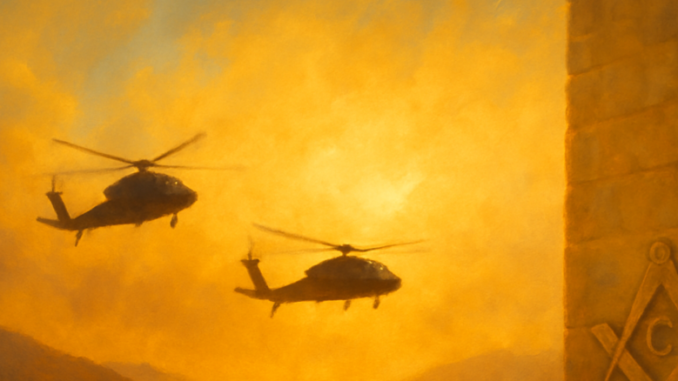
On a summer day above Athens, two firefighting helicopters collided while battling wildfires. A Danish and a Greek pilot lost their lives trying to save others. This tragic event touches something fundamental — the question of what it truly means to place yourself in service of a greater whole. For Freemasons, this moment of sacrifice raises spiritual questions deeply rooted in the tradition of the Craft.
The Paradox of Sacrifice
Firefighters, rescue workers, and pilots who battle wildfires live a daily reality most of us will never experience. They choose to run toward danger while everyone else runs away. That choice is not abstract. It is a concrete, physical act that demands courage, training, and something harder to name — an inner conviction that protecting others matters more than protecting yourself.
In Freemasonry, we speak of shaping the rough ashlar. That shaping does not happen in isolation. It happens in relation to others, in the understanding that personal development gains meaning when it serves the community. The two pilots above Athens, each from a different country, worked together toward the same goal. Their nationality was irrelevant. What mattered was their shared commitment.
What Service Really Means in Practice
Spirituality in Freemasonry is not a vague concept. It is not about lofty ideas or mystical experiences disconnected from everyday life. On the contrary — spirituality takes shape through concrete actions. How do you treat your neighbor? How do you contribute to your community? What choices do you make when no one is watching?
The Greek pilot and his Danish colleague made their spirituality visible through their profession. Every flight over burning terrain was an act of service. This holds up a mirror for the rest of us. Few of us will ever pilot a firefighting helicopter, but each of us can ask: what do I dedicate myself to every day? And do I bring the same level of devotion to it?
Spirituality only becomes real when it translates into acts of service to others.
Three Questions for Self-Reflection
In light of this tragic event, consider asking yourself the following questions. Not to judge yourself, but to give direction to your own spiritual path:
1. Where in my life do I consciously take risks for the well-being of others?
2. How often do I choose comfort over engagement when my help is needed?
3. What small daily actions can I take that demonstrate genuine service?
These questions are not meant to provoke guilt. They serve as a compass. Philosophers like Aristotle emphasized that virtue is not something you possess — it is something you practice. Every single day. The pilots above Athens did not practice courage as an abstract ideal. They practiced it as a living reality.
Transcending Borders Through Shared Purpose
There is something remarkable about the fact that a Dane and a Greek flew side by side. In an era when national borders are so often a source of conflict, their cooperation shows what becomes possible when people unite around a shared purpose. Freemasonry knows this principle well. In lodges around the world, people of different backgrounds, religions, and convictions come together — not despite their differences, but with respect for them.
The work that binds them transcends those differences. That is the essence of brotherhood. Not the absence of diversity, but the recognition that something greater exists beyond individual identity. The firefighting operation above Athens was a living example of this principle. Two men, two nationalities, one mission.
Putting It Into Practice
Spirituality demands action. Here are a few ways to apply the lessons of this moment in your own life:
Take on a task this week that benefits others, without expecting anything in return. Look around your immediate community for someone who needs help and offer your concrete support. Take a moment to reflect on people in professions who risk their safety for others every day — and express your appreciation.
This is not about heroic gestures. It is about consistent action rooted in the conviction that your life gains meaning through connection with others. Goethe once wrote that only the person who acts is truly free. That freedom does not lie in isolation — it lies in engagement.
The Rough Ashlar and the Fire
In Masonic symbolism, we work on the rough ashlar — the unfinished stone that represents our imperfect selves. The fire that destroys forests is a destructive force, but there is another fire: the inner fire that drives growth and transformation. The pilots who flew above Athens knew both fires. They fought one and were driven by the other.
Their sacrifice does not call for glorification. It calls for understanding — understanding of what it means to dedicate your life to something greater than yourself. And it leaves each of us with a question: what fire burns within you?
The collision above Athens reminds us that spirituality is not a luxury reserved for quiet moments. It is a compass for the most difficult choices we face. Service is not something you philosophize about — it is something you do. Every day offers opportunities to shape your own rough ashlar by showing up for others. The question is not whether you will one day be called to a heroic act, but how you demonstrate your dedication today, in the small things. That is spirituality in action.
Copyright text & image: devrijmetselaar.nl
Texts are based on the ideas and content of the author of devrijmetselaar.nl, reviewed, corrected, and supplemented with the assistance of OpenAI. Images are created based on the ideas of the author of devrijmetselaar.nl using OpenAI/DALL-E.
Frequently Asked Questions
What does Freemasonry teach about service to others?
Freemasonry teaches that spirituality is not abstract but expressed through concrete acts of service to the community. The tradition emphasizes that personal development gains meaning when it serves others, and that virtue is practiced daily through real actions, not just noble ideals. This principle is exemplified by those like the firefighting pilots who dedicate their lives to protecting their communities.
How does Freemasonry view sacrifice and courage?
Freemasonry recognizes that true courage involves placing the well-being of others above personal safety and comfort. The Craft teaches that sacrifice is not abstract but demonstrated through daily choices and commitments to serve a greater whole. This spiritual principle transforms ordinary individuals into exemplars of virtue through their dedication to meaningful work.
What can Freemasons learn from the story of these two pilots?
The story of the Danish and Greek pilots demonstrates how Freemasonry's principle of universal brotherhood transcends national borders when united by shared purpose. Their cooperation shows that spirituality becomes real through devotion to service, and that people from different backgrounds can work together harmoniously toward noble goals. This example reinforces the Masonic ideal that what unites us in common cause matters more than what divides us.
How does Freemasonry encourage personal spiritual growth?
Freemasonry encourages spiritual growth through self-reflection and the practice of virtue in daily life, comparing personal development to shaping a rough stone into a finished ashlar. The tradition emphasizes that spirituality develops not through isolation but through meaningful engagement with community and service to others. Members are invited to continuously ask themselves how they can dedicate their talents and actions to genuine service.

Be the first to comment