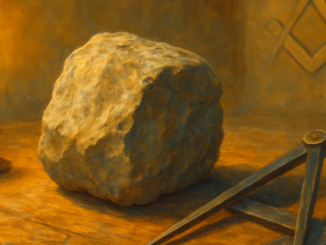
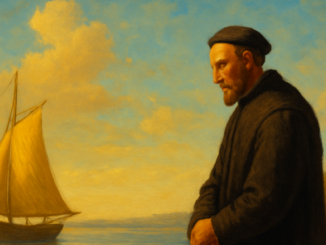
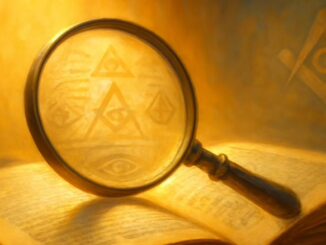
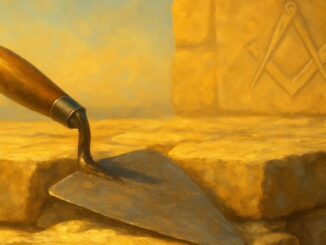
A rough ashlar stone beside Masonic square and compasses symbolizing humility
Personal Development & Leadership

Humility as Strength: What Freemasons Know About Success

In the eighteenth century, when the first Grand Lodges in Europe opened their doors, an unwritten rule applied that remains relevant to this day: whoever enters leaves their social rank at the door. Whether you were a baker or a banker, your standing in the lodge was determined by your inner growth — not by your external achievements. This principle sheds a surprising light on a notion that still circulates in our culture: the belief that everything one touches turns to gold. The Alchemical Myth Debunked The expression “everything I touch turns to gold” traces back to King Midas from Greek mythology. His story ends tragically: he nearly starves to death because even his food transforms into gold. From the earliest philosophical traditions, thinkers understood the Midas myth as a warning against hubris — the dangerous overconfidence that arises when success goes to one’s head. Freemasonry, with its roots in the medieval stonemason guilds, understood this lesson centuries ago. The craftsmen who built the great cathedrals of Europe knew that every masterpiece was the result of countless failed attempts, broken stones, and endless patience. Their wisdom: true craftsmanship reveals itself not in perfection, but in the ability to learn from […]
Masonic rough ashlar and tools symbolizing self-knowledge and ethical choice
Philosophy & Ethics

When Saying No Is Right: The Masonic Ethics of Refusal

There is a curious paradox woven into the fabric of modern life: we celebrate those who say yes to challenges, yet we rarely acknowledge the courage it takes to say no. When a prominent football manager recently declined to take charge of a national team — a role most would consider a tremendous honor — it raised a question that reaches far beyond the back pages. What does it truly mean to turn down something the world expects you to accept? And what can Freemasonry teach us about the ethics of refusal? Refusal as an Act of Integrity Here is a thought worth sitting with: sometimes, declining an offer is ethically purer than accepting it. We live in a culture that glorifies ambition and distrusts modesty. Anyone who turns down a prestigious position is quickly suspected of harboring hidden motives or lacking drive. But what if the opposite is true? What if refusing a role that doesn’t fit you reveals deeper self-knowledge than eagerly seizing it ever could? In Freemasonry, we work with the metaphor of the rough ashlar — the unfinished stone that must be shaped into a perfect cube. This image does not suggest we should become everything […]

A level and whistle symbolizing impartiality in Freemasonry and refereeing
Philosophy & Ethics

Impartiality Under Pressure: The Referee and the Freemason

When the head of refereeing for an international football federation declares that even the most powerful figures have no influence over his decisions, it touches on a universal theme: the question of impartiality. How do you preserve your integrity when external pressure mounts? This challenge plays out not only on the football pitch but also in the quiet of the Masonic lodge, where brethren practice the art of judgment without prejudice. The World of the Referee In international football, the referee stands as a central symbol of fairness. Every decision is analyzed, criticized, and sometimes regarded with suspicion. When a top official must publicly declare that there has been no outside influence — not even from the highest authority — it reveals something about the world he operates in. It is a world of constant scrutiny, where every whistle can be interpreted as evidence of bias. The referee moves through an arena where millions of eyes are watching. His neutrality is not merely expected — it is demanded. And yet, he is human, carrying his own experiences, preferences, and blind spots. The art lies not in denying this humanity but in acknowledging it and rising above it. The referee must […]

Ancient ruins of Nineveh symbolizing the fall of tyranny and Masonic justice
Christianity

Nahum and the Fall of Nineveh: Lessons on Justice

In 612 BCE, the mighty Assyrian Empire collapsed. Nineveh, its grand capital and the nerve center of an unparalleled military power, was razed to the ground by a coalition of Babylonians and Medes. This seismic historical event lies at the heart of one of the shortest yet most intense books in the Old Testament: the Book of Nahum. Spanning only three chapters, this prophetic text raises profound questions about justice, the fall of tyranny, and the possibility of moral reconstruction — questions that resonate deeply within the traditions of Freemasonry. The Historical Context of Nahum For nearly three centuries, the Assyrian Empire dominated the ancient Near East. The city of Nineveh, situated on the banks of the Tigris River in what is now northern Iraq, was renowned for its imposing walls, lavish palaces, and vast libraries. Yet the Assyrians were equally infamous for their ruthless methods of warfare. Conquered peoples were deported en masse, cities were burned to ash, and enemies were publicly humiliated. For the smaller kingdoms of Israel and Judah, Assyria represented a constant and existential threat. The prophet Nahum — whose name fittingly means “comforter” or “one who brings consolation” — likely composed his vision shortly before […]

Crowbar as a Masonic symbol representing spiritual leverage and inner transformation
Spiritual Traditions

The Crowbar Symbol and Its Meaning: A Lever for the Soul

Sometimes you need a crowbar to pry something open — not just in the physical world, but in your inner life as well. The crowbar symbol and its meaning reach far beyond the practical tool we know from construction sites. This simple instrument carries a powerful spiritual message: some doors in our lives only open when we are willing to apply real force. In Freemasonry, where working tools serve as central symbols, the crowbar offers a surprisingly compelling perspective on personal transformation. What the Crowbar Symbol Tells Us About Resistance You probably know the feeling. Something in your life has rusted shut. A habit you cannot let go of. A belief that limits you but that you cannot seem to break through. A relationship that no longer works but that you cling to anyway. In moments like these, the image of the crowbar acts as a mirror. The pry bar does not ask for subtlety — it asks for honesty about what is truly needed. The meaning of this tool lies in its directness. Where other instruments perform fine, delicate work, the crowbar is designed for one purpose: overcoming resistance. In a spiritual sense, it represents those moments when a […]

Referee whistle symbolizing judgment and Masonic self-reflection
Freemasonry & Society

The Referee’s Whistle: When the Crowd Becomes the Judge

A match ends. The ball rolls to a stop. And then something erupts that has nothing to do with sport. The recent decision by a national football association to file complaints against hateful messages directed at players after a World Cup elimination reveals a deeper societal issue. How is it that people who were cheering moments ago can transform, in the blink of an eye, into judges who strip fellow human beings of their dignity? Behind this phenomenon lies a symbolic truth that Freemasons have explored for centuries: the struggle between the lower and higher self, and the choice that every moment demands of us. The Whistle as a Symbol of Final Judgment A referee’s whistle is a small object. Metal, simple, functional. Yet it carries an enormous symbolic weight. The moment it sounds, a match is frozen into a result. Win or lose. Hero or scapegoat. The complexity of ninety minutes of effort, dozens of decisions, and countless variables is reduced to a single number. This is the paradox of every judgment: it brings clarity, but it sacrifices nuance. In Freemasonry, we know a comparable symbol: the gavel. The Worshipful Master strikes it at decisive moments — not to […]

Masonic rough ashlar stone symbolizing the search for understanding and peace
Freemasonry & Society

The Message as Weapon: Conflict and the Search for Understanding

A plane crashes in the jungle. A life ends far from home. A message echoes across borders — designed to shock, to warn, to force the world to listen. When violence becomes a means of communication, society faces a fundamental question: how do we respond to messages written in blood? This is not a question reserved for diplomats and strategists. It strikes at the very heart of what it means to be human in a world of broken connections. The Airplane as a Symbol of Connection An airplane is more than a mode of transport. Symbolically, it represents the deeply human urge to bridge distances, to connect what has been separated. The pilot at the controls embodies the role of a connector between worlds that might otherwise never touch. When such a plane is brought down, it is not merely a machine that is destroyed — a symbol is struck. In Freemasonry, connection plays a central role. The lodge is, by its very nature, a place where people of different backgrounds, professions, and convictions come together. Not despite their differences, but precisely because those differences offer valuable perspectives. The Mason builds bridges, not walls. He seeks what unites people, not […]

Rough ashlar stone symbolising human inconstancy and Masonic self-knowledge
Content & Summary

Montaigne on Inconstancy: Man as an Unfinished Symbol

There is an ancient symbol familiar to most Freemasons: the rough ashlar. It represents the human being in an unworked state — raw, unpolished, and full of contradictions. When we turn to the very first essay in Michel de Montaigne‘s celebrated Essais, that image becomes almost tangible. In his reflections on the inconstancy of our actions, the sixteenth-century philosopher holds up a mirror in which we recognise ourselves as beings who constantly shift, act in contradiction with themselves, and in doing so reveal something profoundly human. The Core Idea: Man as a Riddle to Himself Montaigne opens his essay with a sharp observation. Anyone who tries to judge another person by their actions runs into a fundamental problem: our deeds constantly contradict one another. The same individual who acts with courage today may prove a coward tomorrow. The person who gives generously now may cling to possessions later. For Montaigne, this is not a moral failing — it is simply the human condition laid bare. He resists the temptation to sort people into fixed categories. Labels like “brave” or “greedy” do not do justice to reality. We are not statues of virtue or vice, but living beings who move, stumble, […]

Masonic level and plumb line symbolizing balance and self-reflection
Symbolism & Rituals

When Conviction Capsizes: The Hidden Risk of Certainty

Here is a paradox worth contemplating: the more firmly convinced you are of something, the greater the danger of capsizing. Not figuratively — literally. The word “convinced” traces back to nautical language, where it described a ship carrying so much weight on one side that it listed dangerously, no longer responded to the helm, and risked rolling over at the first strong gust of wind. Certainty as a risk factor. Firmness as a source of instability. Isn’t that one of the most uncomfortable truths language has been quietly trying to tell us all along? Certainty Makes You Lose the Helm Let’s take that paradox seriously. In everyday speech, we say “I’m convinced” as though it’s a virtue — a sign of resolve and strength. We admire people who stand firm, who don’t budge an inch. But an old-time sailor would have raised an eyebrow at such admiration for imbalance. To him, being “over-convinced” wasn’t a badge of honor — it was a diagnosis. A ship that had shifted all its weight to one side was a ship in distress. The rudder rendered useless, the crew at the mercy of forces they could no longer steer against. The shift in meaning […]

Masonic symbols illustrating allusive meaning and subtle reference
Symbolism & Rituals

Allusive Meaning: The Subtle Art of Reference in Freemasonry

You’ve probably had a conversation where someone said something that sounded perfectly innocent on the surface — yet you sensed a deeper layer beneath the words. A subtle nod to something unspoken. A reference only you could recognize. That is the essence of what we call allusive meaning. This ability to communicate through indirect reference — through symbols, gestures, and carefully chosen words — opens up a world of subtle exchange that reaches far beyond the literal. In Freemasonry, this hidden language plays a central and defining role. What Does “Allusive” Actually Mean? The word “allusive” derives from the Latin alludere, which literally means “to play toward something.” An allusive expression plays with meaning without stating it directly. It’s an indirect reference, a hint that only comes alive when the receiver recognizes the underlying layer. Think of a smile that says more than a thousand words, or a hand gesture that evokes a shared memory. In everyday language, we make allusive remarks more often than we realize. When someone says “that was a titanic effort,” they’re indirectly referencing the famous maritime disaster without explicitly naming it. The power of allusive meaning lies in the shared knowledge between speaker and listener. […]

Masonic trowel symbolizing connection and the philosophy of building
Philosophy & Ethics

The Trowel: Masonic Philosophy of Building Yourself

You may have come across the name “Lodge The Trowel” — one of the well-known Masonic lodges in the Netherlands. But what does that name actually mean? And more importantly, what can you learn from the philosophy behind this symbol, whether you’re a Freemason or not? The trowel is far more than a builder’s tool. It’s an invitation to work daily on connection — with yourself, with others, and with the world around you. Why Name a Lodge After the Trowel? The name of a Masonic lodge is never chosen at random. Every lodge carries a name that points to an ideal, a symbol, or an aspiration. A lodge named after the trowel refers to the tool that masons use to spread mortar between stones. Without the trowel, a wall is nothing more than a loose pile of bricks. With the trowel, those individual pieces become a unified structure — one that endures. In Freemasonry, the trowel symbolizes the act of binding people together. Where the hammer and chisel shape and refine individual stones, the trowel is what creates cohesion. It is the tool of community, of brotherhood, of smoothing out the rough edges between people. A lodge that bears […]

A single candle flame symbolizing brief life, loss, and Masonic light
History

Prenatal Loss: How Grief Has Taken Shape Through the Ages

There is a kind of loss that has no grave, no farewell ceremony, and yet leaves a lifelong scar. When a child dies before it is born, it touches the deepest layers of human existence. History teaches us that every culture and every era has grappled with this particular grief — often in silence, sometimes through rituals that seem foreign to us today. Freemasonry, with its long tradition of engaging symbolically with life, death, and rebirth, offers a surprisingly meaningful perspective on this unspoken sorrow. The Paradox of Grief Without Memory How do you mourn someone you never knew, yet loved completely? This is the paradox that parents face after prenatal loss. In our contemporary culture, we are gradually becoming more open about this subject — but that was not always the case. For centuries, this kind of loss was dismissed, denied, or simply not recognized as legitimate grief. Yet history shows that people have always sought ways to give shape to this sorrow. In medieval monastic archives, we find references to special prayers for unbaptized children. Midwives had their own rituals, handed down from generation to generation, to help mothers cope with their grief. The need to mark loss […]

An open antique book with Masonic square and compasses in candlelight
Freemasonry & Connection

Montaigne on Intentions: The True Measure of Our Inner Work

It is late in the evening. A Freemason sits alone in his study, a yellowed book open before him. He reads a passage by a sixteenth-century French thinker and feels the words reaching across the centuries, as though they were written for him personally. The question that surfaces is at once simple and unsettling: not what he has done, but why he did it. In that moment, two traditions touch — separated by four hundred years, yet united in the same search for sincerity. The Heart of Montaigne‘s Essay In one of his brief but penetrating essays, Montaigne argues that our actions cannot be separated from the intentions behind them. The results of what we do may shine in the eyes of the world, but the true value lies in what moved us when we began. A good deed performed out of vanity carries a very different weight than the same act born of genuine compassion. Montaigne invites us to look beyond the surface — past the praise and criticism of others — into the quiet chamber of our own conscience. This is no idle thought experiment. Montaigne warns that we are remarkably skilled at deceiving ourselves. We construct noble […]

Jonah emerging from the whale as a symbol of Masonic transformation
Christianity

Jonah and the Whale: A Masonic Journey to Self-Knowledge

In the eighth century before the Common Era, a short but powerful story emerged within the Hebrew tradition: the Book of Jonah. Spanning just four chapters, it tells of a prophet who flees his divine calling, is swallowed by a great fish, and ultimately comes to a profound reckoning with himself. For centuries, this tale has captivated people not only as a religious text but as a timeless allegory about human resistance and the difficult path toward self-acceptance. For Freemasons, the Book of Jonah offers a surprisingly rich source of recognition and reflection. A Prophet in Flight The story opens with a clear command: Jonah must travel to Nineveh to warn its inhabitants about their moral decay. Nineveh was the capital of the Assyrian Empire at the time — a powerful and feared city notorious for its cruelty. Rather than obey, Jonah boards a ship sailing in the opposite direction, heading for Tarshish, believed to have been a trading port at the very edge of the known world. His flight is not mere cowardice. It is a deeper refusal to confront his own calling. Historically, the story reflects the tension that existed between the Israelites and their neighbors. The Assyrians […]

Warm summer night cityscape symbolizing Masonic trial by fire and character
Philosophy & Ethics

The Tropical Night as Ethical Mirror: When Heat Tests Character

Last night, temperatures in parts of the country refused to drop below comfortable levels — what meteorologists call a tropical night. While many tossed and turned in sweat-soaked sheets, searching desperately for relief, a hidden question lay buried in the oppressive stillness. Not a question about the weather, but about ourselves. How do we behave when things become uncomfortable? As it turns out, the heat of a summer night can be an unexpected teacher in the art of ethical living. The Boiling Point of Character A thermometer measures temperature, but what measures our inner compass when the heat rises? In Freemasonry, we speak of working the rough ashlar into a perfect cube. This is not a one-time act but a lifelong process — one that becomes most visible in moments of discomfort. The tropical night serves as a kind of crucible in which our everyday patience, kindness, and self-control are put to the test. When the night brings no relief, small irritations bubble to the surface. The neighbor who opens his window and plays music. The child who cannot sleep. The partner who claims the only fan. In these seemingly trivial moments, something ancient reveals itself — what the Greeks […]

Rough ashlar being shaped into a perfect cube symbolising steadfastness
History

Twenty-Three Years of Criticism: Steadfastness as the Art of Living

Twenty-three years. It is a number that carries tremendous weight when it refers to criticism — relentless judgment from millions. A veteran of the football pitch spoke these words after a historic match, not as a complaint, but as a simple statement of fact. Within that plain observation lies a profound truth that reaches far beyond the sporting arena and touches one of humanity’s oldest questions: how do we build our character when the world never stops measuring us? The Number as a Mirror of Time Twenty-three years span nearly a quarter of a century. In that time, children become adults, kingdoms rise and fall, and the tectonic plates of collective consciousness shift beneath our feet. When someone says that criticism has been his constant companion for twenty-three years, he is not merely describing opposition. He is describing a shadow as faithful as the light that drives him forward. In the building art of the inner life, we know the principle of the rough ashlar that must be hewn into a perfect cube. Every blow of the hammer, every critical touch, contributes to the refinement of the material. But what happens when those blows never cease? When the chisel keeps […]

Ancient genealogy scroll symbolizing the Masonic blueprint for the soul
Christianity

First Chronicles: The Genealogy as a Blueprint for the Soul

A list of names. Page after page, generation after generation. At first glance, First Chronicles seems like little more than a dry catalog of ancestors and descendants. But imagine looking at a blueprint without realizing it’s a blueprint. The lines and numbers mean nothing — until someone tells you that a cathedral will rise from those markings. That is precisely how this remarkable book of the Bible works: behind its apparent dryness lies a profound blueprint for spiritual construction. The Chain of Names as a Lifeline First Chronicles opens with nine full chapters of genealogical records. From Adam to the exiles who returned to Jerusalem, every link in the chain of generations is carefully documented. In our age of speed and surface-level engagement, such a catalog may seem pointless. But consider those names as the foundation stones of a building. Each name represents a life, a choice, a step in a greater story. Without that one stone, the entire structure loses its coherence. In Freemasonry, we know the concept of the unbroken chain — the connection between all brethren across the centuries. This chain does not consist solely of rituals or symbols; it is made up, above all, of the […]

Cracked mirror reflecting a rough ashlar stone symbolizing Masonic character work
Personal Development & Leadership

The Cracked Mirror: Character as Unfinished Architecture

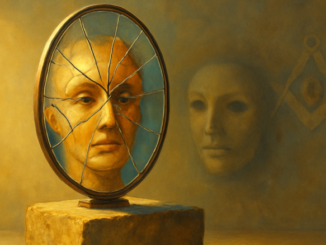
A mirror that cracks no longer shows a true reflection. The glass is still there, the frame intact, but the image looking back at you is splintered, distorted, unreliable. This is how we might view those moments when someone’s actions stand in stark contradiction to the role they occupy. When the news confronts us with people who were given trust and then betrayed it, we are forced to sit with an uncomfortable question: what is personality, really? And can we ever fully know it — in others or in ourselves? The Mask and What Lies Behind It The word “personality” derives from the Latin persona, which originally referred to a theatrical mask. Actors in classical theater wore masks to define their roles. The mask was not meant to deceive — it was meant to clarify. It told the audience who this figure was and what to expect from him. And yet, buried in this etymology lies an unsettling truth: if personality is a mask, what lies behind it? In Freemasonry, this question occupies a central place, even if it is rarely stated so directly. The rough ashlar — the symbol of man at the beginning of his inner journey — […]

Cup of coffee on a quiet harbor dock at sunrise with sailboats in the background
Personal Development & Leadership

Morning Coffee in the Harbor: Stillness as a Mirror for the Soul

Steam curls upward from the cup cradled between my hands. In the harbor, the boats lie still — finally still. After days of relentless wind, the morning has turned so soft that you can hear the water lapping gently against the hulls. As I take my first sip, engines begin to rumble all around me. One by one, sailboats leave the shelter of the harbor, heading home. And I remain seated, watching the departure of others, wondering: what does this moment actually reveal about who I am? The Boat or the Man It is a question seafarers often ask when the weather turns: can the boat handle this? But anyone who is honest knows that the real question is a different one entirely. It is rarely about the strength of the vessel. It is about the person at the helm. Can you withstand the wind, the uncertainty, the unknown waiting beyond the horizon? For the past few days, everyone stayed in port because conditions were too fierce. Not for the boats — for the souls steering them. This distinction touches something essential. In Freemasonry, we speak of working the rough ashlar, of shaping character and personality through labor upon oneself. […]

Block of green soap symbolizing purification and inner work in Freemasonry
Symbolism & Rituals

Green Soap: Purification as a Symbol for Inner Work

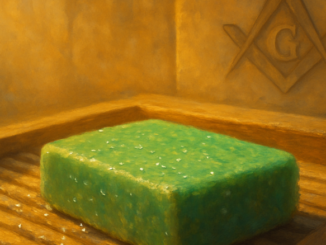
Tucked away in the cupboard beneath the kitchen sink sits an unassuming block. Yellowish-green, greasy to the touch, carrying a scent that calls to mind washdays at your grandmother’s house. Green soap. A product so ordinary that we scarcely give it a second thought. And yet, hidden within this simple cleansing agent lies a wealth of symbolism that teaches us about purification, transformation, and the daily labor we must perform upon ourselves. An Ancient Craft Green soap has a history stretching back well before the Industrial Revolution. In the Low Countries, it was made from vegetable oils and ash — a process that demanded patience and craftsmanship. Soap makers formed their own guilds, with their own rules, their own trade secrets, and their own hierarchy from apprentice to master. They understood that purification is never accidental; it is the result of careful labor and deep knowledge of one’s materials. In this respect, the soap maker’s craft bears striking parallels with other building traditions. Just as the stonemason works the rough ashlar, the soap maker transformed raw ingredients into something that cleanses and restores. The process itself — the slow saponification in which oil and lye become something entirely new — […]