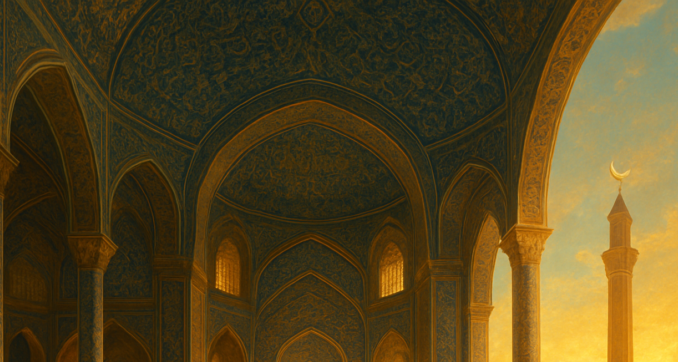
Picture two people sitting across from each other. One wears an apron and speaks of building an inner temple. The other recites verses about prophets enduring trials. On the surface, their worlds seem miles apart. Yet both are speaking about exactly the same thing: the difficult but necessary journey toward self-knowledge. Surah Sad, the 38th chapter of the Quran, offers striking parallels with the Masonic path. Today, we place these two worlds side by side.
The Heart of Surah Sad: Trial as a School of Growth
Surah Sad takes its name from the Arabic letter ص (Sad) with which it opens. The chapter tells the stories of prophets such as David, Solomon, and Job — all of whom passed through profound trials. David wrestled with power and justice. Solomon temporarily lost his kingdom as a lesson in humility. Job endured unimaginable suffering without ever losing his connection to the Divine. The central message is clear: spiritual growth does not happen in spite of hardship, but precisely because of it.
For the devout Muslim, these stories serve as mirrors. They invite self-reflection: how do I behave when life becomes difficult? Do I lose my moral compass, or do I remain steadfast? The surah presents suffering not as punishment, but as an opportunity for purification and growth.
The Masonic Path: Working the Rough Stone
Freemasonry embraces a remarkably similar philosophy, though expressed in different imagery. At its center lies the symbol of the rough ashlar — an unfinished stone that must be shaped into a perfect cube. That work demands effort, discipline, and the willingness to endure discomfort. Just like the prophets in Surah Sad, the Freemason learns that formative experiences are rarely comfortable. The hammer and chisel of Masonic ritual symbolize the conscious choice to work on oneself, even when it hurts.
Where the Quranic tradition speaks of divine trials, the Freemason speaks of the initiatory journey. Both traditions recognize that no one arrives in this world as a finished product. There is work to be done. The outside world may only see the result, but both paths value the process above the final outcome.
Two Perspectives, One Insight
Let’s make the comparison more concrete. Surah Sad tells how Solomon, despite all his wisdom and wealth, had a moment of inattention. He became so captivated by his horses that he forgot the evening prayer. In response, he gave up his possessions to refocus on what truly matters. The story speaks to the dangers of material attachment and the importance of spiritual vigilance.
A Freemason will immediately recognize this motif in the symbol of the level — a constant reminder that earthly status and possessions are temporary. Whether it concerns a powerful king in an ancient story or a modern professional in the lodge, the message remains the same: attachment to the external obscures the inner light.
Spiritual growth does not require avoiding trials. It demands consciously living through them as a pathway to deeper understanding.
David as Builder and Judge
One of the most compelling aspects of Surah Sad is its portrayal of David — not merely as a king, but as a craftsman. The Quran states that God made iron pliable in his hands so that he could forge coats of mail. David was a builder, a maker who worked with his hands. This resonates directly with the Masonic reverence for craft as a spiritual metaphor.
At the same time, David was tested in his role as judge. Two disputing parties appeared before him, and he was called upon to deliver a fair verdict without bias. The Freemason likewise holds justice as a core value. In the ritual setting, every brother is reminded of his duty to judge honestly and without prejudice — not only others, but above all himself.
Practical Lessons for Today
What can we, as readers in 2026, take away from this comparison in practical terms? First, the recognition that difficult moments are not obstacles but learning opportunities. The next time you face a setback at work or in your relationships, remember the prophets of Surah Sad. They emerged stronger not by denying their suffering, but by living through it with awareness.
Second, both traditions place great emphasis on reflection. The Muslim has the daily prayers as anchor points throughout the day. The Freemason practices nightly self-examination. Choose a fixed moment in your day to pause and reflect. Ask yourself: what did I build today, and what did I tear down? This simple practice connects you to an age-old stream of seekers.
Consider adopting these principles drawn from both traditions: view setbacks as formative experiences rather than punishments; practice daily self-reflection, even if only for five minutes; guard against attachment to status and possessions; and judge fairly — especially when it comes to yourself.
What Both Paths Share
The Quranic tradition and Freemasonry meet in their shared conviction that every human being is a work in progress. Neither promises easy answers or quick salvation. Both demand commitment, honesty, and the courage to look in the mirror without turning away. Surah Sad tells of prophets who fell and rose again. The lodge speaks of brothers who enter the darkness in order to find the light.
The forms differ, the language differs, the rituals differ. But the essence remains recognizable: the person who consciously chooses to grow will find a way, regardless of which tradition inspires them. That may well be the most beautiful insight this comparison has to offer.
Surah Sad and Freemasonry speak from different times and cultures, yet they ultimately tell the same story. The path to inner truth runs through trial, reflection, and the deliberate work of self-improvement. Whether you open the Quran or enter a lodge, you will find the same invitation: to become more today than you were yesterday. That invitation stands open for everyone — starting now.
Copyright text & image: devrijmetselaar.nl
Texts are based on the ideas and content of the author of devrijmetselaar.nl, reviewed, corrected, and supplemented with the assistance of OpenAI. Images are created based on the ideas of the author of devrijmetselaar.nl using OpenAI/DALL-E.


Be the first to comment