A single candle flame glowing in darkness symbolizing Masonic inner light
Spiritual Traditions

Violence Against Journalists: Keeping Light in Dark Times

The brutal murder of a local sports journalist in Italy strikes a deep chord. Here was someone who told stories about sport and community — silenced by unimaginable violence. News like this raises questions that go far beyond the headline: how do we preserve our inner light when the world reveals its darkest side? This article offers practical guidance from a spiritual perspective rooted in Masonic tradition. When the Incomprehensible Crosses Your Path You read the news, scroll past it, but something lingers. An uneasy feeling in your stomach. A question you don’t ask aloud: what am I supposed to do with this? It’s a familiar moment for anyone who tries to live consciously. Senseless violence confronts us with the limits of our understanding and our power. In Freemasonry, this moment is never avoided. It sits at the very heart of the Craft: how do you relate to darkness while striving toward light? The tradition teaches that spiritual growth doesn’t happen in spite of life’s dark aspects — it happens through our conscious engagement with them. This is not abstract theory. It is a daily practice. The First Response: Acknowledgment Without Judgment What do you actually do when such news […]
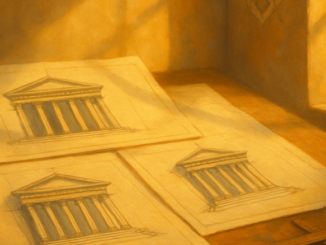
Three symbolic Masonic temples representing history, humanity, and inner growth
Symbolism & Rituals

Three Temples, One Journey: What’s the Difference?

When Freemasons speak of “the temple,” they rarely mean the same thing. One refers to a biblical structure erected thousands of years ago. Another speaks of a collective ideal that encompasses all of humanity. And yet another points inward, toward something only he can build. Three temples, three perspectives — and yet they seem inseparably linked. So what exactly is the difference? And more importantly, what does that difference tell us about the journey every seeker undertakes? Solomon’s Temple: The Historical Foundation The first temple at the heart of Masonic symbolism is Solomon’s Temple. According to biblical tradition, this structure was built in tenth-century Jerusalem, and it serves as the backdrop against which the ritual work of Freemasonry unfolds. Here, stonemasons, architects, and craftsmen worked together on something greater than themselves. Solomon’s Temple represents the external, the visible, the tangible result of human cooperation. For those outside the Craft, this temple is often the most recognizable symbol. It is a story of stone, cedarwood, and gold — of King Solomon who sought wisdom and the master builder Hiram who applied his skill. From this perspective, the temple is treated as a historical given, a place that once existed and now […]

Quill pen signing a parchment document symbolizing Masonic transition
Symbolism & Rituals

What a Presidential Resignation Reveals About Masonic Symbolism

In 1215, an English king pressed his seal onto a document that would curtail his own power. The Magna Carta was not signed out of conviction but under the weight of circumstances that left no alternative. More than eight centuries later, a Hungarian president signed a document sealing his own departure from office. The signature — as a symbol of power, surrender, and transformation — carries a rich history that reaches deep into the traditions of Freemasonry. The Historic Power of Ink on Parchment Looking back at medieval traditions, we see that the signature was far more than a formality. Kings and nobles used signet rings to authenticate documents, and the seal itself carried profound symbolic weight. Breaking a seal was an act of dishonor; affixing one was a sacred promise. In the craft guilds from which Freemasonry evolved, the same principle held true: a master who placed his mark upon a finished work bound his honor to its quality. In this context, the signature represents no simple act of identification. It is a visible trace of an inner state — a moment in which the invisible is made visible. When someone signs, they simultaneously reveal their willingness to bear […]

Open book with Masonic square and compasses symbolizing truth and self-reflection
Michel de Montaigne – The Essays

Montaigne on Liars: Philosophical Roots of Truthfulness

Have you ever wondered why a lie can sting so deeply, even when its content is entirely trivial? There’s something fundamentally violated when someone knowingly speaks an untruth — and you feel it in your bones. Michel de Montaigne, the sixteenth-century French essayist, grappled with the very same question. In his ninth essay, “On Liars,” he explores not merely what lying is, but why it is so reprehensible. To understand how he arrived at his insights, we need to look at the philosophical traditions that shaped his thinking: Stoicism, Skepticism, and Renaissance Humanism. The Stoic Legacy: Truth as Virtue Montaigne’s deep aversion to lying is firmly rooted in Stoic philosophy. Thinkers like Seneca and Epictetus regarded truthfulness not as a social convenience, but as a cardinal virtue. For the Stoics, human beings were fundamentally rational creatures, and lying represented a betrayal of that rationality. When you lie, they reasoned, you disturb the natural order of the logos — the universal reason that binds all things together. Seneca, whose letters Montaigne studied with great devotion, wrote extensively about the relationship between one’s words and one’s character. A man who lies, Seneca argued, cannot truly know himself. This is precisely the insight […]

Symbolic ruins of a temple being rebuilt representing Masonic inner work
Christianity

Haggai and the Temple: Rebuilding as an Inner Calling

Imagine standing before the ruins of something that was once magnificent. Perhaps it’s a building, perhaps a relationship, perhaps a part of yourself you’ve long neglected. The foundations are still there, but the glory has faded. What do you do? Turn away and walk on — or pick up the first stone and start again? The brief biblical book of Haggai, just two chapters long, poses exactly this question. And the answers it offers resonate with striking power through the symbolism that Freemasons have cherished for centuries. A Prophet Standing Between Rubble and Possibility Haggai emerged during one of the most pivotal moments in the history of the Jewish people. After decades of exile in Babylon, a remnant of the nation returned to Jerusalem. What they found was a devastated city — and what struck them most deeply was the sight of Solomon’s Temple lying in ruins. This was no ordinary building. It was the spiritual heart of their community, the place where heaven and earth met in their experience of the divine. Yet despite their return, something curious happened. Instead of rebuilding the Temple, the people turned their attention to their own houses. They made their private dwellings comfortable […]

Broken golden chain symbolizing Freemasonry brotherhood and ethical labor
Personal Development & Leadership

The Broken Chain: Luxury, Labor, and True Brotherhood

A golden chain around the neck. A handbag of supple leather. A timepiece built to last generations. These objects radiate craftsmanship, tradition, and a connection to the artisan who created them. But what if that chain doesn’t only link gold — what if it also conceals a shadow chain of exploitation? Recent police raids on renowned Italian fashion houses force us to confront a fundamental question: what does true connection actually mean? The Jewel and Its Shadow Every piece of jewelry tells two stories. The first is visible: the sparkle, the design, the status it projects. The second story lies hidden in the journey the object took before it reached the display window. In workshops — sometimes far removed from the gleaming boutiques — hands bend over workbenches. Those hands have names, faces, families. The question raised by the Italian investigations is simple yet deeply unsettling: are those hands treated as brothers, or as tools? In Freemasonry, the chain is a powerful symbol. Brothers stand in a circle, hands clasped together, as a sign of unbreakable unity. That chain is not a hierarchy, not a production line. It is a horizontal bond of equality. Every link carries equal weight. When […]

A man stepping from a dark doorway into sunlight symbolizing freedom
Personal Development & Leadership

The Way Out of Darkness: Brotherhood Without a Blood Oath

In a dimly lit room somewhere in southern Italy, a middle-aged man sits across from his lawyer. His hands tremble slightly as he signs the documents that will formally sever his ties to the organization he was born into. For the first time in his life, he gets to choose which brotherhood he belongs to. This scene — now increasingly possible thanks to new Italian legislation — touches on a question that Freemasons have grappled with for centuries: what makes a true brotherhood? A Law That Liberates The Italian government has recently passed legislation offering members of mafia families a formal pathway out of organized crime. The law provides protection, guidance, and a route toward building a new life. It represents an acknowledgment of something long considered unspeakable: that people born into criminal networks are not necessarily bound to that legacy forever. The blood oath, the code of silence, the family loyalty that was considered unbreakable for generations — it turns out these chains can be cut after all. To outsiders, this might sound obvious. But anyone familiar with the structure of these organizations knows how deep the bonds run. Members are not recruited — they are born into a […]

Skull and candle in a Masonic chamber of reflection symbolizing mortality
History

End of Life and the Art of Living: Two Perspectives

France recently passed a law permitting assisted dying under strict conditions — a decision that strikes at the very heart of how a society thinks about life, death, and human dignity. As public debate intensifies, this moment invites deeper reflection: how did people in earlier centuries approach the end of life, and how does that compare to our modern outlook? Freemasonry, rooted in centuries-old traditions of self-examination, offers a uniquely illuminating perspective on this timeless question. The Past: Death as a Daily Companion For our ancestors, death was not a topic to be avoided. In the medieval world, the end of life was ever-present: infant mortality was staggeringly high, epidemics swept through communities without regard for wealth or status, and average life expectancy was a fraction of what we know today. This reality produced a culture that did not hide from death but placed it squarely at the center of daily awareness. The ars moriendi — the art of dying — flourished as a literary genre in the fifteenth century. Countless manuals appeared to prepare people for a “good death.” This good death had nothing to do with pain management or medical intervention. It was about spiritual readiness. People died […]

Square and compass symbolizing truth and integrity in Freemasonry
Content & Summary

Montaigne on Liars: Truth as the Foundation of Character

Have you ever considered what really happens when someone lies? Not just to the truth itself, but to the bond between people? In his ninth essay from the first book of his famous Essais, Michel de Montaigne tackles precisely this question. ‘On Liars’ is a compact yet powerful meditation on the nature of falsehood, the role of memory, and why sincerity forms the bedrock of every meaningful human relationship. Let’s explore the core of this timeless essay — and why it still matters, especially for those who value integrity and brotherhood. The Starting Point: A Poor Memory Montaigne opens his essay with a striking confession: he has an extraordinarily poor memory. This personal trait becomes the launching pad for his entire reflection on lying. He observes that people with weak memories are often suspected of being liars because they struggle to tell their stories consistently. Yet Montaigne turns this assumption on its head. Precisely because he knows his memory fails him, he has learned to always speak the truth. A liar, after all, needs an excellent memory to keep track of all his fabrications. This insight feels remarkably modern. Montaigne demonstrates that honesty is not merely a moral choice — […]

Candlelit Masonic lodge with open Bible showing the Book of Zephaniah
Christianity

Zephaniah and the Day of Purification: A Prophetic Mirror

Candles flicker softly in the dim light of the lodge as a brother reads aloud from an ancient text — a prophet warning of a day of reckoning, yet promising that from the ashes something new will rise. The brethren listen in silence, recognizing in these age-old words something strikingly contemporary: the necessity of inner purification before any true building can begin. The Book of Zephaniah, written in the kingdom of Judah during the seventh century BCE, speaks with an urgency that still resonates today. The Prophet and His Time Zephaniah was active during the reign of King Josiah, a period when Judah was struggling with religious decay and societal corruption. The prophet spoke to a people who had neglected their foundations — a nation that maintained the outer temple walls while allowing the inner temple to crumble. His message was twofold: first, a confrontation with what had become rotten; then, a promise of restoration for those willing to be reshaped. This small book, only three chapters long, opens with a gripping description of what Zephaniah calls the “Day of the Lord.” This is no simplistic fire-and-brimstone sermon but a call to fundamental reflection. The prophet does not only address […]

Masonic square and compass with symbolic scales representing value and measure
Freemasonry & Society

Falling Inflation, Rising Worries: A Philosophical Exploration

Here is a paradox that demands deeper reflection: economists tell us inflation is falling, that the numbers are moving in the right direction, that the curve is finally bending downward. Yet we look at the receipt at the checkout and feel something quite different. Groceries still cost more than we expect, the energy bill still stings, and fixed costs still gnaw at our peace of mind. How can something simultaneously improve and remain painful? This tension between measurement and experience — between abstract truth and felt reality — touches on fundamental questions about how we, as human beings, assign value to the world around us. The Gap Between Numbers and Feeling Let us first examine the paradox more closely. When economists speak of falling inflation, they mean the rate at which prices are rising is slowing down. Prices are not falling — they are simply rising less quickly. It is the difference between a car still moving forward, but decelerating. For anyone already struggling to keep up, this offers little comfort. The distance between where you are and where you need to be is still growing, just not as fast. This is not a matter of ignorance or misunderstanding on […]

Masonic lodge in solemn remembrance during a ceremony honoring a departed Brother
Philosophy & Ethics

Grieving a Colleague: What Loss Teaches Us About Ethics

The phone goes silent after the message. A referee stares at an empty field where yesterday a familiar face still stood. The news of a valued colleague’s sudden death hits like a hammer blow. In that moment of loss, a question emerges that reaches far beyond personal grief: what does our mourning reveal about who we truly are — and how we treat one another? The Silence After Loss When a colleague dies unexpectedly, a hole opens up in the world. Not just in the workplace, but in the fabric of everyday connections. The world of refereeing, like any tight-knit community, knows this feeling of collective grief. These are moments when achievements and results suddenly seem meaningless. What remains is the memory of a person — shared experiences, the way someone carried themselves through life. In Freemasonry, we know these moments of stillness as well. When a Brother enters the Eternal East, as passing is described in Masonic terms, the lodge gathers in reflection. Not to judge what someone accomplished, but to remember who someone was. This tradition reminds us that ethics is not only about action — it is also about remembrance and honor. Ethics in the Face of […]

Masonic lodge interior with symbolic tools representing allusive speech
Philosophy & Ethics

Allusive Speech: The Hidden Art of Meaning in the Lodge

When the first speculative lodges opened their doors in the eighteenth century, the brethren developed a remarkable way of communicating. They did not speak directly about the things that moved them most deeply. Instead, they chose allusive language — a style in which meaning lies hidden behind images, references, and symbols. The allusive meaning of their words opened doors that direct speech would have left firmly shut. This article explores how this subtle art of allusion still forms the backbone of philosophical transmission within Freemasonry. What Is Allusive Language? To speak allusively means to hint, to reference without making something fully explicit. The word comes from the Latin alludere, meaning “to play upon” or “to touch lightly.” When someone speaks allusively, they approach a subject without spelling it out entirely. The listener must make the connection, fill in the missing piece, and complete the meaning. This is not a sign of vagueness — it is an act of trust in the intelligence and sensitivity of the person listening. In the philosophical tradition, this kind of indirect speech has deep roots. Socrates asked questions rather than providing answers. The mystical poets of the Middle Ages wrapped their insights in allegory. Zen […]

A painter in a Masonic lodge contemplating a canvas at twilight
History

When Time Catches Up: Lessons From Vanished Worlds

A lodge painter sets down his brush and stares at the canvas. He has just learned that an actor has died — someone who once played a paleontologist surrounded by prehistoric creatures. How strange, he thinks, that certain people remind us of forgotten ages, of what once was and will never return. In the silence of his studio, a question lingers: what remains when the last echo of a voice fades away? The Echo of Extinct Worlds There is something deeply fascinating about stories of extinct creatures. When we immerse ourselves in prehistoric times, we realize just how brief our human existence truly is. Millions of years passed before the first humans ever set foot on this earth. And yet, generation after generation, we strive to leave behind something that outlasts us. This longing for a legacy that defies time touches the very heart of what Freemasons have contemplated for centuries. Freemasonry has always maintained a special relationship with the past. Lodges preserve traditions stretching back to the medieval stonemasons’ guilds — and perhaps even further. Not because the past was better, but because there is wisdom in continuity. Every Freemason who enters a lodge joins a chain of brothers […]

Famous Freemasons worldwide and the artistic legacy they left behind
Culture & Media

Famous Freemasons and Their Artistic Legacy Worldwide

Have you ever wondered why certain works of art move you so deeply? A symphony that sends shivers down your spine. A building that stops you in your tracks. An opera in which light and darkness engage in an unmistakable dance. Behind many of these masterpieces stand famous Freemasons worldwide — creators who wove their inner quest for truth into the very fabric of their art. Their work is more than aesthetics. It is an invitation to look, to feel, and to discover something within yourself. Famous Freemasons Worldwide in Music Consider the great composers of the eighteenth and nineteenth centuries. Many of them were members of a Masonic lodge. Their music was no random arrangement of notes — it was a deliberate attempt to make harmony audible. The Viennese composer who wrote The Magic Flute filled his opera with initiation rituals, with the tension between light and darkness, and with the journey from ignorance to wisdom. Every aria is a step along that path. What these composers had in common was their belief that music is far more than entertainment. They saw sound as a building block for an inner temple. Just as a lodge works toward the betterment […]

A flickering candle flame dancing in the darkness of a Masonic lodge
Symbolism & Rituals

The Flickering Candle: A Spiritual Perspective on Light in Motion

There is a moment — often unnoticed — when a flame begins to dance. Not the calm, upright flame of still air, but that restless flicker that makes us look up from whatever we were doing. A flickering candle carries a spiritual significance that reaches far beyond the simple physics of moving air. In Freemasonry, where candlelight has played a central role in rituals and gatherings for centuries, this flicker takes on a deeper layer of meaning — one that invites contemplation about the human soul and its ceaseless quest for truth. Why a Flickering Candle Speaks to Us Spiritually The human eye is irresistibly drawn to movement. From an evolutionary standpoint, this was a survival mechanism — but somewhere along the way, it also gave rise to a capacity for wonder. When a candle flame begins to flicker, we no longer see a static object. We see something that lives. The flame seems to breathe, to respond, almost to communicate. Across countless spiritual traditions, the behavior of fire is interpreted as a sign, a message, or a presence. Freemasonry does not stand in opposition to these interpretations but examines them through a symbolic lens. The flickering light is not […]

Ancient watchtower at dawn symbolizing Habakkuk's search for light
Christianity

Habakkuk: The Doubter and the Seeker of Light

When an ancient prophet raises his fists toward the heavens and demands to know why evil goes unpunished, he touches something deeply universal. The Book of Habakkuk is not a triumphant hymn of praise — it is a struggle, a conversation with the unknown. For the religious reader, a man speaks to his God. For the Freemason, an echo resounds of the eternal quest for light amid darkness. Two perspectives, one fundamental question: how do we live with uncertainty? The Prophet as Doubter Habakkuk occupies a unique place among the prophetic books of the Bible. Where most prophets speak on behalf of the divine to the people, Habakkuk reverses the direction entirely. He speaks to the divine on behalf of himself — and in doing so, on behalf of every person who has ever wrestled with injustice. His opening question is raw and unvarnished: why must I witness violence? Why do you make me look upon destruction? This is no rhetorical device. It is genuine anguish. For the traditional reader of scripture, Habakkuk represents the believer who grows through doubt into deeper trust. The prophet eventually receives a vision — an answer that urges him to wait and to have […]

An empty chair in a Masonic lodge symbolizing remembrance and legacy
History

When Statesmen Pass: History and the Empty Chair

Imagine opening the news tomorrow morning to learn that a prominent statesman has died unexpectedly. That empty seat in a chamber, that sudden void in public discourse. If you’ve ever felt that strange mixture of disbelief and reflection upon hearing such news, you’ve touched something deeply human — the question of what a person leaves behind when life ends abruptly. In the history of Freemasonry, this question has always occupied a central place. The Sudden Absence When a prominent figure is suddenly gone, a peculiar emptiness takes hold. It reaches beyond the political arena or the public sphere — it settles into our collective consciousness. Someone who was fully present yesterday is simply no longer among us today. That confrontation with finality touches something universal. It doesn’t matter whether you admired or criticized the person in question: death observes no party lines. In Masonic lodges around the world, this reality has been confronted for centuries. Not as morbid fascination, but as a fundamental part of life’s journey. The central question is never how long someone lived, but what they left behind for the world. Historical Echoes of Impermanence The history of Freemasonry is threaded with moments when influential members departed […]

A moment of tribute connecting victory to those who came before us
History

Dedicating Victory to Those You Lost: A Masonic Reflection

Perhaps you’ve experienced it yourself: a moment of triumph, of completion, where your first thought didn’t go to yourself but to someone who is no longer here. Someone who shaped you, who set you on your path, but who never got to see you cross the finish line. When a young tennis player dedicates her greatest title to her late mother — moving a former champion in the audience to tears — it touches something far deeper than sport. It touches the age-old question: how do we honor those who came before us? The Power of the Gesture On the Centre Court of one of the world’s most famous tennis tournaments, a scene recently unfolded that transcended athletic achievement. A young champion, still trembling from the intensity of the match, directed her first words not to sponsors or coaches, but to the mother she had lost years ago. It was a moment of radical vulnerability on the highest stage. And it was contagious: a former champion sitting in the crowd, herself hardened by years of elite competition, could not hold back her tears. What makes such a gesture so powerful? It breaks through the logic of the present moment. It […]

Polar bear resting peacefully, symbolizing devotion, care, and Masonic reflection
History

Farewell to a Polar Bear: Lessons in Care and Devotion

Imagine a creature that spent 36 years surrounded by dedicated caretakers, that amazed generations of visitors, and that ultimately departed this world in peace. The passing of the oldest polar bear ever held in captivity stirs something deep within us — perhaps because her remarkably long life raises questions we rarely ask ourselves. What does it truly mean to live well? And what do we leave behind when our time comes? A Life Beyond the Statistics Polar bears in captivity typically live to around twenty years of age. The fact that this particular bear reached thirty-six makes her story extraordinary. Her keepers spoke of her not merely as an animal of unusual longevity but as a creature of remarkable character. She was headstrong, recognized familiar faces, and seemed to form bonds — in her own way — with the people around her. Perhaps you recognize the feeling that arises when you hear about an animal that has lived so far beyond expectations. A kind of respect emerges, an acknowledgment that this being experienced something most of its kind never will. And it is precisely that recognition that invites deeper reflection on what a long life actually means. Time as a […]