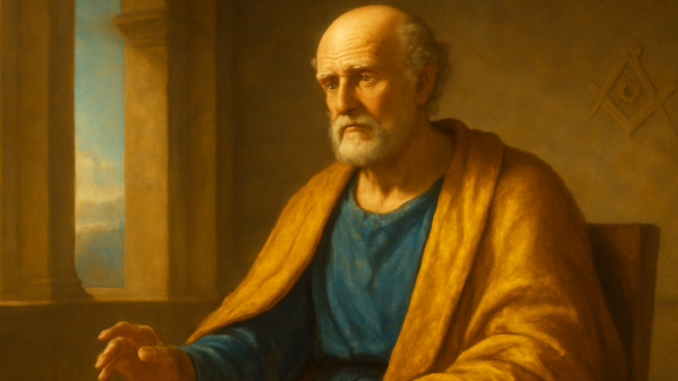
When the Roman philosopher Seneca sat down to write his fifty-fourth letter to Lucilius, he was gasping for breath in the grip of a severe asthma attack. At the very edge of death, he found not despair but clarity. For anyone familiar with Freemasonry, his words carry a strikingly familiar resonance — the conviction that mortality is not a dead end, but a teacher. How do the insights of a first-century Stoic thinker connect to the fraternal bonds and ritual wisdom that Freemasons hold dear?
Seneca’s Voice: Illness as a Philosophical Teacher
In Letter LIV, Seneca describes how a sudden asthma attack brought him to the brink of death. He refers to the condition by its Greek name and characterizes the experience as a rehearsal for dying. Where most people would succumb to panic, Seneca saw an opportunity for reflection. His illness forced him to examine what truly matters — not wealth, not fame, but the inner freedom of a mind unchained by fear.
Seneca did not treat death as an enemy but as a companion. He wrote that he had lived for years as though every day might be his last. This mindset liberated him from needless worry and made room for what truly counts: living virtuously, acting with intention, and maintaining genuine connections with others. For Seneca, illness was not a punishment but a reminder of the impermanence that all human beings share.
The Masonic Perspective: Mortality in Ritual
For Freemasons, the confrontation with mortality is not an abstract philosophical exercise — it is a central element of ritual practice. The symbolism of death permeates multiple degrees and ceremonies. This is not a morbid fascination but an invitation to self-examination. When a Mason pauses to contemplate the finite nature of life, he is reminded of the urgency of working on his inner temple right now, in this moment.
The skull and crossbones, which appear in certain Masonic rituals, do not symbolize an ending. They represent transformation. Just as the rough ashlar is shaped into the perfect ashlar, so the individual is refined through an awareness of his own finitude. The Freemason sees death as a passage — a transition from darkness into light. This perspective aligns seamlessly with Seneca’s conviction that death is not a foe to be conquered but a teacher pointing us toward the essence of life.
Where Both Worlds Converge
Both Seneca and Freemasonry emphasize that an awareness of mortality leads to a richer, more virtuous existence. Neither tradition views finitude as a threat; both see it as a catalyst for growth. The Stoic practices daily detachment from material concerns. The Freemason moves through rituals designed to confront him with his own impermanence. In both traditions, death is not a taboo — it is a mirror.
True brotherhood emerges when people are willing to look together at what binds them: not their titles or possessions, but their shared mortality and the choice to live meaningfully despite it.
In his letter, Seneca stresses the importance of friendship and connection. He writes to Lucilius not merely to share philosophical insights but to strengthen their bond. This emphasis on spiritual kinship mirrors the Masonic value of brotherhood. In the Lodge, men meet as equals regardless of their social standing. What unites them is a shared pursuit of truth and a willingness to support one another — especially in difficult times.
Seeking Light in the Darkness
A central theme in both Seneca’s philosophy and Freemasonry is the search for light. For the Stoic, this light is reason — the ability to think clearly in the midst of chaos. For the Freemason, light is synonymous with knowledge, insight, and moral illumination. Both traditions recognize that light often shines brightest in moments of darkness, when illness, loss, or doubt compel us toward honest self-reflection.
Seneca describes how, during his illness, he did not seek distraction but instead confronted his own fears head-on. This inner labor is comparable to the Freemason’s work on his rough ashlar. It demands courage, honesty, and perseverance. The reward is not the absence of suffering but a deeper understanding of oneself and a firmer foundation for a meaningful life.
What Both Traditions Teach Us
Comparing Seneca’s insights with Masonic values reveals a shared core: the conviction that conscious living begins with accepting our finitude. Both traditions invite self-reflection — not as somber brooding, but as a source of strength and clarity. They emphasize that true connection between people arises when they dare to face life’s great questions together.
The common ground can be distilled into four pillars. First, self-reflection: both Seneca and Freemasonry encourage daily contemplation. Second, virtue: the pursuit of good character stands at the center of both traditions. Third, brotherhood: connection with others strengthens personal growth. Fourth, light and knowledge: both traditions seek illumination amid uncertainty.
The voice of Seneca and the ritual symbolism of Freemasonry speak from different eras and contexts, yet their message resonates across the centuries. Those who dare to pause and reflect on finitude discover the urgency of living fully, connecting deeply, and growing continually. In that discovery lies a wealth that transcends time and place.
Seneca’s Letter LIV reminds us that illness and death are not enemies to be vanquished but teachers who lead us back to what is essential. The Freemason recognizes in this Stoic wisdom the very values that stand at the heart of his own tradition: self-reflection, brotherhood, and the unceasing search for light. When we accept our mortality, a space opens for deeper connection — with ourselves and with the brothers and sisters who walk the path alongside us.
Copyright text & image: devrijmetselaar.nl
Texts are based on the ideas and content of the author of devrijmetselaar.nl, reviewed, corrected, and supplemented with the assistance of OpenAI. Images are created based on the ideas of the author of devrijmetselaar.nl using OpenAI/DALL-E.


Be the first to comment