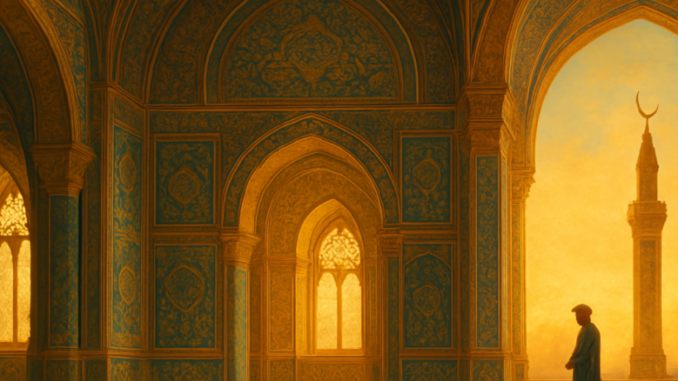
There are moments when a person bends the knee — not in submission to any earthly power, but in recognition of something far greater than oneself. In the Islamic tradition, Surah Al-Jathiyah describes precisely such a moment of cosmic humility. For the Freemason, this image carries a familiar resonance: within the lodge, too, bowing is understood as the beginning of wisdom. Two worlds, two traditions, one universal experience.
The Essence of Surah Al-Jathiyah
Surah Al-Jathiyah is the forty-fifth chapter of the Quran. Its name, often translated as “The Kneeling” or “Crouching,” derives from verse 28, which depicts all communities kneeling on the Day of Judgment. Revealed in Makkah, this surah draws attention to the signs of God present throughout creation: the heavens, the earth, the animals, the alternation of day and night. Each of these is an invitation to reflection for those who truly wish to see.
The message is clear: knowledge and gratitude are central. Those who recognize the signs embedded in nature are called to humility. At the same time, the surah warns against arrogance and indifference. Those who mock the divine message or allow themselves to be guided solely by their own whims become blind to the deeper truth of existence.
The Perspective of the Believing Muslim
For the Muslim, kneeling is both a physical and spiritual act of surrender to the Creator. The five daily prayers include this bow as an integral element. In Surah Al-Jathiyah, this posture takes on an eschatological dimension: on the day when all souls are judged, no one stands upright. All kneel, without exception, before absolute justice.
This perspective underscores the equality of all human beings before the divine. Wealth, status, and earthly power lose their significance. What remains is the weight of one’s deeds and intentions. The believing Muslim sees in this surah an exhortation to live now with an awareness of that ultimate accountability — and to never carelessly pass by the signs woven into creation.
The Perspective of the Freemason
The Freemason enters the lodge as a seeker of light. This light symbolizes knowledge, truth, and moral illumination. During initiation, the candidate is often confronted with his own limitations: he arrives as a rough ashlar, imperfect and unworked. The act of bowing — whether physical or internal — marks the beginning of a journey toward self-knowledge.
Unlike a religious context, Freemasonry prescribes no specific creed. The Supreme Being, the Great Architect of the Universe, may be understood by each brother according to his own conviction. Yet the Freemason recognizes in the theme of humility something essential: without acknowledging that one does not know or control everything, no genuine growth is possible. The prideful man builds on sand.
Humility is not weakness — it is the gateway to real knowledge, in both the Islamic tradition and in Freemasonry.
What These Two Worlds Share
Despite their differences in form and context, both traditions share a deep awareness that the human being is not the center of the universe. The kneeling believer and the seeking Freemason alike acknowledge that something exists which is greater than the individual ego. This awareness opens the door to ethical action, to respect for others, and to a life that reaches beyond the material.
Both traditions see signs in nature that invite contemplation. Both regard humility as a prerequisite for wisdom. Both consider pride and blindness to truth as obstacles on the path. And in both, the inner journey takes precedence over outward display.
Historical thinkers like Averroes — the twelfth-century Islamic philosopher who made Aristotle accessible to Europe — would likely have recognized this common ground. Goethe, who was initiated as a Freemason and held a deep fascination with Eastern spiritual texts, also saw in diverse traditions a shared quest for truth. The Enlightenment itself, during which modern Freemasonry took its definitive shape, was nourished by the exchange of knowledge between cultures.
What We Can Learn
The comparison between Surah Al-Jathiyah and the spiritual practice of Freemasonry teaches us that humility is not a sign of weakness but of strength. It takes courage to admit that one is imperfect, that one’s knowledge is limited, that there is always more to learn. The Muslim who kneels and the Freemason who crosses the threshold of the lodge make the same fundamental choice: they open themselves to growth.
In an age where self-glorification and superficiality often dominate, both traditions offer a counterbalance. The signs in creation — whether understood as divine revelation or as symbols of a deeper order — invite wonder. And wonder, as Aristotle knew well, is the beginning of all philosophy.
Brotherhood Beyond Boundaries
Freemasonry has historically welcomed men of diverse religious backgrounds. In the eighteenth century, Christians, Jews, and Muslims sometimes worked side by side in lodges, united by the pursuit of moral elevation. Surah Al-Jathiyah reminds us that before the divine — however one defines it — all people are equal. This idea forms a bridge that connects traditions without denying the unique character of each.
Surah Al-Jathiyah and Freemasonry each speak their own language, but they share a universal truth: genuine growth begins where pride ends. Whether one kneels in prayer or steps across the threshold of the lodge, it is humility that opens the gate to light. In that shared posture lies an invitation to every seeker: bow not before the small, but before the greatness that transcends us all.
Copyright text & image: devrijmetselaar.nl
Texts are based on the ideas and content of the author of devrijmetselaar.nl, reviewed, corrected, and supplemented with the assistance of OpenAI. Images are created based on the ideas of the author of devrijmetselaar.nl using OpenAI/DALL-E.



Be the first to comment