Ancient Roman oil lamp illuminating a writing tablet symbolizing reflection
Marcus Aurelius – Content & Summary

Marcus Aurelius Book VII: On the Fickleness of Fortune

Deep in the night, the emperor picks up his writing tablet. Outside, wind howls past the legion tents along the Danube frontier. Inside, by the flickering light of an oil lamp, Marcus Aurelius bends over a question every human being knows: how do you remain steadfast when fortune turns against you? His answers, recorded in Book VII of the Meditations, still speak to anyone searching for inner peace amid uncertainty — and they carry a particular resonance for those who walk the path of self-improvement through Freemasonry. The Core Idea of Book VII The central theme of Book VII revolves around how we deal with change and adversity. Marcus Aurelius argues that external events are, in themselves, neutral. It is our judgment that turns them into disasters or blessings. This foundational Stoic principle receives a deeply personal and practical treatment in this book. The emperor does not write as an abstract philosopher but as a man who contends daily with illness, war, and political intrigue. What sets Book VII apart from the other books of the Meditations is its emphasis on the transience of all things. Marcus Aurelius reminds himself repeatedly that fame is fleeting, that bodies decay, and that […]
Open book with Voltaire's prayer for tolerance illuminated by candlelight
Symbolism & Rituals

Voltaire’s Prayer for Tolerance: Its Philosophical Roots

Imagine reading a text nearly three centuries old, yet feeling how strikingly relevant every word remains. Voltaire’s prayer for tolerance, found in his Treatise on Tolerance, still resonates deeply. But where did these ideas come from? Which philosophers whispered in his ear, and which intellectual currents nourished the soil from which this extraordinary plea for human decency grew? In this article, we trace the philosophical roots of a text that distills the entire Enlightenment into a handful of sentences. The Legacy of Stoicism When Voltaire writes about universal human brotherhood and the primacy of inner virtue over outward forms, we hear unmistakable echoes of Stoic philosophy. Thinkers such as Marcus Aurelius, Seneca, and Epictetus emphasized that all human beings belong to a single cosmic community. The Stoics believed that reason connects us, regardless of origin or religious conviction. This idea — that we are all citizens of the same world — forms the foundation of Voltaire’s call to bear with one another despite our differences. Seneca wrote extensively in his letters about the necessity of clemency and the mastery of anger. He regarded wrath as a disease of the mind that disrupts our rational faculties. Voltaire, who knew Seneca’s work […]

Ancient Roman philosopher writing by lamplight, symbolizing Seneca's Letter XXVI
Lucius Annaeus Seneca – Letters to Lucilius

Seneca’s Letter XXVI: Philosophical Roots of Death and Life

An old man sits at his writing desk, the oil lamp casting dancing shadows across rolls of parchment. Outside, evening descends over Rome, but Lucius Annaeus Seneca barely notices. He is writing to his friend Lucilius about something that has occupied his mind for years: the approach of death and the art of truly living. In this twenty-sixth letter, a rich philosophical tapestry unfolds — woven from threads of Stoicism, Epicureanism, and ancient Greek wisdom. What thinkers and traditions shaped Seneca’s reflections on the ultimate transition, and why do they still matter to Freemasons today? The Stoic Foundation: Living in Accordance with Nature Seneca’s thinking about death and life is deeply rooted in Stoic philosophy, a school founded by Zeno of Citium around 300 BCE. The Stoics taught that death is not an evil but a natural part of the cosmic process. Chrysippus, one of the great systematizers of early Stoicism, developed the concept of the logos — the rational order that permeates the universe. For Seneca, this means that death need not be feared, because it is part of the very same logos that makes life possible. In Letter XXVI, Seneca applies this teaching to his own aging. He […]

Rough ashlar and sculpting tools symbolizing Platonic and Masonic education
Plato – Content & Summary

Plato’s Republic Book III and Freemasonry: Education & Virtue

How do you shape a human being into a virtuous one? This question has occupied philosophers for millennia, and few have explored it as thoroughly as Plato in the third book of The Republic. In this remarkable text, the Athenian thinker presents his vision of education as the key to a just society — a vision that resonates strikingly with the way Freemasonry forms its members. In this article, we bring two worlds into conversation: the classical Athens of Plato and the symbolic workshop of the Masonic lodge. What do they share, and what can we learn from the comparison? The Heart of Book III: Music, Gymnastics, and the Soul In the third book of The Republic, Plato continues his dialogue through Socrates about the ideal state. The central question is how the Guardians — the protectors of the city — should be educated. Plato identifies two pillars: musical training for the soul and gymnastic training for the body. This division is far from arbitrary. The philosopher believes that harmony in the soul must precede harmony in the state. Musical education, in Plato’s framework, encompasses far more than music in the modern sense. It includes poetry, storytelling, and myth. Plato […]

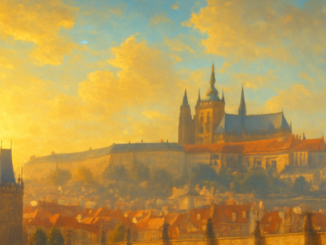
Mystical view of Prague with Charles Bridge and Prague Castle at dusk
Symbolism & Rituals

Prague as a Mystical City in The Secret of Secrets

Why did Dan Brown choose Prague as the setting for The Secret of Secrets? And what mystical claims does he make about a city that for centuries attracted alchemists, astronomers, and seekers of hidden truth? The novel paints the Bohemian capital as far more than a picturesque backdrop — it becomes a character in its own right, steeped in secrets. Let’s explore what the book suggests about Prague, and why those claims both fascinate and demand closer scrutiny. What Makes Prague So Special in the Story? In The Secret of Secrets, Dan Brown presents Prague not merely as scenery but as an active participant in the mystery. The novel positions the city as a kind of spiritual nexus where different esoteric traditions converge. Prague is portrayed as a place where the boundary between the visible and the hidden is thinner than anywhere else — a city built on secrets. Is there historical truth behind this? To some extent, yes. Under Emperor Rudolf II, who reigned from 1576 to 1612, Prague genuinely became a magnet for mystics, alchemists, and scholars. Johannes Kepler worked there on his astronomical calculations, while figures like John Dee and Edward Kelley sought the emperor’s favor with […]

Rough ashlar stone with gavel and chisel symbolizing Masonic self-reflection
Michel de Montaigne – Freemasonry & Connection

Montaigne on Preaching Virtue: When Good Intentions Fail

You probably recognize this scenario: someone with the best of intentions lectures others about how they should live, while quietly struggling with those very same shortcomings. Or perhaps you’ve caught yourself offering unsolicited advice when your own house was far from being in order. In the sixteenth century, Michel de Montaigne wrote a remarkably short but incisive essay on this very phenomenon — that preaching virtue can itself become a kind of vice. His observation touches on something that also lies at the heart of Freemasonry: true wisdom begins with self-reflection, not with correcting others. The Paradox of Moral Admonition Montaigne observed that some people are so busy proclaiming virtue that they forget to practice it themselves. Preaching becomes a form of self-deception — a way of masking personal failings behind a façade of moral superiority. The philosopher from Bordeaux had little patience for this kind of posturing. He saw clearly how rhetorical display so often substitutes for genuine character development. This is not a cynical observation but a call for honesty. Montaigne genuinely believed in virtue, yet he understood that true virtue is quiet work. It is the daily discipline of self-examination, the willingness to face your own shadow […]

Open copy of Marcus Aurelius Meditations with Masonic square and compasses
Marcus Aurelius – Freemasonry & Connection

Marcus Aurelius on Evil: Book VII Wisdom for Freemasons

A candle flickers as a Freemason sits in silence after the evening’s labor. In his hands rests a worn copy of the Meditations. He reads a passage from Book VII — about people who do harm without realizing it — and recognizes something familiar, something discussed in lodge: how do you respond to injustice without losing your own inner balance? Marcus Aurelius, the Roman emperor-philosopher who lived nearly nineteen centuries ago, turns out to be remarkably relevant for anyone seeking moral clarity. The Heart of Book VII: Justice in the Face of Evil In the seventh book of his Meditations, Marcus Aurelius wrestles with a question that occupies every thoughtful person: how should you respond to those who do wrong? The emperor, who dealt daily with intrigue, betrayal, and human weakness, chose an unexpected path. Rather than anger or retaliation, he advocated understanding. Not because wrongdoing should be condoned, but because anger damages one’s own soul. Marcus Aurelius writes that those who do evil act out of ignorance about what is truly good. This idea, which traces back to Socrates and Plato, forms the backbone of his approach. Evil is not a deliberate choice of wrong over right, but a […]

Open book showing Voltaire's Prayer for Tolerance with candlelight
Symbolism & Rituals

Voltaire’s Prayer for Tolerance: Meaning and Key Lessons

Imagine standing in a room filled with people from vastly different backgrounds, beliefs, and worldviews. What is the common thread that binds them all together? Voltaire grappled with precisely this question when he wrote his famous Prayer for Tolerance in 1763. This short but powerful text forms the emotional climax of his Treatise on Tolerance. In it, we find a core idea, central themes, and concrete lessons that remain strikingly relevant — lessons you can apply in your own life today. The Context: Why Voltaire Wrote This Prayer Voltaire’s Prayer for Tolerance did not emerge in a vacuum. He wrote it in direct response to the Jean Calas affair — the case of a Protestant merchant who was wrongfully convicted and executed for the alleged murder of his own son. In reality, the son had taken his own life, but religious prejudice fueled a horrific miscarriage of justice. Voltaire was so deeply shaken by this event that he launched a campaign to rehabilitate Calas and, at the same time, penned a sweeping analysis of the urgent need for tolerance. The prayer forms the closing passage of his treatise, and its tone is remarkably personal. Where the rest of the work […]

Ancient philosophical text symbolizing Seneca's reflections on mortality and life
Lucius Annaeus Seneca – Content & Summary

Seneca on Death and Life: Lessons from Letter XXVI

You wake up each morning, start your day, and rarely pause to consider that every day lived is one fewer remaining. Lucius Annaeus Seneca did exactly that. In his twenty-sixth letter to his friend Lucilius, he writes with striking candor about aging, mortality, and the question of how to truly live when the end draws near. Far from being a gloomy meditation, this letter offers a practical guide for anyone who wants to live more consciously. What can we still learn from this wisdom, written nearly two thousand years ago? The Heart of Letter XXVI: Old Age as a Teacher Seneca writes this letter as an elderly man. He describes how his body shows unmistakable signs of decline, how his physical strength is fading — yet how his mind seems to grow clearer with each passing year. The central idea is surprisingly optimistic: old age is not a punishment but a gift. It is the period in which you can finally test whether your philosophical convictions truly hold up under pressure. Seneca compares life to a voyage at sea. As long as you are sailing, you can claim you are unafraid of the storm. But only when the harbor comes […]

Dan Brown's Origin novel with Masonic symbols representing science and faith
Origin

Dan Brown’s Origin: Technology, Faith, and Freemasonry

You know the moment: someone enthusiastically tells you about a book that “turns everything upside down” about religion and science. Chances are they’re talking about Dan Brown’s Origin. The sixth installment in the Robert Langdon series, published in 2017, sparked immediate debate. But what does the book actually claim? And how do its central ideas connect to lines of thought that Freemasonry has been exploring for centuries? In this article, we break down the core premise of Origin and offer practical ways to engage with its provocative themes yourself. The Central Question of Origin Origin revolves around two questions that have occupied humanity for millennia: where do we come from, and where are we going? Dan Brown places his protagonist Robert Langdon at the center of a scientific presentation that claims to answer both. The fictional scientist in the novel, Edmond Kirsch, says he has developed a computer simulation that explains the origin of life without any divine intervention. At the same time, this simulation predicts a future in which technology and humanity merge into one. The book suggests that artificial intelligence can not only explain how life began but also predict how religion will become obsolete. This is the […]

Symbolic illustration of Plato's ideal city connected to Masonic lodge imagery
Plato – Freemasonry & Connection

Plato’s Ideal City and Freemasonry: Building Connection

Imagine standing with a group of people before an empty plot of land. Your shared task: build a city from scratch — not just any city, but a community where everyone can thrive. Where do you begin? What values do you lay as the foundation? This is precisely the challenge Plato takes on in Book II of The Republic, and it is the very same question that Freemasons have been grappling with for centuries whenever they speak of building a better world. The City as a Mirror of the Soul In The Republic Book II, Plato makes a surprising move. Rather than diving straight into a debate about the nature of justice, he proposes designing an ideal city first. His reasoning is beautifully practical: justice is easier to recognize in a larger system than in a single individual, just as large letters are easier to read than small ones. The city becomes a magnifying glass for the human soul. For Freemasons, this approach feels immediately familiar. In the lodge, we work on two structures simultaneously: the inner temple of the self and the collective brotherhood. What we learn inside the lodge about cooperation, harmony, and virtue, we carry into the […]

Open book with Montaigne essays and philosophical symbols of wisdom and virtue
Michel de Montaigne – Philosophical Background

Montaigne on Virtue Preaching: Philosophical Roots & Context

We have all experienced it: someone delivers a passionate speech about honesty or integrity, and yet something feels off. The words are right, but the speaker fails to convince. Michel de Montaigne wrote about this very phenomenon in the sixteenth century. In his brief but incisive essay on how the preaching of virtue can itself become a vice, he dissected the gap between words and deeds. But where did these insights come from? Which philosophers and intellectual traditions shaped his thinking? This article traces the sources behind this essay and shows how their wisdom remains strikingly practical today. The Stoic Legacy: Seneca as Teacher Montaigne read the Roman philosopher Seneca with extraordinary care. In Seneca’s letters to Lucilius, he found a recurring theme: the dangers of hollow rhetoric. Seneca warned that philosophers who speak beautiful words without living by them ultimately discredit philosophy itself. For Seneca, philosophy was never an academic exercise — it was a daily practice of self-improvement. This Stoic emphasis on congruence — between inner conviction and outward action, between belief and behaviour — resonated deeply with Montaigne. In his own era, he observed how preachers and moralists lost themselves in theatrical performances about virtue while their […]

Statue of Marcus Aurelius representing Stoic philosophy and justice
Marcus Aurelius – Meditations

Marcus Aurelius on Evil and Justice: Philosophical Roots

You’re facing a difficult decision. Someone has wronged you, and the urge to strike back burns hot. It’s precisely in moments like these that Book VII of Marcus Aurelius’ Meditations offers concrete guidance. But where did these insights originate? Which philosophical traditions shaped the thinking of this Roman emperor? And more importantly — how can you put this ancient wisdom to work in your life today? The Stoic Foundation: Mastering Your Reactions Marcus Aurelius wrote from within a tradition that began three centuries before his time. Around 300 BCE, Zeno of Citium founded the Stoic school in Athens. Its core principle was simple yet powerful: you have no control over what happens to you, but you have full control over how you respond. In Book VII, Marcus Aurelius applies this directly to questions of evil and justice. When someone insults or harms you, the event itself is neutral. It’s your judgment about it that turns it into something painful. This is not passivity. It’s an active choice to direct your energy toward what you can actually influence. Try it yourself: the next time someone’s behavior irritates you, ask yourself, “Can I change this?” If yes, take action. If not, accept […]

Voltaire portrait beside Masonic symbols representing tolerance and wisdom
Symbolism & Rituals

Voltaire on Tolerance as a Virtue: Wisdom for Freemasons

Tolerance is often treated as a passive attitude today — a matter of letting others do as they please so long as they don’t bother you. Voltaire saw things very differently. For him, tolerance was an active virtue demanding courage, self-reflection, and wisdom. When we place his ideas alongside the Masonic tradition, a remarkably rich conversation emerges about what it truly means to be tolerant. The Outsider Sees Tolerance as Weakness Let’s be honest: for many people in the eighteenth century, tolerance was seen as a sign of indifference or even cowardice. The reasoning went that anyone who took their own convictions seriously could not possibly bear others thinking radically differently. Voltaire knew this criticism all too well. In his time, religious minorities were persecuted, dissenters were banished, and books were burned. The social norm was not tolerance but conformity. From this perspective, tolerance was suspicious. It implied that you didn’t truly believe in anything — that you lacked principles. Intolerance was often dressed up as virtue: one was simply protecting truth against error. Those who showed tolerance, it was claimed, had chosen no side and therefore had nothing meaningful to offer. Voltaire’s Reversal: Tolerance Requires Strength Voltaire turned this […]

Ancient Stoic column and Masonic square and compasses symbolizing inner wisdom
Lucius Annaeus Seneca – Freemasonry & Connection

Seneca on True Joy: Wisdom That Freemasons Recognize

When the Roman philosopher Lucius Annaeus Seneca wrote his twenty-third letter to Lucilius on the subject of true joy, he touched on something universal. His words, nearly two thousand years old, still resonate with anyone searching for meaning beyond the superficial. For Freemasons, this letter strikes a particularly familiar chord — the conviction that genuine fulfillment does not come from the outside, but must be built from within. Let us explore how Seneca’s insights and the Masonic tradition converge in their shared pursuit of inner light. The Stoic and His Student: A Conversation About Happiness Seneca wrote his famous letters to a younger friend, Lucilius, as a form of philosophical correspondence. In Letter XXIII, he poses a fundamental question: what makes a person truly happy? He warns Lucilius against the mistake so many of us make — seeking joy in possessions, status, or fleeting pleasures. These forms of happiness, Seneca argues, are fragile and entirely dependent on circumstances beyond our control. True joy, by contrast, springs from a clear conscience and a virtuous character. The Stoic philosopher uses the image of a spring that wells up from within, as opposed to water piped in from elsewhere. External happiness is like […]

Dan Brown Inferno book with Masonic and Dante Alighieri symbolism
Inferno

Dan Brown’s Inferno: Symbolism Through Two Different Eyes

When Dan Brown brings the rich symbolic world of Dante Alighieri to life in his thriller Inferno, a fascinating question emerges: how differently do people read these layers of meaning? The casual reader sees an exciting story peppered with historical references. The Freemason may recognize a much deeper structure. Both perspectives deserve attention — and together, they reveal why symbolism has captivated humanity for centuries. The Outsider’s Perspective: Thrills and Historical Decoration For most readers of Inferno, the symbolism functions primarily as atmosphere. Dan Brown guides his protagonist Robert Langdon through the streets of Florence, Venice, and Istanbul, where he solves riddles rooted in Dante’s Divine Comedy. The casual reader experiences these symbols as decorative elements that enrich the narrative. The concentric circles of Hell, the mysterious death masks, and the hidden messages in artworks all serve to drive the plot forward. This type of reader enjoys the intellectual treasure hunt without necessarily seeking deeper layers of meaning. The symbols are puzzle pieces, not windows into inner transformation — and that is a perfectly valid way to read the book. Dan Brown himself has said in interviews that he deliberately uses symbols as narrative tools to make complex themes accessible […]

Ancient Greek city representing Plato's ideal city and philosophical wisdom
Plato – Philosophical Background

Plato’s Ideal City: Philosophical Roots of The Republic II

Why would anyone actually want to be just? Is it because justice is inherently valuable, or merely because we fear the consequences of injustice? In the second book of The Republic, Plato places this fundamental question at the center of his inquiry and embarks on the ambitious task of designing an ideal city. But which philosophical traditions and thinkers shaped the background of this thought experiment? Let us engage with Plato’s ideas and discover how his ideal city is rooted in ancient wisdom traditions — traditions that continue to resonate deeply within Freemasonry today. What Question Drives Plato? The conversation in Book II opens with a challenge posed to Socrates by Glaucon and Adeimantus. They want to know whether justice is intrinsically valuable, or whether people only act justly out of fear of punishment or desire for reward. This question was far from new in Plato’s time. The Sophists — itinerant teachers of wisdom such as Protagoras and Gorgias — had already argued that moral values are nothing more than human constructions. In their view, justice was essentially a social contract, an agreement designed to protect the weak from the strong. Plato profoundly disagreed. For him, justice had to be […]

Marcus Aurelius statue symbolizing Stoic justice and Masonic inner temple
Marcus Aurelius – Content & Summary

Marcus Aurelius Book VII: On Evil and Justice

There may have been a moment in your life when someone wronged you and you felt anger rising like a tide. Or perhaps you recognize those times when your own thoughts tormented you more than the situation itself. Marcus Aurelius, the Roman emperor-philosopher, wrestled with exactly these questions. In Book VII of his Meditations, he examines what evil truly is, how justice guides our actions, and why inner peace never depends on the behavior of others. The Heart of Book VII: What Is True Evil? Marcus Aurelius opens Book VII with a radical proposition: the evil others inflict upon you does not damage your soul. What truly harms you is your own reaction to it. This is a foundational Stoic insight that he returns to again and again. When someone insults you, lies to you, or deceives you, the real danger lies not in the act itself but in how you choose to respond. If you allow yourself to be swept away by anger and resentment, you surrender your power. If you remain aligned with your inner compass, you preserve your freedom. The emperor wrote these reflections as private notes, never intended for publication. That is precisely what makes them […]

Montaigne essay on virtue and vanity reflected in Masonic lodge symbolism
Michel de Montaigne – Content & Summary

Montaigne on Preaching Virtue: When Does Wisdom Become Vanity?

It is a winter evening in the lodge. A brother delivers a lecture on humility — yet his words drip like honey from his lips, every gesture studied, every pause calculated. The audience nods politely, but something feels off. Is this still the sharing of wisdom, or has it become performance? Michel de Montaigne would have smiled knowingly at this scene. In his twenty-fifth essay, he examines precisely this tension: at what point does the preaching of virtue become its opposite? The Heart of Essay 25: Dissecting a Paradox In this short but razor-sharp essay from the first book of his Essays, Montaigne raises an uncomfortable question. Anyone who constantly and emphatically speaks of virtue may, in doing so, reveal a lack of true inner virtue. This was a provocative thought in an era when moral instruction was regarded as a noble pursuit. Montaigne turns the assumption on its head. He suggests that genuine virtue does not need to advertise itself — it has already become self-evident through action. The essay is remarkably compact, which suits its message perfectly. Montaigne does not write to impress; he writes to question. He draws on classical thinkers such as Seneca and engages with […]

Portrait of Voltaire symbolizing Enlightenment tolerance and Freemasonry
Symbolism & Rituals

Voltaire on Tolerance: Philosophical Roots of a Virtue

Imagine you’re in a heated discussion with someone whose views are radically different from your own. You feel the urge to push back, to correct, perhaps even to condemn. But then something stops you: tolerance is not weakness — it’s a deliberate choice. François-Marie Arouet, better known as Voltaire, understood this better than most. His writings on tolerance drew from centuries of philosophical tradition. Which thinkers shaped his ideas? And how can their insights still guide us today? The Stoic Foundation: Seneca and Marcus Aurelius Voltaire was an avid reader of the Roman Stoics. Seneca, the philosopher and statesman, taught that anger and intolerance spring from flawed judgments about reality. When someone insults or contradicts you, it is not the other person who wounds you — it is your own interpretation of their words. This insight echoes powerfully through Voltaire’s case for tolerance: once we accept that people think differently because of their upbringing, culture, and experiences, the grounds for condemnation simply dissolve. Marcus Aurelius, the philosopher-emperor, took the idea even further. In his Meditations, he wrote that we should regard even our opponents as fellow human beings who act according to their own logic. Voltaire translated this into a […]