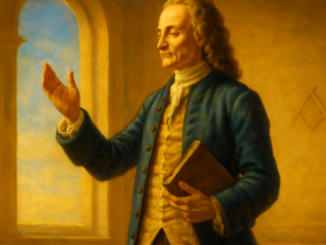
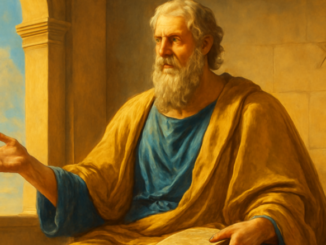
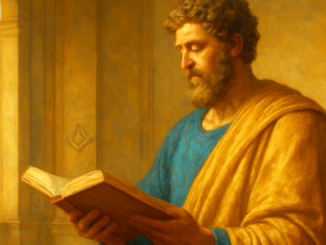
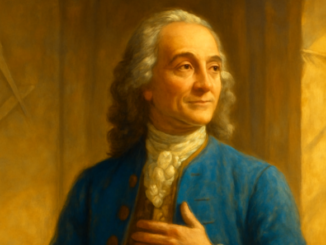
Ancient philosophical text illuminated by candlelight symbolizing Masonic wisdom
Lucius Annaeus Seneca – Letters to Lucilius

Seneca on True Joy: The Philosophical Roots of Letter XXIII

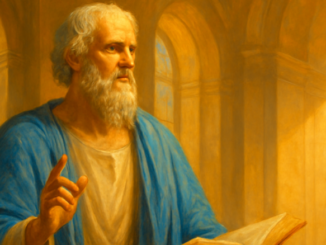
A candle flickers in the early morning light as a Freemason opens the yellowed pages of an ancient book. He reads the words of a Roman philosopher, written nearly two thousand years ago, and feels an unexpected sense of recognition. Seneca writes about joy — not the fleeting excitement of the moment, but something deeper, something enduring. In that stillness before the rush of the day, a question takes shape: what makes joy truly real? The Stoic Tradition as Foundation To fully appreciate Letter XXIII, we need to return to the roots of Stoicism. This philosophical school was founded around 300 BC in Athens by Zeno of Citium. The Stoics believed that true happiness does not depend on external circumstances but on the inner condition of the individual. Lucius Annaeus Seneca, writing in the first century AD, built upon this foundation while adapting it to the realities of Roman life. Stoic ethics revolves around the concept of virtue as the highest good. External things such as wealth, fame, and even health are regarded as “indifferent things.” This does not mean they are worthless, but rather that they cannot serve as the source of lasting happiness. Seneca applies this principle in […]

The Lost Symbol book with Masonic square and compasses symbolism
Symbolism & Rituals

The Lost Symbol: Dan Brown’s Claims About Masonic Rituals

When Dan Brown’s The Lost Symbol hit bookshelves in 2009, it instantly became a global bestseller — and placed Freemasonry squarely at the center of public conversation. Set against the monumental backdrop of Washington D.C., the thriller painted Masonic rituals as keys to an ancient mystery. But what exactly does Brown claim about these rituals? And how do his assertions hold up against the actual history and practice of Freemasonry? The Central Premise: Freemasonry as Guardian of Ancient Secrets The Lost Symbol presents Freemasonry as the custodian of an ancient mystery — a secret reaching back to the earliest human civilizations. Dan Brown portrays Masonic rituals not as quaint traditions or fraternal ceremonies, but as carriers of hidden knowledge. According to the novel, these symbolic acts contain a deeper truth about the human mind and its untapped potential. Freemasonry doesn’t serve as mere background scenery in the story; it is the engine that drives the entire plot. The rituals function as literal keys to deciphering a great secret concealed within the architecture and geography of the American capital. Brown suggests that Masonic rituals are symbolic echoes of a lost wisdom — one that originated in the ancient mystery schools of […]

Ancient Greek temple symbolizing Plato's ideal city and the soul's inner order
Plato – Content & Summary

Plato’s Republic Book II: The Ideal City as Mirror of the Soul

Picture the scene: a group of men gathered in the home of a wealthy Athenian merchant. Evening falls, the wine flows, yet no one speaks of trade or politics. Instead, one of them poses a question that cuts to the bone — what is justice, really, and why should anyone choose to live justly? Socrates, the philosopher who never stopped asking questions, is challenged not merely to argue that justice is good, but to prove why. This conversation, recorded by Plato in the second book of The Republic, lays the foundation for one of the most influential philosophical works in Western history — and one that resonates deeply with anyone committed to self-improvement and the pursuit of moral truth. The Challenge of Glaucon and Adeimantus Book II opens with a provocative twist. Glaucon, Plato’s own brother, takes on the role of devil’s advocate. He presents the famous story of the Ring of Gyges: a shepherd discovers a magical ring that renders him invisible. Armed with this power, he seduces the queen, murders the king, and seizes the throne. The question Glaucon raises is deeply unsettling — if we could act without consequence, would anyone still choose to be just? His […]

Open book with Masonic symbols representing Montaigne's educational philosophy
Michel de Montaigne – Freemasonry & Connection

Montaigne on Education: Lessons for the Seeking Freemason

Imagine a child who is not taught to obey, but to think independently. A child who is not stuffed with facts, but invited to ask questions. In the sixteenth century, Michel de Montaigne wrote an essay outlining precisely this vision of education. What he put to paper over four hundred years ago touches on something every Freemason recognizes: the conviction that true growth begins with the development of an independent mind and a virtuous character. In this article, we explore how Montaigne’s pedagogical ideas connect with the core values of Freemasonry. The Heart of Montaigne’s Educational Philosophy In his essay ‘On the Education of Children,’ Montaigne pushes back against the educational practices of his era, which he considered mechanical and superficial. Teachers crammed students full of trivia without paying attention to understanding or application. Montaigne argued for something radically different: an education that sharpens judgment rather than merely filling the memory. The child must learn to weigh, compare, and draw conclusions independently. This is not a passive process, but an active quest for insight. What does this look like in practice? Montaigne advises that an educator should confront the child with a variety of viewpoints and encourage them to choose […]

Ancient Roman bust of Marcus Aurelius symbolizing Masonic brotherhood and Stoic wisdom
Marcus Aurelius – Freemasonry & Connection

Marcus Aurelius Book VI: Brotherhood as the Art of Living

Have you ever wondered why certain ancient wisdom still strikes such a powerful chord? Nearly two thousand years ago, Marcus Aurelius wrote about the art of living among others, and his words feel as though they could have been penned yesterday. In Book VI of his Meditations, the Roman emperor-philosopher reveals what it truly means to live as a human being among human beings. For Freemasons, these reflections sound remarkably familiar — because the values Marcus Aurelius describes also form the very foundation of the Craft. Humanity as One Body Throughout Book VI, Marcus Aurelius returns again and again to the theme of human interconnectedness. He does not see humanity as a collection of isolated individuals, but as parts of a single great organism. Just as a hand or a foot only finds its purpose as part of the body, so too does a person discover meaning through relationship with others. This is not idle philosophical musing — it is a call to action. When you wake in the morning and feel annoyed at the people you will encounter that day, Marcus Aurelius reminds you that they are your kindred. Not because you share the same blood, but because you […]

Voltaire portrait with Masonic symbols representing tolerance and Enlightenment
Symbolism & Rituals

Voltaire on Tolerance: Virtue as the Foundation of Society

Some ideas from the eighteenth century feel remarkably current — and Voltaire’s reflections on tolerance are a prime example. Writing during a period of religious persecution and deadly conflict, Voltaire articulated a vision of tolerance that went far beyond political convenience. In his second essay on the subject, he presented tolerance not merely as a practical necessity, but as a fundamental human virtue — a perspective that aligns seamlessly with the principles of Freemasonry. The Historical Context of Voltaire’s Plea Voltaire wrote his reflections on tolerance against the backdrop of the Calas affair, in which a Protestant father was wrongfully convicted and executed for the alleged murder of his son. This gross miscarriage of justice, fueled by religious fanaticism, struck Voltaire to his core and became the catalyst for his passionate defense of tolerance as a moral duty. In his second essay on the topic, he moved beyond practical arguments to make a bolder claim: tolerance is not a sign of weakness but a hallmark of civilization and inner strength. Voltaire placed his argument within a sweeping historical framework. He pointed to ancient civilizations such as the Roman Empire, where diverse religions coexisted for long periods. This tolerance did not […]

Ancient manuscript and magnifying glass symbolizing the Priory of Sion mystery
Symbolism & Rituals

The Priory of Sion in The Da Vinci Code: Fact or Fiction?

You may have read the book or watched the movie: Dan Brown’s The Da Vinci Code spins a breathtaking tale about a secret organization that has supposedly guarded an explosive secret for centuries. The Priory of Sion sits at the very heart of the story. But what exactly does the book claim? And more importantly, how can you, as a critical reader, evaluate such claims for yourself? In this article, we unravel the central assertions of this bestselling novel and give you practical tools to separate fact from fiction. What Does The Da Vinci Code Claim About the Priory of Sion? In The Da Vinci Code, Dan Brown portrays the Priory of Sion as an ancient secret brotherhood dating back to the era of the Crusades. According to the story, this organization was founded to protect an explosive secret: the alleged bloodline of Jesus Christ and Mary Magdalene. The book suggests that famous historical figures such as Leonardo da Vinci, Isaac Newton, and Sandro Botticelli served as Grand Masters of the Priory. Brown presents a fascinating theory within his novel: through secret documents and symbols, the Priory supposedly passed this secret down through the centuries. Artworks, architecture, and hidden codes […]

Ancient scroll symbolizing Seneca's Letter XXIII on true joy and inner peace
Lucius Annaeus Seneca – Content & Summary

Seneca’s Letter XXIII: On True Joy and Inner Tranquility

What is the difference between superficial happiness and deep, unshakable joy? In his twenty-third letter to his friend Lucilius, the Roman philosopher Lucius Annaeus Seneca confronts this fundamental question head-on. He examines why most people spend their entire lives chasing fleeting pleasures, while the only source of genuine fulfillment lies within themselves. Nearly two thousand years later, this letter still holds up a timeless mirror for anyone wondering where lasting happiness truly comes from. The Heart of Letter XXIII Seneca opens this letter with a deceptively simple question: are you truly happy, or are you merely playing the part of someone who is? He urges Lucilius to look honestly into the mirror. Roman society of Seneca’s day — much like our own — offered endless distractions and superficial pleasures: banquets, fame, possessions. But Seneca warns that this kind of joy is as fleeting as morning mist. The moment circumstances change, happiness evaporates along with them. The philosopher draws a sharp distinction between laetitia — exuberant cheerfulness — and gaudium — deep, inner joy. The former depends on external factors and shifts with fortune. The latter springs from the soul itself and cannot be taken away by circumstance. This distinction forms […]

Square and compasses on an open copy of Plato's Republic
Plato – Freemasonry & Connection

Plato’s Republic and Justice: A Masonic Dialogue

What is justice, really? Plato poses this question in the opening book of his masterwork The Republic, and it has echoed through the centuries with undiminished force. What makes this question especially compelling for Freemasons is that it lies at the very heart of their Craft. When a Brother enters the lodge, he embarks on a quest for truth and virtue — for right action in a complex world. Plato’s ancient inquiry and the Masonic tradition share far more common ground than one might expect at first glance. Why Does Plato Begin With a Conversation About Justice? The first book of The Republic takes place in the house of Cephalus, a wealthy old man who enters into conversation with Socrates. The setting may seem incidental, but nothing in Plato is accidental. He deliberately chooses a dialogue — a conversation among people with different backgrounds and perspectives. Socrates does not arrive to deliver answers; he comes to think together with others. This method of collectively seeking truth is precisely what Freemasons strive for in their meetings: not to claim wisdom, but to discover it together. Cephalus suggests that justice simply means speaking the truth and repaying your debts. Socrates challenges this […]

Open book with classical philosophical texts representing Montaigne's education
Michel de Montaigne – Philosophical Background

Montaigne on Education: Philosophical Roots of Formation

Why did a sixteenth-century French nobleman write an essay on the education of children that still provokes deep reflection more than four centuries later? And which thinkers whispered their insights to him as he sat writing in his famous tower? Michel de Montaigne drew from a rich philosophical tradition when he committed his thoughts on formation to paper. Let us explore the sources that nourished his vision — and discover why they still matter to anyone walking the path of self-improvement. Which Philosophical Currents Shaped Montaigne’s Thinking? Montaigne lived during an era of intellectual rebirth. Renaissance Humanism had rediscovered the classical texts and brought a fresh perspective on human nature and its possibilities. This humanism was characterized by a return to the sources: Greek and Roman thinkers were no longer filtered through medieval interpretations but read and questioned directly. In his essay on the education of children, we see three major currents converge: Stoicism, with its emphasis on virtue and character; Skepticism, with its critical stance toward dogmatic knowledge; and the practical humanism of Plutarch, which viewed formation as the art of living. Montaigne blended these ingredients into his own recipe, rooted in personal experience rather than abstract theory. What […]

Ancient Stoic philosophical texts symbolizing Masonic brotherhood and wisdom
Marcus Aurelius – Meditations

Marcus Aurelius Book VI: Philosophical Roots of Brotherhood

What drives a Roman emperor to write about the interconnectedness of all people while camped in a war zone? And why do those thoughts still resonate nineteen centuries later in the rituals of Masonic lodges around the world? The answers lie buried deep in the philosophical traditions that shaped Marcus Aurelius — traditions that continue to provide the foundations for fraternal bonds to this day. Where Did Marcus Aurelius Draw His Ideas From? This is perhaps the first question that arises when reading Book VI of the Meditations. Marcus Aurelius did not write in a vacuum. He stood on the shoulders of giants — generations of Stoic thinkers who had laid the groundwork before him. The Stoa, founded by Zeno of Citium around 300 BC, taught that all human beings are part of one cosmic community. This concept, the cosmopolis, forms the backbone of everything Marcus wrote about our obligations to one another. But the emperor did not limit himself to a single source. He drank from multiple philosophical rivers: the practical ethics of Epictetus, the letters of Seneca, and the moral biographies of Plutarch. Each of these thinkers contributed a unique stone to the edifice of his thought on […]

Ambigram design illustrating the relationship between fiction and Masonic symbolism
Angels & Demons

Ambigrams in Angels & Demons: Fiction vs. Real Symbolism

Imagine a word that reads exactly the same when you flip it upside down — symmetrical, mysterious, and seemingly impossible. In Dan Brown’s bestselling thriller Angels & Demons, these typographic designs called ambigrams play a starring role as alleged secret symbols of an ancient brotherhood. But what does the novel actually claim? And how do those claims hold up against what we genuinely know about symbols, secret societies, and Freemasonry? What Exactly Are Ambigrams? Let’s start at the beginning. The word “ambigram” derives from the Latin ambi (both sides) and gramma (letter). An ambigram is a typographic design that can be read in more than one way — most commonly by rotating it 180 degrees. It is an art form that truly came into its own during the twentieth century, developed by graphic designers and calligraphers experimenting with symmetry and legibility. Here’s the critical question: if ambigrams are a modern invention, how could they possibly be the secret signs of an eighteenth-century secret society? That contradiction takes us straight to the heart of what the novel claims. What Does the Novel Actually Claim? In Angels & Demons, ambigrams are presented as authentic, historical symbols of the Illuminati — the Bavarian […]

Voltaire writing his Treatise on Tolerance, symbolizing Masonic ideals
Symbolism & Rituals

Voltaire on Tolerance: The Calas Affair and Freemasonry

What drives a person to stand up against injustice when the rest of society looks the other way? In 1762, Jean Calas — a Protestant merchant from Toulouse — was sentenced to death on the strength of religious prejudice alone. Voltaire took up his pen and wrote his famous Treatise on Tolerance. But what does this eighteenth-century plea for humanity have to do with Freemasonry today? Far more than you might expect. What Actually Happened in the Calas Affair? Let’s start with the facts. Marc-Antoine Calas, Jean’s son, was found dead in the family home. In all likelihood, he had taken his own life. But a rumor spread quickly through Toulouse: that his father had murdered him to prevent his conversion to Catholicism. Without credible evidence, Jean Calas was tortured and broken on the wheel — a judicial murder driven by religious hysteria. Voltaire learned of the case and launched a years-long campaign for Calas’s posthumous rehabilitation. His Treatise on Tolerance is no dry legal argument. It is a passionate appeal for basic human decency. The question he posed remains just as relevant today: how can we call ourselves civilized while condemning our fellow human beings on the basis of […]

Ancient Stoic philosophy book with Masonic square and compass symbolizing wisdom
Lucius Annaeus Seneca – Freemasonry & Connection

Seneca on Simplicity: Letter XX and the Masonic Path

What does it truly mean to live in accordance with your beliefs? Lucius Annaeus Seneca posed this question to his student Lucilius nearly two thousand years ago — and it is precisely the same question that Freemasons continue to ask themselves on their journey toward inner truth. In his twentieth letter from the Epistulae Morales, the Stoic philosopher explores how simplicity and consistency form the foundation of an authentic philosophical life. These ancient insights resonate deeply with the timeless principles of Freemasonry, and they deserve a closer look. Why Does Seneca Consider Simplicity a Foundation? Seneca opens his twentieth letter with an urgent appeal: let your words and your actions align. He criticizes those who profess philosophy with their lips yet deny it through their daily conduct. For Seneca, simplicity is not poverty or deprivation — it is a deliberate choice to release what is unnecessary. The real question he poses is this: do you live according to what you preach? This principle of harmony between the inner life and outward behavior is far from an abstract philosophical exercise. Seneca asks Lucilius to test himself honestly: can you be content with little? Could you endure the loss of wealth and […]

Ancient Greek temple columns symbolizing Plato's Republic and Masonic philosophy
Plato – Philosophical Background

Plato’s Republic and Justice: Philosophical Roots Explored

In fifth-century Athens, where democracy and philosophy flourished side by side, a young thinker posed a question that has never been abandoned since: what is justice, really? Plato did not write his dialogue The Republic in an intellectual vacuum. His struggle with this concept was rooted in decades of philosophical debate, political upheaval, and the tragic fate of his teacher Socrates. To understand why the first book of The Republic still resonates within the rituals and principles of Freemasonry, we must travel back to the sources that shaped Plato’s thought. The Sophistic Legacy: Justice as Convention Plato’s dialogue opens with a confrontation that exposes the intellectual heart of his era. Thrasymachus, a sharp-tongued Sophist, provocatively declares that justice is nothing more than the advantage of the stronger. This was no idle intellectual fancy. The Sophists — travelling teachers who sold rhetoric and wisdom — had fundamentally transformed Greek thought in the decades before Plato. Figures such as Protagoras and Gorgias undermined belief in absolute truths. Their relativism held that laws and morality were merely human conventions, malleable to the wishes of whoever held power. Plato grew up in this intellectual arena. His family belonged to the Athenian aristocracy, and he […]

Open book with Masonic square and compasses symbolizing education and Freemasonry
Michel de Montaigne – Content & Summary

Montaigne on Education: The Art of Forming Free Minds

In 1580, Michel de Montaigne wrote a remarkable essay that turned the educational thinking of his time upside down. What began as a letter to the Countess Diane de Foix evolved into a fundamental critique of sixteenth-century schooling. While his contemporaries focused on rote transmission of knowledge, Montaigne argued for something radically different: the formation of a discerning, free, and morally strong individual. His ideas would go on to influence educators and philosophers for centuries — and, less widely known, they helped shape the Masonic ideal of the searching, self-improving human being. A World in Turmoil: The Historical Context The France in which Montaigne lived was torn apart by religious wars between Catholics and Huguenots. Education at universities and colleges was dominated by scholastic methods: students memorized vast quantities of texts without truly understanding them. Latin and Greek were the languages of instruction, and the primary goal was to produce scholars who could cite classical authorities on command. Montaigne had experienced this system firsthand at the Collège de Guyenne in Bordeaux, one of the finest schools of the era. Yet looking back, he found it deeply wanting. Montaigne’s father, Pierre Eyquem de Montaigne, had already taken an unconventional approach by […]

Statue of Marcus Aurelius representing Stoic brotherhood and philosophy
Marcus Aurelius – Content & Summary

Marcus Aurelius Book VI: On Brotherhood and Humanity

In the year 170 AD, amid grueling military campaigns along the Danube frontier, the Roman Emperor Marcus Aurelius sat down in the solitude of his army tent and wrote some of the most penetrating reflections ever composed on what it means to be connected to our fellow human beings. Book VI of his Meditations, nearly two thousand years later, still speaks powerfully to anyone who contemplates brotherhood, community, and the art of living together. The Historical Context of Book VI Marcus Aurelius ruled as emperor from 161 to 180 AD, a reign marked by wars, plagues, and political turmoil. Yet this philosopher-king found time to examine his inner life with remarkable honesty. Book VI was most likely composed during the Marcomannic Wars, when the emperor was confronted daily with the rawest dimensions of human existence — violence, betrayal, and death. It was precisely under these harsh conditions that he developed his deepest insights into human connection. The Stoic philosophy in which Marcus Aurelius had been educated by teachers such as Junius Rusticus and Apollonius of Chalcedon formed the bedrock of his thinking. The Stoics taught that all human beings are part of a single cosmic community, bound together by the […]

Voltaire writing by candlelight symbolizing Enlightenment tolerance and reason
Symbolism & Rituals

Voltaire and the Calas Affair: Philosophical Roots of Tolerance

In 1762, the Protestant merchant Jean Calas was executed in Toulouse on charges of murdering his own son. The trial was steeped in religious prejudice and judicial arbitrariness. Voltaire, deeply shaken by this judicial scandal, took up his pen and wrote his celebrated Traité sur la tolérance — Treatise on Tolerance. Yet this was no impulsive reaction. It was the culmination of centuries of philosophical thought on tolerance, reason, and human dignity. The intellectual heritage behind this essay reveals deep roots that continue to resonate in the principles of Freemasonry to this day. The Stoic Legacy: Universal Humanity The deepest roots of Voltaire’s thinking on tolerance reach back to the Stoic philosophy of antiquity. Thinkers such as Seneca, Epictetus, and Marcus Aurelius developed the concept of the cosmopolis — a world community in which all human beings share in the same universal reason. For the Stoics, every person, regardless of origin or creed, carried a divine spark within. Seneca wrote in his letters to Lucilius that we are all members of one great body and that nature has brought us forth as kindred. This idea formed a foundation upon which later arguments for tolerance could be built. Voltaire was an […]

Ancient Stoic philosopher reflecting in contemplation within a symbolic lodge
Lucius Annaeus Seneca – Letters to Lucilius

Seneca on Simplicity and Fidelity: The Philosophical Roots

Can anyone truly practice philosophy when their life contradicts their words? Lucius Annaeus Seneca poses this question with striking sharpness in his twentieth letter to Lucilius. It is a question that has echoed through the centuries and still reverberates today in the silence of the Masonic lodge, where the tension between professing and practicing lies at the very heart of the work. Let us explore the philosophical sources Seneca drew upon when he composed this remarkable letter. The Paradox of the Talking Philosopher Seneca opens his letter with a challenge that is as simple as it is unsettling: let your actions match your words. The demand sounds self-evident, and that is precisely what makes it so treacherous. The Stoic tradition from which Seneca emerged had always wrestled with the gap between theory and practice. Zeno of Citium, the founder of the Stoa around 300 BCE, was already criticized by opponents who argued that his strict doctrines were impossible to live by. Seneca acknowledges this tension openly. He was himself a wealthy man at the court of Emperor Nero — a position that was difficult to reconcile with his preaching of sobriety. Yet this is not hypocrisy in the simple sense […]

Ancient Greek columns symbolizing Plato's Republic and Masonic philosophy
Plato – Content & Summary

Plato on Justice: The Republic Book I and Its Masonic Echoes

What does it mean to be just? This seemingly simple question opens one of the most influential philosophical works in the Western tradition. In the first book of The Republic, Plato sends his teacher Socrates into dialogue with three interlocutors, each defending a different definition of justice. None of them manages to convince Socrates — and yet this is no tale of intellectual defeat. It is a shared search for truth, the kind of quest that has inspired Freemasons for centuries. The Setting: An Encounter at the Piraeus The conversation takes place in the harbor of Athens, the Piraeus, where Socrates is stopped by Polemarchus after attending a religious festival. Polemarchus invites him to the home of his elderly father Cephalus, a wealthy arms dealer. What begins as a polite exchange about old age and wealth quickly transforms into a profound philosophical exploration. Cephalus remarks that wealth allows him to be honest and pay his debts. In doing so, he implicitly suggests a definition of justice: speaking the truth and returning what you owe. Socrates immediately exposes the weakness of this definition with a striking example. Suppose you have borrowed a sword from a friend who has since gone mad. […]