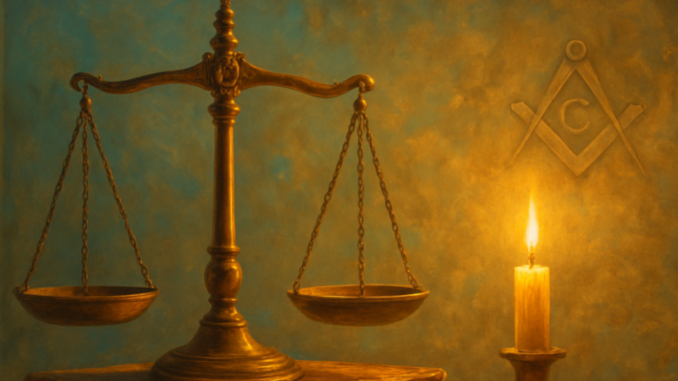
In 1762, Cesare Beccaria published his groundbreaking treatise on crime and punishment, arguing for a more just approach to violence and retribution. When we are confronted today with atrocities that defy our imagination, a fundamental question arises: how should society respond to such evil? Freemasonry, with its centuries-old emphasis on moral improvement and justice, offers a historical framework for reflecting on these profound questions.
The Enlightenment Ideal of Justice
The eighteenth century brought a fundamental shift in how Western civilization thought about crime and punishment. Philosophers like Voltaire and Montesquieu railed against arbitrary and cruel penalties. They believed that civilization was best served by a legal system that pursued rehabilitation rather than revenge. Beccaria’s work became a source of inspiration for reformers across Europe, including many Freemasons who debated the ideal society within the walls of their lodges.
During this period, a new awareness emerged: extreme acts of violence were not merely crimes against an individual but offenses against the entire human community. The ritual work of Freemasonry reflected this understanding. The symbolic journey from darkness to light represented the possibility of moral transformation — even in the darkest of circumstances.
The Rough Ashlar and the Shadow Side of Humanity
One of the oldest symbols in Freemasonry is the rough ashlar, representing unrefined human nature. This symbol acknowledges a sobering truth: every human being carries within them the capacity for both great good and terrible evil. The philosopher Thomas Hobbes described humanity’s natural state in the seventeenth century as a war of all against all. Without civilization and moral formation, he argued, chaos would reign.
Man is a wolf to man, unless he learns to govern himself and respect his fellow human beings.
Freemasonry offers a powerful answer to this pessimistic view of human nature. Through ritual, reflection, and brotherly connection, the Craft strives to refine the rough ashlar into a perfect ashlar — one that fits harmoniously into the greater edifice of humanity. This process, however, is never automatic. It requires conscious, sustained effort.
Historical Responses to Atrocities
Throughout history, societies have wrestled with the question of how to respond to extreme acts of violence. In medieval Europe, public retribution was the norm. The executioner was a central figure in civic life, and public executions drew enormous crowds. This system was not designed to heal — it was designed to instill fear.
The Enlightenment thinkers broke with this tradition. They argued that a civilized society must never lower itself to the level of the criminal. Marcus Aurelius, the Roman emperor and Stoic philosopher, wrote as early as the second century that revenge poisons the soul of the avenger. True justice, he maintained, must spring from reason, not from rage.
The Lodge as a Space for Moral Reflection
Since the seventeenth century, Masonic lodges have served as spaces where men of diverse backgrounds came together to reflect on life’s most profound questions. How do we live justly? How do we respond to injustice? What is our duty toward the victims of violence? These questions were never approached with dogmatic answers but through a method of collective inquiry and contemplation.
The philosopher John Locke, whose ideas on natural rights profoundly influenced early Freemasonry, argued that every human being possesses inalienable rights. When those rights are brutally violated, the community has a dual obligation: to seek justice and to honor the dignity of the victim.
From this Masonic tradition of moral reasoning, several principles emerge that remain deeply relevant today:
- Justice as the protection of the vulnerable, not as vengeance
- Remembrance as a tribute to those who were lost
- Reflection as a means to understand our own capacity for darkness
- Community as a buffer against isolation and despair
From Past to Present: Lessons for Today
When we are confronted with reports of atrocities that fill us with horror, the temptation is strong to succumb to anger or cynicism. The historical tradition of Freemasonry points toward a different path — not one of forgetting or minimizing, but of active remembrance and moral reflection.
Aristotle taught that virtue does not arise from theory alone but from practice. Every time we choose compassion over revulsion, understanding over condemnation, action over passivity, we are building that better world that Freemasonry envisions. This does not mean that perpetrators go unpunished. It means that we, as a society, refuse to be defined by their actions.
History teaches us that civilizations capable of responding to violence and injustice with dignity ultimately grew stronger. Not by forgetting, but by remembering and building. The rough ashlar becomes a perfect ashlar only through patient, persistent work.
The confrontation with extreme human darkness is as old as humanity itself. From the Stoics to the Enlightenment philosophers, from the first Masonic lodges to the present day, people have sought ways to reconcile justice with humanity. The lesson from history is clear: we do not build a better world by allowing ourselves to be overwhelmed by evil, but by working tirelessly toward the light. That is the task of every builder, in every age.
Copyright text & image: devrijmetselaar.nl
Texts are based on the ideas and content of the author of devrijmetselaar.nl, reviewed, corrected, and supplemented with the assistance of OpenAI. Images are created based on the ideas of the author of devrijmetselaar.nl using OpenAI/DALL-E.
Frequently Asked Questions
What is the connection between Freemasonry and the Enlightenment movement?
Many Freemasons were actively engaged with Enlightenment ideals, debating concepts of justice and an ideal society within their lodges. The fraternity embraced the philosophical shift toward rehabilitation rather than revenge in criminal justice, influenced by thinkers like Beccaria, Voltaire, and Montesquieu. This connection reflects Freemasonry's historical commitment to moral improvement and reasoned progress.
What does the 'rough ashlar' symbol teach us about human nature?
The rough ashlar represents unrefined human nature and acknowledges that all people carry the capacity for both great good and terrible evil. Freemasonry uses this symbol to emphasize that moral development is not automatic but requires conscious, sustained effort through ritual, reflection, and brotherly connection. It offers hope by suggesting that through the Craft, rough human nature can be refined into something that harmoniously contributes to society.
How does Freemasonry's approach to justice differ from medieval practices?
While medieval societies relied on public retribution and fear-based punishment, Freemasonry aligns with Enlightenment principles that argue a civilized society must never lower itself to the level of the criminal. The fraternity emphasizes that true justice must spring from reason rather than rage, and focuses on moral transformation and rehabilitation. This reflects the Masonic belief that humanity can be elevated through education and ethical reflection rather than vengeance.
What role does the lodge play in addressing moral and ethical questions?
The lodge serves as a dedicated space for moral reflection where members engage with profound questions about justice, violence, and human nature. Through ritual work and brotherly discussion, Freemasons explore how to respond to evil and darkness with reason and civilization rather than revenge. This tradition of moral deliberation positions Freemasonry as a historic framework for understanding justice and human improvement.

Be the first to comment