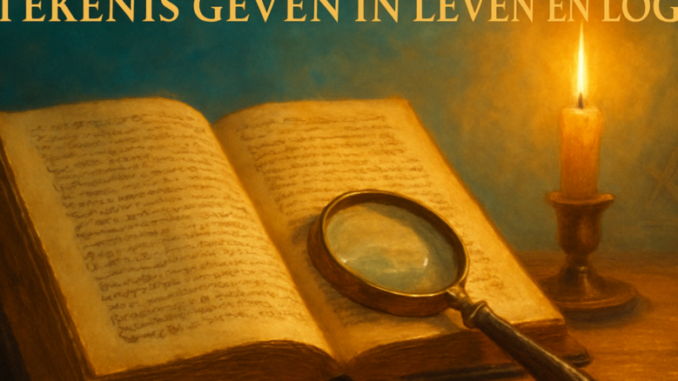
In 1784, Immanuel Kant penned his famous essay on the meaning of Enlightenment. His answer was simple yet profound: it is the capacity to think for oneself, to refuse to accept the world at face value and instead seek to understand it actively. What Kant described touches on something essential — the art of interpretation, or the process of giving meaning to what we experience and observe. Both in our everyday lives and within the walls of a Masonic lodge, this act of interpretation plays a central role, though it takes on distinctly different forms in each setting.
What Interpretation Really Means
Interpretation is the process through which we transform raw experiences, facts, and observations into something comprehensible and meaningful. It goes far beyond mere explanation. When we interpret, we connect what we perceive with our own values, our life history, and our worldview. The Greek philosopher Aristotle spoke about the necessity of knowing not only what something is, but also why it matters. Interpretation, then, is an active endeavor — it demands reflection and a willingness to pause at what often seems self-evident.
In daily life, we interpret constantly, often without realizing it. A glance from a colleague, an unexpected turn in the news, a chance encounter — we are always trying to understand what these events mean to us. Sometimes we do this intuitively, sometimes deliberately. The quality of our interpretation largely determines how we relate to the world around us.
Interpretation in Everyday Life
Outside the context of ritual and tradition, interpretation is primarily a personal affair. We make sense of things through the lens of our own background, education, and experience. An economist will read a news report on unemployment figures differently than an artist, and a parent will approach a children’s story with different eyes than someone without children. This multiplicity of perspectives makes life rich, but it also brings challenges.
In our modern society, we are inundated with information that demands interpretation. Social media, news outlets, and personal networks deliver a constant stream of impressions. The French philosopher Michel de Montaigne wrote extensively in his essays about the importance of critical self-reflection when processing knowledge. He warned against uncritically adopting the opinions of others and emphasized that true wisdom comes from thinking through what we encounter for ourselves.
Those who interpret well learn not only about the world, but above all about themselves.
A Different Approach Within the Lodge
Where interpretation in everyday life tends to be individual and spontaneous, within Freemasonry it takes on a more structured and communal dimension. The lodge offers a unique environment in which interpretation is not only encouraged but also guided by centuries-old rituals and symbols. Here, personal reflection does not stand alone — it is placed within a tradition stretching back to the medieval builders’ guilds and the Enlightenment philosophers of the eighteenth century.
Symbols such as the compasses, the square, and the rough ashlar all call for interpretation. They carry no fixed meaning imposed from outside. Instead, they invite each Freemason to discover a personal significance, in dialogue with the broader tradition. Johann Wolfgang von Goethe, himself a Freemason, described this process as a continuous search for truth that can never be fully concluded. The ritual acts as a mirror in which participants can contemplate themselves and their place in the world.
What Both Worlds Share
Despite their differences in form and context, everyday interpretation and Masonic interpretation share a common core. In both cases, the aim is to actively seek meaning — to refuse to settle for superficial explanations. Whether in the lodge or outside it, interpretation requires honesty with oneself and a willingness to examine assumptions and revise them when necessary.
Both demand reflection and a pause to consider what has been observed. Both recognize that meaning does not come from the outside but must be discovered from within. And both treat interpretation as an ongoing process rather than a one-time conclusion.
The key difference lies in guidance and community. In everyday life, we often face the task of meaning-making alone, while the lodge offers a brotherhood in which interpretation can be shared and deepened. This does not make the Masonic approach superior — but it does make it different. It shows that there are multiple paths to meaning.
What We Can Learn
The question of what interpretation means is ultimately a question about how we stand in life as human beings. Whether or not we are Freemasons, the invitation is the same: take the time to understand what you experience. Do not be swept along by the noise of the moment, but pause to consider what is truly of value. The philosopher Baruch Spinoza emphasized that true freedom comes from understanding — from seeing through the causes behind our experiences and emotions.
In a world that seems to spin faster every day, the art of interpretation may be more important than ever. It offers a counterbalance to the superficiality of the moment, an anchor in the storms of information and opinion. Whether you reflect alone or in the circle of a lodge, the search for meaning is what makes us human.
Interpretation is not a luxury — it is a necessity for anyone who wishes to live consciously. It connects us to the philosophical tradition of thinkers like Aristotle, Montaigne, and Spinoza, and it lies at the very heart of Masonic practice. By actively giving meaning to what we experience, we transform passive observation into active wisdom. And so we build, stone by stone, a life that is not only lived but truly understood.
Copyright text & image: devrijmetselaar.nl
Texts are based on the ideas and content of the author of devrijmetselaar.nl, reviewed, corrected, and supplemented with the assistance of OpenAI. Images are created based on the ideas of the author of devrijmetselaar.nl using OpenAI/DALL-E.
Frequently Asked Questions
What is the connection between Kant's idea of Enlightenment and Freemasonry?
Kant believed Enlightenment was the capacity to think for oneself rather than accept the world at face value. Freemasonry embodies this principle by encouraging members to actively interpret and understand their experiences within a framework of centuries-old wisdom and symbols. The Lodge provides a structured environment where personal reflection is guided by tradition, helping members develop their own meaningful understanding of life.
How is interpretation different in a Masonic lodge compared to everyday life?
In everyday life, interpretation is primarily personal and spontaneous, filtered through individual backgrounds and experiences. Within Freemasonry, interpretation becomes a guided, communal practice where personal reflection is enriched by ritual, symbols, and a tradition spanning centuries. This structured approach helps members move beyond individual perspectives to discover deeper, shared meanings.
Why does Freemasonry emphasize the importance of thinking for oneself?
Freemasonry values critical thinking because true understanding requires active engagement with ideas rather than passive acceptance. By encouraging members to interpret symbols and teachings through their own reflection, the Lodge fosters genuine wisdom and personal growth. This approach aligns with the Enlightenment principle that authentic knowledge comes from thinking through what we encounter for ourselves.
Can people with different backgrounds interpret Masonic teachings differently?
Yes, and this diversity is one of Freemasonry's strengths. Like in everyday life, members bring their own values, experiences, and perspectives to their interpretation of Masonic symbols and rituals. The Lodge's communal environment allows these varied interpretations to enrich the collective understanding while maintaining the essential truths embedded in Masonic tradition.
What does it mean to interpret well, according to the article?
Interpreting well means engaging in active reflection rather than accepting things at face value, as Montaigne and Kant emphasized. Those who interpret well learn not only about the world but also about themselves, developing deeper self-awareness and wisdom. In Freemasonry, this process is supported by guided rituals and symbols that facilitate meaningful personal and communal understanding.

Be the first to comment