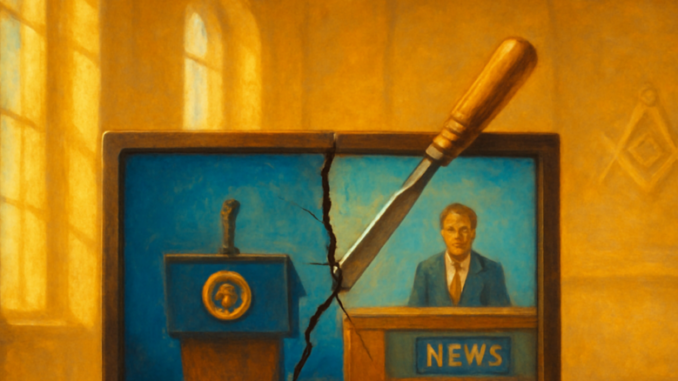
When major broadcasters decide to stop giving a head of state an unfiltered platform, we witness more than a political standoff. We see a clash of personalities — characters who cannot or will not tolerate each other. For the casual observer, it is spectacle, news that fades from memory within days. But for those willing to look deeper, a timeless question unfolds: what makes a person who they are, and how do we engage with others whose character fundamentally differs from our own?
The Perspective of the Spectator
For the average news consumer, the ongoing media conflict in the United States is primarily a matter of picking sides. People see two camps: the networks that refuse to broadcast certain statements without commentary, and a president who feels censored as a result. Personalities are reduced to caricatures. One is arrogant, the other cowardly. Judgments come quickly, are forgotten even faster, and life moves on.
This perspective is understandable, but it is shallow. It reduces complex human beings to labels and, in doing so, misses the deeper question lurking beneath every conflict: why do people act the way they do? What drives someone to seek confrontation, and what compels another to draw a line? The spectator sees the stage but remains blind to what unfolds behind the curtains — in the souls of the players themselves.
The Perspective of the Freemason
The Freemason approaches the same conflict from an entirely different angle. Central to the Masonic tradition is the working of the rough ashlar — the ongoing labor of refining one’s own character. When a Freemason looks at this media standoff, he does not primarily see right and wrong. He sees unworked stones colliding. He asks: what inner forces are at play here? Which virtues are absent, and which might be quietly present but hidden from view?
The eighteenth-century philosopher Immanuel Kant, whose ideas on autonomy and duty resonate deeply within Masonic thought, wrote about the importance of developing a consistent character. A person of true character does not act out of caprice or self-interest alone, but from principles carefully considered and deliberately chosen. The Freemason recognizes in every public conflict the presence or absence of such inner principles.
What Both Perspectives Share
Despite their differences, the spectator and the Freemason share a fundamental experience: both are touched by the question of authenticity. Is what we see real, or is it a mask? The Roman philosopher-emperor Marcus Aurelius warned in his Meditations of the danger of wearing masks. He wrote that a person who constantly plays a role eventually forgets who he truly is.
Personality is not what a person shows the world — it is what remains when all masks have been removed.
This insight connects both perspectives. Whether one judges from the comfort of an armchair or reflects within the walls of a lodge, the core question remains the same: are we dealing with authentic personalities or constructed personas? And perhaps more importantly — how honest are we about our own masks?
Conflict as a Mirror
Every major public conflict functions as a mirror. The way we react to the clash between media and power reveals as much about ourselves as it does about those involved. The French essayist Michel de Montaigne, whose work on friendship and self-knowledge is explored elsewhere on this site, understood this better than most. He wrote that we often reject in others what we refuse to acknowledge in ourselves.
For the Freemason, this mirror is not a source of judgment but of self-examination. When he feels irritation at the behavior of a public figure, he asks himself: where does this irritation come from? What part of me is being touched? This is not an idle philosophical exercise — it is practical work on one’s own personality, carried out with the same discipline one brings to the craft.
Lessons for Everyday Life
What can we take away from these two perspectives? First, that hasty judgment rarely yields wisdom. The spectator who believes he understands everything after reading a headline misses the nuance that makes human character so endlessly complex. Second, that every conflict is an invitation to self-reflection. The Freemason who imagines himself above the fray forgets that he is part of the same human condition.
The spectator learns to judge more slowly and look more deeply. The Freemason is reminded of his own imperfection. Both discover that personality is not static — it is perpetually in development.
The eighteenth-century poet Johann Wolfgang von Goethe, himself a Freemason, wrote that character is formed in the stream of the world. We do not discover who we are in isolation, but in the friction of engaging with others. The current media conflict, however unpleasant it may be, offers — when viewed through this lens — an opportunity for growth, provided we are willing to look into the mirror it holds before us.
Whether we watch as curious outsiders or as seeking Freemasons, the conflict between media and power confronts us with fundamental questions about personality. It is not the question of who is right that deserves our attention, but the question of what all this teaches us about human character — including our own. In that shift from judgment to self-reflection lies perhaps the greatest wisdom we can distill from these turbulent times.
Copyright text & image: devrijmetselaar.nl
Texts are based on the ideas and content of the author of devrijmetselaar.nl, reviewed, corrected, and supplemented with the assistance of OpenAI. Images are created based on the ideas of the author of devrijmetselaar.nl using OpenAI/DALL-E.
Frequently Asked Questions
What is the main difference between how spectators and Freemasons view media conflicts?
Spectators tend to view media conflicts as a simple matter of picking sides, reducing complex figures to caricatures and quickly forgetting about the issue. Freemasons, by contrast, approach the same conflict by examining the inner character of those involved, asking what principles and virtues are present or absent, drawing on the Masonic practice of refining one's own character through the working of the rough ashlar.
How does Freemasonry relate to character development?
Central to Freemasonry is the concept of the rough ashlar — the ongoing labor of refining and improving one's own character. Freemasons believe in developing consistent character through carefully considered and deliberately chosen principles, influenced by philosophical ideas about autonomy and duty rather than acting out of caprice or self-interest.
What is the deeper question beneath media conflicts according to this article?
Beyond the surface-level political standoff lies a timeless question about authenticity and human nature: what makes a person who they are, and how do we engage with others whose character fundamentally differs from our own? Both spectators and Freemasons grapple with whether what we see in public figures is genuine or merely a mask.

Be the first to comment