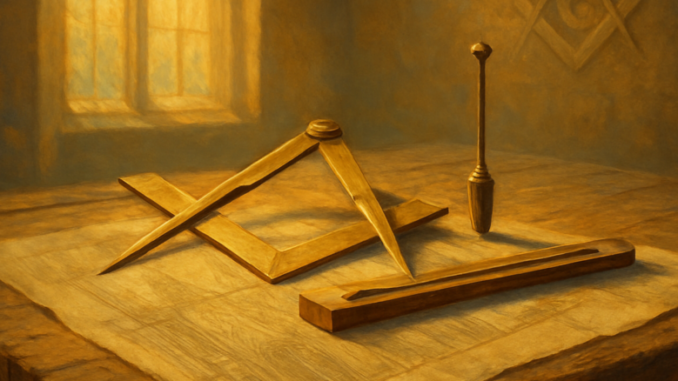
Freemasonry is one of the world’s oldest and most widely recognized fraternal organizations, and at the heart of its tradition lies a rich and carefully constructed system of symbols. These symbols serve as a universal language within the brotherhood — communicating moral teachings, philosophical principles, and historical continuity across cultures and centuries. Understanding freemasonry symbols meaning requires more than a passing glance; it demands an appreciation of their historical roots, their layered interpretations, and the context in which they are used. From the stonemason’s working tools to celestial imagery and architectural motifs, Masonic symbolism offers a fascinating window into the values and worldview of the Craft.
Historical Background of Masonic Symbolism
The origins of Freemasonry as a formal institution are generally traced to the early eighteenth century, when the first Grand Lodge was established in London in 1717. However, the symbolic vocabulary of Freemasonry draws from a much deeper well — one that includes the traditions of operative stonemasons from the medieval guilds of Europe, the philosophical currents of the Renaissance, Hermetic and Neoplatonic thought, and the rich allegorical traditions of the ancient world.
Medieval stonemasons — the “operative” masons who built cathedrals, castles, and civic structures — used tools such as the square, compass, level, and plumb rule in their daily work. When Freemasonry transitioned from operative to “speculative” masonry in the seventeenth and eighteenth centuries, these practical instruments were retained but transformed into moral and philosophical metaphors. Rather than measuring stone, the square would henceforth measure a man’s conduct; rather than drawing architectural arcs, the compass would define the limits of desire and ambition.
Figures such as Elias Ashmole, the antiquarian and early documented Freemason initiated in 1646, helped shape the speculative and philosophical dimension of the fraternity. The Enlightenment thinkers who embraced Freemasonry — including figures like Voltaire, Benjamin Franklin, and later Goethe — were drawn in part by its symbolic architecture, seeing in it a language capable of expressing universal truths that transcended religious and national divisions.
The symbolic system was further codified and elaborated in the nineteenth century. Masonic scholars such as Albert Pike, whose monumental work Morals and Dogma (1871) remains one of the most detailed explorations of Masonic symbolism, and Albert Mackey, whose Encyclopaedia of Freemasonry became a standard reference, gave formal structure to the meanings attributed to Masonic symbols. Their writings made clear that these symbols were not arbitrary decorations but intentional vehicles of philosophical and moral instruction.
The Core Symbols of Freemasonry and Their Meanings
The catalog of symbols used within Freemasonry is extensive, but several stand out as foundational — recognized by Masons across all jurisdictions and understood as central to the teachings of the Craft.
The Square and Compasses
Perhaps the most universally recognized of all freemasonry symbols, the square and compasses (often depicted with the letter “G” at their center) form the emblem most closely associated with the fraternity. Separately, each tool carries its own significance. Together, they represent a synthesis of moral and intellectual virtue.
The square is the symbol of morality. In practical stonemasonry, the square ensures that corners are true and angles are correct — that the work is done with precision and integrity. In speculative Freemasonry, the square represents the necessity of living a morally upright life, of acting with fairness, honesty, and accountability in all relationships. When a Mason is said to be “on the square,” it is a statement about his character.
The compasses represent the ability to circumscribe — to set limits and boundaries. In philosophical terms, they symbolize the importance of keeping one’s passions and desires within due bounds. Where the square governs the relationship between a man and his fellow human beings, the compasses govern the relationship between a man and himself. Together, they suggest a balance between social virtue and personal discipline.
The letter “G” that commonly appears between the square and compasses is generally interpreted as standing for both “Geometry” — the foundational science of the ancient builders — and “God” or “the Great Architect of the Universe,” the non-denominational supreme principle recognized in Masonic tradition. This dual meaning reflects Freemasonry’s characteristic layering of the practical and the spiritual.
The All-Seeing Eye
The all-seeing eye, also called the Eye of Providence, is one of the most recognized and sometimes misunderstood of all freemasonry symbols. Within the Masonic tradition, it represents the omniscient gaze of the Great Architect of the Universe — the idea that a supreme intelligence observes all human actions, including those performed in secret. It is, at its core, a symbol of divine watchfulness and moral accountability.
The symbol predates Freemasonry and can be found in ancient Egyptian iconography, particularly in the Eye of Horus, as well as in Christian religious art where it represented the Trinity. In Masonic usage, it was incorporated into lodge décor and ritual contexts during the eighteenth century. It appears famously on the reverse of the Great Seal of the United States, a design finalized in 1782, though its inclusion there was the work of Charles Thomson and William Barton — not Freemasons — and its connection to the fraternity is more cultural association than direct influence.
Within the lodge, the all-seeing eye serves as a reminder that virtue must be practiced consistently, not only when observed by others. It encourages the Mason to internalize ethical principles rather than performing them superficially.
The Rough and Perfect Ashlars
Two contrasting stones — the rough ashlar and the perfect ashlar — form a pairing of symbols that is central to the teaching of the First and Second Degrees of Craft Freemasonry. An ashlar is simply a stone: in operative masonry, rough ashlars were raw stones just removed from the quarry, while perfect ashlars had been smoothed and dressed for use in building.
In speculative Freemasonry, the rough ashlar represents the initiate in his natural, uninstructed state — full of potential but unpolished. The perfect ashlar represents the ideal toward which every Mason strives: a person refined by education, reflection, moral effort, and brotherly guidance. The journey from one to the other is the essential metaphor of the Masonic path. The working tools — the gavel, the chisel, and others — are the instruments by which this transformation is accomplished.
The Pillars: Boaz and Jachin
Two pillars, named Boaz and Jachin, hold a prominent place in Masonic symbolism and lodge architecture. Their names are drawn from the Hebrew Bible (1 Kings 7:21), where they are described as the two great pillars that stood at the entrance of Solomon’s Temple in Jerusalem — the architectural centerpiece of Masonic legend and allegory.
“Boaz” is generally translated as meaning “in strength” or “strength,” while “Jachin” is understood to mean “he will establish” or “steadfastness.” Together, they represent the dual principles of strength and establishment — the qualities necessary to build anything enduring, whether a physical structure or a virtuous life.
In the lodge room, these pillars flank the entrance and serve as reminders of the temple from which Masonic legend derives its most powerful narratives, particularly the story of Hiram Abiff, the master architect whose dedication to integrity and knowledge forms the dramatic heart of the Third Degree ritual.
The Trowel
Among the working tools of Freemasonry, the trowel is particularly significant as a symbol of brotherhood and unity. Used by operative masons to spread cement and bind stones together, it symbolizes in the speculative tradition the act of spreading brotherly love — the “cement” that holds the fraternal community together. The trowel represents the Mason’s commitment to building connections with his fellow brothers, to smoothing over differences, and to reinforcing the bonds of the fraternity.
The Level and the Plumb Rule
The level teaches equality. In operative masonry, it ensures that surfaces are horizontal and true. In the moral allegory of the Craft, it reminds Masons that all members stand on equal footing within the lodge — regardless of rank, wealth, or social position. The Masonic lodge has historically been a space in which a nobleman and a commoner could meet on equal terms, united by shared principles rather than social hierarchy.
The plumb rule, which ensures that vertical lines are true, represents integrity and uprightness of conduct — specifically, the virtues of justice and moral rectitude. Together, the level and the plumb rule form a complementary pair: the one governing horizontal equality, the other governing vertical principle.
Celestial and Architectural Symbolism
Beyond the working tools, Freemasonry employs a rich vocabulary of celestial and architectural imagery, reflecting both its philosophical heritage and the influence of Enlightenment rationalism.
The Sun and the Moon
The sun and the moon are prominent fixtures in Masonic symbolism, often represented in lodge décor and ritual contexts. The sun, as the source of light and life, represents the active, illuminating principle — often associated with reason, knowledge, and divine truth. The moon, which reflects the sun’s light, represents the receptive principle and the constancy of cyclical change.
In a lodge, the sun and moon are associated with specific officers — the Junior and Senior Wardens — who symbolically govern the day’s labor and rest. More broadly, these celestial bodies reinforce the Masonic emphasis on light as a metaphor for enlightenment, wisdom, and the gradual acquisition of knowledge.
The Mosaic Pavement
The floor of a traditional Masonic lodge is decorated with a black-and-white checkered pattern known as the mosaic pavement. This alternating pattern of light and dark squares represents the duality inherent in human existence — the interplay of good and evil, joy and sorrow, light and shadow. Rather than a pessimistic vision, it is an acknowledgment that life contains both, and that wisdom lies in navigating these contrasts with equanimity and moral clarity.
The Acacia
The acacia tree holds deep symbolic meaning within Freemasonry, particularly in connection with the Third Degree and the legend of Hiram Abiff. According to Masonic tradition, an acacia sprig was placed at the grave of the murdered master builder, and it later served as the sign by which his resting place was found. The acacia thus symbolizes immortality, the endurance of the soul, and the hope of resurrection or renewal — themes that echo across many of the world’s religious and philosophical traditions.
The Symbolic Journey Through the Degrees
It is important to understand that Masonic symbols are not static decorations but dynamic elements in a structured educational journey. The three degrees of Craft Freemasonry — Entered Apprentice, Fellow Craft, and Master Mason — each introduce the candidate to a set of symbols appropriate to that stage of instruction. The symbols build upon one another, creating a cumulative vocabulary of moral and philosophical meaning.
As an Entered Apprentice, the candidate is introduced to the rough ashlar, the 24-inch gauge, and the common gavel — tools that speak to the beginning of the journey of self-improvement. As a Fellow Craft, deeper symbols related to geometry, the liberal arts, and the architecture of Solomon’s Temple are introduced. The Master Mason degree presents the most profound and emotionally resonant symbols, particularly those surrounding the legend of Hiram Abiff and the themes of mortality, integrity, and spiritual hope.
Higher degrees — such as those conferred in the Scottish Rite and the York Rite — extend this symbolic vocabulary further, drawing on additional allegorical narratives from biblical history, chivalric tradition, and Hermetic philosophy.
Symbolism as a Universal Language
One of the most remarkable features of Masonic symbolism is its intentional universality. The founding principle that Freemasonry should be open to men of all faiths — requiring only a belief in a Supreme Being and not adherence to any specific creed — meant that its symbolic language needed to transcend particular religious traditions while still speaking to the deepest human concerns.
The use of architectural metaphor was particularly well suited to this purpose. Building — the act of creating something structured, durable, and beautiful from raw material — is a universal human activity with obvious moral and spiritual resonance. The great Masonic scholar Albert Pike wrote that “Masonry, around whose altars the Christian, the Hebrew, the Moslem, the Brahmin, the followers of Confucius and Zoroaster, can assemble as brethren and unite in prayer,” captures this aspiration. The symbols, rather than the words of any particular scripture, create the shared space in which this gathering is possible.
This symbolic universality has also meant that Masonic imagery has permeated the broader culture in ways both recognized and unrecognized. Architects, artists, composers, and writers who were Freemasons — including Mozart, whose opera The Magic Flute is rich with Masonic symbolism — incorporated elements of the Craft’s imagery into their work, embedding Masonic meaning in the broader cultural fabric.
Frequently Asked Questions
What is the most important symbol in Freemasonry?
While all Masonic symbols carry significance within their context, the square and compasses are most widely recognized as the central emblem of Freemasonry. Together, they encapsulate the moral and philosophical core of the Craft: living uprightly in relation to others (the square) and keeping one’s own passions within proper limits (the compasses). The letter “G” at their center adds the dimensions of geometry and the divine, completing a symbol of remarkable depth and economy.
Is the all-seeing eye a Masonic symbol?
The all-seeing eye has been adopted within Freemasonry as a symbol of the Great Architect of the Universe — the divine intelligence that observes all human actions. However, it is not exclusively Masonic in origin; it appears in ancient Egyptian, Christian, and other traditions. Its appearance on the reverse of the U.S. dollar bill is often associated with Freemasonry in popular culture, though its inclusion on the Great Seal of the United States was not directly the work of Masonic designers.
Do Masonic symbols have different meanings in different degrees?
Yes. One of the defining features of Masonic symbolism is that many symbols are introduced with a basic meaning in the early degrees and then revisited with deeper or more nuanced interpretations as the Mason progresses. The rough and perfect ashlars, for instance, have an immediate pedagogical meaning in the First Degree but resonate more profoundly as the Mason reflects on them over a lifetime in the Craft. This layered quality is intentional — symbols are meant to grow with the Mason.
Why does Freemasonry use symbols rather than direct instruction?
Freemasonry’s preference for symbolic and allegorical instruction reflects a deeply held philosophical conviction: that truths grasped through reflection and personal discovery are more fully understood and more lastingly held than those simply stated outright. This Socratic approach to moral education — leading the student to insight through imagery, narrative, and contemplation — was particularly appealing to Enlightenment thinkers who valued reason and intellectual engagement. Symbols also serve as a universal language, communicating across linguistic and cultural boundaries.
Are Masonic symbols secret?
The symbols of Freemasonry are largely not secret in the modern era. Many have been extensively published and discussed in books, encyclopedias, and online resources. What has traditionally been guarded are not the symbols themselves but the specific ritual contexts in which they are presented and their particular application within the degrees. The emphasis on discovery — on the candidate encountering symbols in a specific order and context — is part of their educational power. Modern Freemasonry is generally transparent about its symbolism while preserving the integrity of its ritual experience.
Frequently Asked Questions
What is the meaning behind the Square and Compass symbol in Freemasonry?
The Square and Compass are foundational Masonic symbols derived from the working tools of medieval stonemasons. In speculative Freemasonry, the Square represents morality and the measurement of one's conduct, while the Compass symbolizes the need to set limits on desires and ambitions. Together, they express the Masonic principle of balancing freedom with responsibility in pursuit of self-improvement.
Why does Freemasonry use so many symbols?
Freemasonry employs an extensive symbolic system because symbols serve as a universal language that communicates moral teachings and philosophical principles across cultures and centuries. This symbolic approach allows Masons to express complex ideas about ethics, personal growth, and universal truths in a way that transcends language barriers and connects the fraternity to its deep historical roots.
How did Masonic symbols develop from medieval stonemasons to modern Freemasonry?
During the transition from operative masonry (practical stonework) to speculative masonry in the seventeenth and eighteenth centuries, the tools and practices of medieval craftsmen were reimagined as moral and philosophical metaphors. What were once practical instruments for building became vehicles for teaching character development and spiritual insight, preserving the fraternity's connection to its noble architectural heritage.
Are Masonic symbols based on ancient or occult traditions?
Masonic symbolism draws inspiration from multiple legitimate historical and philosophical sources, including medieval guild traditions, Renaissance philosophy, and ancient allegorical teachings. Rather than being secretive or sinister, these symbols represent an intentional effort to express universal truths and moral principles through a carefully constructed system of instruction that has been documented and explained by Masonic scholars for centuries.
What role did Enlightenment thinkers play in shaping Masonic symbolism?
Enlightenment philosophers such as Voltaire, Benjamin Franklin, and Goethe were attracted to Freemasonry precisely because its symbolic architecture offered a language capable of expressing universal truths that transcended religious and national divisions. Their participation helped elevate and formalize the symbolic system, establishing Freemasonry as a vehicle for philosophical inquiry and the advancement of human knowledge during a transformative period in intellectual history.
Be the first to comment