You know the moment. A family dinner, a meeting at work, a conversation with friends. Someone brings up a loaded topic, and suddenly the tension is palpable. How do you respond? Do you get swept up in the emotion, withdraw entirely, or look for a third way? The deep divisions currently visible in political movements around the world show just how sharply disagreements can cut. But it’s precisely in moments like these that we have the opportunity to reveal our true character. Freemasonry offers concrete, practical tools for staying grounded when division swirls around you.
When Convictions Collide
Picture this: you’re sitting with a group of people you respect. Maybe colleagues, maybe brethren in your lodge, maybe old friends. A discussion erupts over a sensitive subject. You notice your heart rate climbing. You feel the urge to raise your voice — or to say nothing at all. This is the moment when your personality is truly tested. It’s not your opinion that defines who you are, but how you express it and how you treat those who see things differently.
Current tensions within political movements worldwide illustrate just how difficult this is. People who worked side by side for years find themselves divided. Friendships cool. Families drift apart. It’s a pattern that has repeated itself throughout history. The philosopher Aristotle wrote about the importance of phronesis — practical wisdom — in precisely these situations. The point is not to be right; the point is to act well.
The Masonic Lodge as a Training Ground
Freemasonry follows a remarkable rule: within the lodge, discussions of politics and religion are off the table. This isn’t weakness or avoidance — it’s deliberate wisdom. The lodge is a space where people from every background come together to work on themselves. By keeping the most divisive topics outside the door, room opens up for something else entirely: practicing brotherhood with people who may think fundamentally differently than you do.
This principle can be applied well beyond the lodge. It doesn’t mean you should never talk about difficult subjects. It means you choose consciously when and how you do so — and crucially, with whom. Voltaire, whose ideas are deeply intertwined with the Enlightenment values that helped shape Freemasonry, stressed the importance of tolerance, even when someone else’s views are deeply unsettling to you.
Four Practical Steps for Moments of Tension
How do you translate these principles into everyday life? Here are four actions you can apply immediately when you notice a conversation getting heated:
1. Pause deliberately. Take three seconds before you respond. This gives your brain the chance to shift from reaction to reflection. You prevent yourself from saying something you’ll regret.
2. Ask a question instead of making a statement. Ask the other person why this topic matters so much to them. You don’t have to agree, but you show respect for the person behind the opinion.
3. Name what you share. Even in the fiercest disagreement, there is often a common concern: safety, justice, care for others. By naming that shared ground, you build a bridge.
4. Know your limits. You don’t have to engage in every debate. It’s mature — not cowardly — to say: “I’d rather not discuss this right now.” That’s not avoidance; it’s self-awareness.
The Rough Ashlar in Times of Division
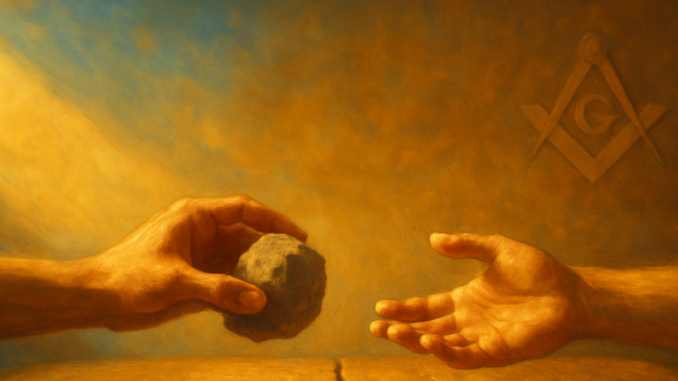
In Freemasonry, we work with the symbol of the rough ashlar — the unfinished stone that we polish into a perfect cube. This is not a one-time act but the work of a lifetime. It’s precisely in moments of division and tension that the rough edges of our personality become visible. The impulse to judge, the need to be proven right, the fear of being excluded for thinking differently — these are the places where the real work lies.
The goal was never for all of us to think alike. The goal is to treat one another with respect despite our differences.
Marcus Aurelius, the Stoic emperor whose Meditations are still widely read today, wrote that we have no control over what others do or think — only over our own responses. This insight is as relevant now as it was two thousand years ago. When you see division around you — in politics, in your community, or even in your own mind — that’s the moment to ask yourself: who do I want to be in this situation?
An Invitation to Self-Reflection
In the coming days, you will inevitably encounter situations where opinions clash. Maybe in a news article you read, maybe in a conversation. Use those moments as practice. Notice what happens inside you. What emotions rise to the surface? What thoughts? And then: consciously choose how you respond. Not because you need to be perfect, but because every choice is an opportunity to move closer to the person you want to become.
Division is as old as humanity and will never disappear — nor does it need to. The question is not how we eliminate disagreement, but how we conduct ourselves in the midst of it. Freemasonry teaches us that personal growth doesn’t happen under perfect conditions; it happens in the friction of daily life. The tension you feel when opinions collide isn’t something to avoid. It’s the whetstone on which your character is shaped. So step into the coming week with intention, armed with the knowledge that every interaction is a chance to build a stronger, wiser version of yourself.
Copyright text & image: devrijmetselaar.nl
Texts are based on the ideas and content of the author of devrijmetselaar.nl, reviewed, corrected, and supplemented with the assistance of OpenAI. Images are created based on the ideas of the author of devrijmetselaar.nl using OpenAI/DALL-E.
Frequently Asked Questions
Does Freemasonry ban all discussions about politics and religion?
Freemasonry doesn't ban these discussions entirely—rather, the lodge maintains a rule against discussing them within lodge meetings. This creates a dedicated space where members from diverse backgrounds can practice brotherhood and mutual respect regardless of their personal beliefs. Members are free to discuss these topics elsewhere, but the lodge itself remains a neutral ground for personal development.
How can Masonic principles help me handle disagreements with family and friends?
Freemasonry teaches practical wisdom (phronesis) through its emphasis on character and how you treat others, rather than whether you're right. The four practical steps outlined—pausing before responding, asking questions to understand others' perspectives, and finding common ground—are tools any person can use to transform heated conversations into respectful dialogue that strengthens relationships.
What does Freemasonry teach about tolerance toward people with different beliefs?
Freemasonry is rooted in Enlightenment values that emphasize tolerance and respect for people with different viewpoints. The fraternity brings together men from every background and belief system, teaching that brotherhood transcends disagreement. This principle reflects the philosophy of thinkers like Voltaire, who stressed the importance of respecting others even when their views deeply differ from your own.
Can Masonic lessons about character really apply to everyday situations?
Absolutely. The article demonstrates how Masonic principles translate directly to family dinners, workplace meetings, and conversations with friends. By practicing these skills within the lodge, Masons develop the character and practical wisdom needed to handle division gracefully in all areas of life, turning moments of tension into opportunities to reveal who they truly are.


Be the first to comment