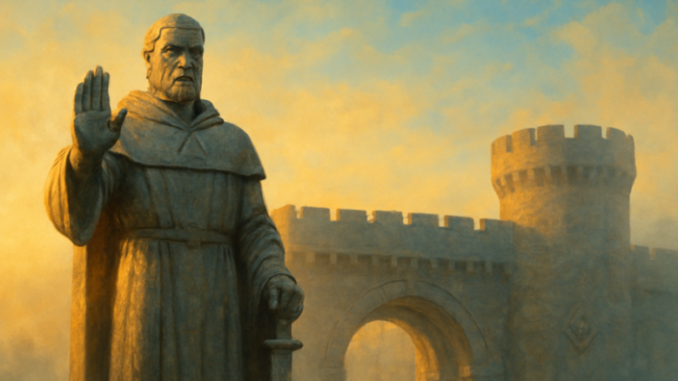
Recently, a man was arrested at a military airbase in the Netherlands after shouting that he was carrying a bomb. It turned out to be a false alarm — but the consequences were very real: evacuations, widespread fear, and criminal charges. This incident raises a timeless question that philosophers and Freemasons have grappled with for centuries: what is the ethical responsibility we bear for the words we speak?
The Heavy Burden of Careless Words
In 1651, the English philosopher Thomas Hobbes published his Leviathan, arguing that words form the very foundation upon which the social contract rests. Without reliable communication, he maintained, society descends into chaos. A false statement about danger doesn’t merely erode trust between individuals — it undermines the entire structure that protects us all. Hobbes understood something we too often forget: words are not idle sounds. They are acts with consequences.
More than a century later, Immanuel Kant would develop this insight further through his categorical imperative. Act only according to that maxim by which you can at the same time will that it should become a universal law, he wrote. Applied to this incident: what if everyone freely uttered false threats? The world would become unlivable. It is precisely this line of reasoning that reveals the gravity of such statements.
Freemasonry and the Duty of Truthfulness
Within Freemasonry, the ethics of the spoken word holds a special place. Since the founding of the first Grand Lodge in London in 1717 — under the guidance of figures such as James Anderson and Jean Théophile Désaguliers — the principle of sincerity has been central to the Craft. A Freemason pledges at his initiation to speak the truth and to choose his words with care. This is no arbitrary tradition. It reflects a deeply held conviction that language is the tool with which we build or destroy the temple of society.
Every word we speak is a stone we lay: it can strengthen the temple or cause it to collapse.
The ancient rituals remind brethren to guard their tongues as a sentinel guards his post. This principle dates from an era when a man’s word was his only guarantee. Contracts were sealed by a handshake, and promises were sacred. The recent incident at the Dutch airbase demonstrates that this ancient wisdom has lost none of its relevance.
From Aristotle to the Airbase
As far back as the fourth century B.C., Aristotle examined the virtue of truthfulness in his Nicomachean Ethics. He positioned it between two extremes: the boaster who exaggerates and the self-deprecator who understates. The truthful person, Aristotle argued, speaks the truth because it is right — not because it is easy or advantageous. A false bomb threat fits none of these categories. It is a form of speech entirely detached from ethical consideration.
The Stoic philosopher Marcus Aurelius would likely observe that such words spring from a disordered mind. For him, self-mastery was the key to a virtuous life. He who does not control his words does not control himself. And he who does not control himself cannot be a constructive member of the community.
The Responsibility of the Speaker
This incident illustrates a fundamental principle that both philosophy and Freemasonry underscore: to speak is to act. The man who claimed to have a bomb set an entire chain of events in motion. Security personnel were forced to respond, emergency protocols were activated, and people experienced genuine fear — all because of a few words.
In the eighteenth century, Voltaire emphasized the importance of responsible citizenship. Though he became famous for his defense of free expression, he was keenly aware of its other side. Freedom brings responsibility. The right to speak implies the duty to speak carefully. This balance between liberty and responsibility lies at the heart of Enlightenment ethics — and it remains just as vital today.
Lessons for the Present Day
What can we, in 2026, learn from this incident and the historical wisdom that applies to it? First, that words have power. In an age of social media and instantaneous communication, this truth is more urgent than ever. What we say — whether digitally or in person — carries consequences that reach far beyond what we often realize.
Second, this event reminds us of the Masonic virtue of reflection before speech. In the lodge, brethren are taught to think first, then speak. This sequence is not a mere formality — it is an approach to life. It is an exercise in self-discipline that elevates the quality of every interaction we have.
Consider the consequences of your words before you speak. Ask yourself: would I want everyone to act this way? Treat your word as a binding promise. Recognize that speaking is itself a form of action.
Freemasonry does not offer ready-made answers to complex ethical questions. What it does offer is a framework for reflection — a space where men of all backgrounds come together to contemplate their place in the world and their responsibility toward others. This recent incident is a modern reminder of an ancient truth: our words shape the world in which we live.
The arrest at the Dutch airbase may seem like an isolated incident, but it touches on fundamental questions about human responsibility. From Aristotle to the Enlightenment philosophers, from Thomas Hobbes to the rituals of Freemasonry, the wisdom of the ages speaks with one voice. Words are not idle utterances — they are the building blocks of our shared reality. Let this event remind us of the duty that each of us carries: the duty to speak with care, with truth, and with respect for the community of which we are a part.
Copyright text & image: devrijmetselaar.nl
Texts are based on the ideas and content of the author of devrijmetselaar.nl, reviewed, corrected, and supplemented with the assistance of OpenAI. Images are created based on the ideas of the author of devrijmetselaar.nl using OpenAI/DALL-E.



Be the first to comment