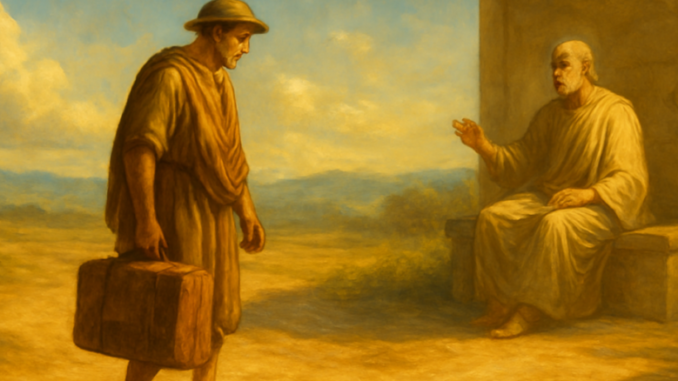
Why do we sometimes feel compelled to leave, even when we know deep down that no destination will change a thing? Lucius Annaeus Seneca posed this very question nearly two thousand years ago in his twenty-eighth letter to Lucilius. His answer strikes at the heart of Stoic philosophy and echoes a wisdom that also runs through the traditions of Freemasonry: the inward journey is the only journey that truly matters.
What Was Seneca Really Saying in Letter XXVIII?
In Letter XXVIII, Seneca addresses his friend Lucilius, who has apparently been traveling from place to place in search of peace of mind. Seneca’s message is unequivocal: you carry yourself wherever you go. The problem does not lie in the place where you happen to be — it lies in the restlessness you bring with you. This is no casual observation. It is rooted deeply in the Stoic tradition that Seneca inherited from his predecessors and refined into a living philosophy.
The Stoics held that external circumstances are inherently neutral. It is our judgment of situations that produces suffering or joy. When someone travels to escape problems, they merely change the scenery — not the inner drama. Seneca reminds Lucilius that Socrates once remarked on the futility of changing countries while the soul remains sick. This echo of Socrates reveals how Seneca was building on an ancient tradition of wisdom that stretches back centuries before his own time.
Which Philosophers Shaped Seneca’s Thinking?
Seneca stood on the shoulders of giants. Zeno of Citium, the founder of the Stoic school, laid the foundation upon which Seneca built. Zeno taught that virtue is the only true good and that external things — wealth, health, location — are ultimately indifferent. Chrysippus, a later head of the Stoic school, systematized these teachings into a coherent philosophical framework. Seneca knew these works intimately and applied them to the daily lives of his Roman contemporaries.
Seneca also drew from the Cynic tradition. Diogenes of Sinope, the famous Cynic who lived in a barrel, demonstrated that happiness depends neither on possessions nor on where you reside. This radical detachment resonates powerfully in Seneca’s argument against travel as escape. Epicurus, too, though from a different school altogether, left his mark on Seneca. Epicurus stressed the value of inner calm — ataraxia — a state that cannot be reached through external change.
He who does not know himself can be at home nowhere, for he carries his restlessness like a shadow.
How Does This Fit the Stoic View of the Soul?
The Stoics regarded the human soul as a part of the universal reason — the logos. This soul possesses the capacity for self-examination and can distinguish between what lies within our power and what does not. Travel falls into the category of externals. Whether you find yourself in Rome or Athens, your rational faculty remains the same. The real question is not where you are, but how you use your mind.
Seneca applies this principle in concrete terms. He suggests that Lucilius should work on his character rather than his travel itinerary. The true philosopher journeys inward, not outward. This inner voyage demands discipline, honesty, and the willingness to face uncomfortable truths. It is far easier to board a ship than to confront your own shortcomings.
What Does This Have to Do with Freemasonry?
In Freemasonry, the journey plays a central symbolic role. The candidate who enters the lodge begins an initiatory journey that is not geographic but spiritual. He moves from darkness toward light, from ignorance toward understanding. This journey is not an escape — it is a deliberate choice to come to know oneself. The symbols of the square and compasses remind the Freemason that he must measure and order his own thoughts and actions.
The rough ashlar that must be shaped into a perfect cube reflects precisely what Seneca describes. The work takes place within yourself, not in your surroundings. No lodge in the world can make you a better person if you are unwilling to pick up the gavel. Just as Seneca warns Lucilius that no journey helps without inner work, Freemasonry teaches that rituals and symbols only gain their power when animated by personal effort and genuine self-reflection.
Why Does This Wisdom Still Matter Today?
In an age when travel is easier than ever, the temptation to fight restlessness with movement is enormous. Flight may look like a solution, but it offers only postponement. Seneca’s letter reminds us that real change begins with standing still. The Stoic tradition — passed down through Seneca to later thinkers like Marcus Aurelius and eventually into the humanist currents that influenced Freemasonry — offers a compass for anyone at risk of losing their way.
The question Seneca raises is timeless: what are you actually looking for? If the answer is inner peace, then the destination cannot be found on any map. The philosophical background of Letter XXVIII reveals a profound connection between Stoic ethics, Socratic self-knowledge, and the symbolic journey that every seeker — Freemason or not — must sooner or later undertake.
Seneca’s twenty-eighth letter is more than a warning against restless travel. It is an invitation to self-examination, rooted in a philosophical tradition that teaches us we must become our own masters. Whether you follow the Stoic path of wisdom or walk the symbolic journey of Freemasonry, the message remains the same: the road to enlightenment begins exactly where you stand — and it leads inward.
Copyright text & image: devrijmetselaar.nl
Texts are based on the ideas and content of the author of devrijmetselaar.nl, reviewed, corrected, and supplemented with the assistance of OpenAI. Images are created based on the ideas of the author of devrijmetselaar.nl using OpenAI/DALL-E.
Frequently Asked Questions
What is the main message of Seneca's Letter XXVIII to Lucilius?
Seneca's main message is that external travel cannot solve internal problems because you carry yourself wherever you go. The restlessness and problems that drive travel originate from within the individual, not from external circumstances. He argues that changing locations does nothing to address the inner turmoil of the soul, echoing Socrates' wisdom that geographical change is futile when the soul remains sick.
Which ancient philosophers influenced Seneca's thinking on travel and escape?
Seneca's philosophy was shaped by several major thinkers: Zeno of Citium and Chrysippus, the founders of Stoicism who taught that virtue is the only true good and external circumstances are indifferent; Diogenes of Sinope from the Cynic tradition, who demonstrated that happiness depends neither on possessions nor location; and Epicurus, who emphasized inner calm (ataraxia) as something that cannot be achieved through external change.
How does Stoic philosophy relate to Seneca's view that travel cannot bring peace of mind?
Stoic philosophy, which Seneca inherited and refined, holds that external circumstances are inherently neutral and it is our judgment of situations that creates suffering or joy. According to this tradition, changing your location does not change your inner judgments or mental state. Therefore, traveling to escape problems merely changes the scenery while leaving the internal drama—the restless soul—unchanged.

Be the first to comment