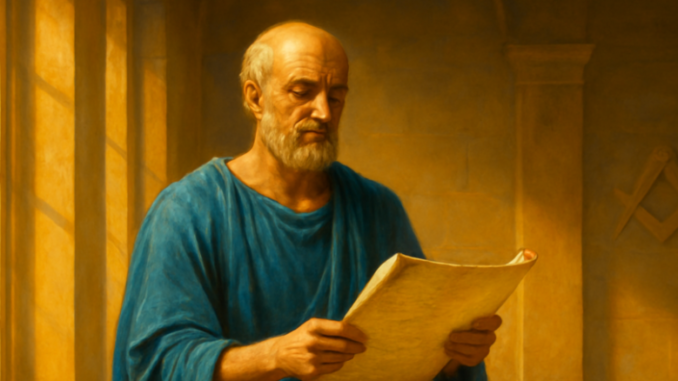
A candle flickers in the early morning as a Freemason opens his journal. Before him lies a translation of Seneca’s letters, turned to the very first one. He reads words written nearly two thousand years ago and feels an uncanny recognition: time slipping away unnoticed, the urgent need to claim every moment. In the stillness of the lodge, where the hourglass stands prominently displayed, these ancient words take on an unexpected immediacy.
The Stoic Roots of Time Awareness
Lucius Annaeus Seneca wrote his first letter to Lucilius around 63 AD, during a period when he was withdrawing from political life at the court of Emperor Nero. That this letter on the use of time opens his entire correspondence is no accident. Seneca immediately lays the foundation of Stoic philosophy as a way of life: the realization that time is our only true possession, and simultaneously our most vulnerable one.
The Stoic school, founded by Zeno of Citium around 300 BC, regarded time as an ethical category. Where other philosophical traditions focused on knowledge or happiness as the highest good, the Stoics saw virtuous action in the here and now as the essence of a life well lived. Seneca inherits this conviction but gives it a more personal and urgent character than his predecessors Chrysippus or Cleanthes ever did.
Epicurus as an Unexpected Ally
Remarkably, in this very first letter Seneca approvingly quotes his philosophical opponent Epicurus. He writes that Epicurus once reproached a friend for living as though he would live forever. This is neither a mistake nor mere eclecticism — Seneca demonstrates that wisdom knows no school boundaries. The Epicurean emphasis on savoring the present moment aligns far more closely with Stoic practice than superficial contrasts might suggest.
Both schools shared the conviction that philosophy is not a theoretical exercise but a practice of living. Epicurus’ Garden and the Stoic Stoa were not academic institutions but communities where people learned to relate differently to time, desire, and mortality. This practical orientation explains why Seneca’s letters have remained more accessible across the centuries than the technical treatises of other ancient thinkers.
The Hourglass as a Stoic Symbol
In Freemasonry, the hourglass holds a prominent place as a symbol of the fleeting nature of time. This symbol was not chosen arbitrarily. The eighteenth-century founders of modern Freemasonry, including James Anderson and Jean Théophile Désaguliers, were deeply versed in classical philosophy. The Stoic tradition, with Seneca as its most widely read representative, served as a major source of inspiration for the moral symbolism of the fraternity.
The hourglass reminds us that every moment that passes never returns, and that the only time truly ours is the present in which we act.
Seneca would have recognized this symbolism immediately. In his letter, he describes how time escapes us through three channels: the past that is no more, the future that remains uncertain, and the present that is so brief we scarcely notice it. The hourglass makes this abstract insight visible and tangible. Every grain of sand that falls is a call to awareness.
Marcus Aurelius and the Tradition of Self-Examination
Seneca’s first letter does not stand alone. It forms part of a broader Stoic tradition of self-examination that reaches its peak in the Meditations of Marcus Aurelius. Where Seneca writes as a mentor to a younger friend, Marcus writes to himself. Both, however, share the same urgency: life is short, and only those who focus their attention on what truly matters live with dignity.
This tradition of daily self-examination resonates powerfully with Masonic practice. The ritual moment of reflection, the act of giving an account of the day that has passed, the question of whether one has spent time building or tearing down — these are variations on the same theme Seneca articulated two thousand years ago.
Time as Ethical Responsibility
What sets Seneca’s approach apart from modern productivity philosophies is the moral character of his concept of time. He does not write about efficiency or output but about dignity and meaning. For him, wasting time is not a practical problem but an ethical failure. Whoever gives away his time to insignificant things is, in essence, giving away himself.
The Stoics viewed time as the only thing truly belonging to us. Seneca connects the squandering of time to moral negligence. The hourglass in the lodge symbolizes this same philosophical urgency. Daily self-examination forms the bridge between ancient wisdom and modern practice.
The Enduring Appeal of the First Letter
Seneca’s first letter to Lucilius is far more than a historical document. It is an invitation to adopt a way of being that has remained relevant across the ages. Its philosophical background — rooted in Stoicism yet open to insights from other traditions — makes it a universal text. Freemasonry, with its emphasis on personal development and symbolic awareness, finds in this letter a natural ally.
The question Seneca poses to Lucilius is the same question the hourglass poses to every Freemason who enters the lodge: what are you doing with the time you have been given? The answer lies not in the past or the future, but in the present moment in which you choose to act.
Seneca’s first letter opens not just a correspondence but a philosophical path. The Stoic tradition from which he draws, the dialogue with Epicurus he engages in, and the practical urgency he articulates all find their echo in the symbolism of Freemasonry. The hourglass that stands in the lodge is more than a decorative element — it is a philosophical statement about the nature of human existence, a silent reminder that every passing grain of sand demands our conscious attention and purposeful action.
Copyright text & image: devrijmetselaar.nl
Texts are based on the ideas and content of the author of devrijmetselaar.nl, reviewed, corrected, and supplemented with the assistance of OpenAI. Images are created based on the ideas of the author of devrijmetselaar.nl using OpenAI/DALL-E.
Frequently Asked Questions
What is the connection between Seneca's First Letter and Freemasonry?
Seneca's First Letter emphasizes the Stoic philosophy that time is our most precious possession, a theme that resonates deeply with Freemasonry. The hourglass, a prominent symbol in Freemasonry, represents this same concept of time's fleeting nature. Freemasons use Seneca's ancient wisdom about living virtuously in the present moment as a foundation for their philosophical and ethical teachings.
Why did Seneca quote Epicurus in his First Letter despite being a Stoic philosopher?
Seneca quoted Epicurus to demonstrate that wisdom transcends philosophical school boundaries. Both Stoicism and Epicureanism, despite their surface differences, shared the conviction that philosophy is a practical way of living rather than mere theory. Both schools emphasized relating differently to time, desire, and mortality, making them aligned in their practical approach to life.
What does the hourglass symbolize in Freemasonry?
The hourglass in Freemasonry symbolizes the fleeting and precious nature of time, reflecting Stoic philosophy. It serves as a reminder that time is humanity's only true possession and that one must live virtuously and consciously in the present moment. This symbol connects the ancient wisdom of Seneca and Stoic philosophy to Masonic teachings about how life should be lived.


Be the first to comment