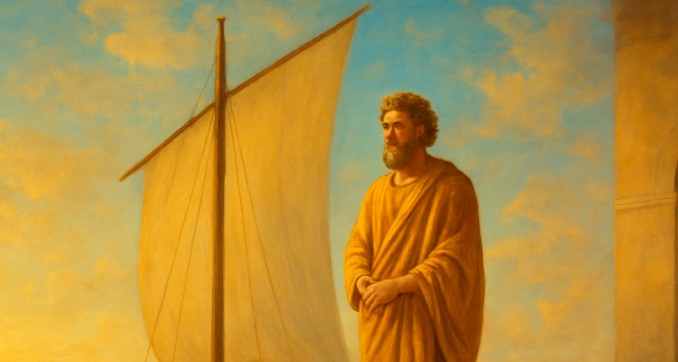
Imagine standing before a mirror each morning and asking yourself what could make this day truly meaningful. Marcus Aurelius, the Roman emperor and philosopher, posed exactly this question to himself. In the twelfth and final book of his Meditations, he unfolds his deepest reflections on the divine, the order of the universe, and our place within it. For Freemasons, his conclusions resonate with remarkable force — particularly with the concept of the Great Architect of the Universe. This article offers an accessible summary of his ideas and explores how this ancient wisdom remains profoundly applicable today.
The Heart of Book XII: An Ordered Universe
Marcus Aurelius never intended his Meditations as a philosophical treatise for public consumption. They were private notes — a conversation with himself. Book XII serves as the closing chapter of this inner dialogue, and its central theme is unmistakable: the universe is not a place of chaotic randomness but a purposeful whole. The Stoics called this ordering force the logos — a rational principle that permeates and connects all things.
For Marcus Aurelius, God is not a personal deity who intervenes from above. Rather, the divine manifests itself in the lawfulness of nature, the interconnection of all things, and the faculty of reason that allows human beings to participate in a greater whole. This is not passive belief but an active recognition that carries real consequences for how one lives.
Practical Lessons from the Stoic View of God
What does this mean for daily life in concrete terms? Marcus Aurelius draws three practical conclusions from his vision of the divine.
First: accept what lies beyond your control. If the universe is rationally ordered, then setbacks have their place within the greater whole. You need not welcome them, but resisting them is futile. Second: direct your energy toward what you can influence — your own thoughts, choices, and reactions. Third: act in accordance with reason, for in doing so you align yourself with the logos itself.
For the Freemason, the Great Architect of the Universe is not a dogma but an invitation — an invitation to recognize the ordering principle at work in oneself and in the world at large.
The Images Marcus Aurelius Uses
Marcus Aurelius illustrates his reflections with vivid imagery drawn from nature and everyday life. He compares the individual to a branch on a tree: severed from the tree, the branch dies, but as part of the whole, it flourishes. In the same way, each person is connected to humanity and to the universe. Anyone who isolates themselves or lives only for their own sake cuts themselves off from their very source of life.
Another recurring image is that of the river. Life flows past like water. Everything changes; nothing endures. But this is not a cause for despair — it is a call to acceptance and to focusing on the present moment. The emperor reminds himself that he will soon be forgotten, just as the emperors before him have been. This awareness of mortality makes every day precious and every action meaningful.
The Great Architect in a Masonic Perspective
In Freemasonry, the concept of the Great Architect of the Universe is deliberately kept open-ended. It is not the specific god of a specific religion but a symbol for the ordering principle that underlies creation. This connects seamlessly with the Stoic logos as Marcus Aurelius describes it. Both traditions invite humility: we are not the designers of the universe but builders working within a greater plan.
The practical implication for the Freemason is the same as for the Stoic: work on yourself as you would on a rough stone. Bring your own life into alignment with the higher order you acknowledge, even though you cannot fully comprehend that order. The tools at your disposal are the very ones Marcus Aurelius names: self-reflection, discipline, compassion, and rationality.
Concrete Steps to Apply This Wisdom
How do you translate two-thousand-year-old imperial wisdom into your own life? Here are four practical actions you can begin immediately:
Start each morning with a simple question: what can I contribute to the greater whole today? When something goes wrong, ask yourself: does this lie within or beyond my control? End each day with a brief reflection: did I act in accordance with my highest values? And seek out silence regularly — time to connect with something greater than yourself, whether you call it God, nature, or the logos.
These practices are not complicated, but they do require consistency. Marcus Aurelius wrote his notes as a daily exercise, not as a one-time revelation. The power lies in repetition.
Why This Matters Now
In an age when many people are searching for meaning and direction, the Stoic vision offers a refreshing alternative to both dogmatic belief and nihilistic relativism. You do not need to understand everything to recognize that there is order. You do not need to subscribe to a specific religion to feel connected to something greater than yourself. And you do not need to be powerless to accept that not everything is in your hands.
With Book XII, Marcus Aurelius extends an invitation: see yourself as part of a larger edifice. Contribute your stone with craftsmanship and integrity. Trust that the whole is meaningful, even when you cannot see the full design. This is not naïve optimism — it is the sober realism of a man who governed an empire while war and plague raged around him.
Book XII of the Meditations stands as Marcus Aurelius’ definitive statement on humanity’s place within an ordered universe. The Great Architect of the Universe, as Freemasons name the ordering principle, is what the Stoics called the logos: the reason that permeates and connects all things. The practical lesson is clear. Recognize that you are part of something greater. Focus on what you can influence. Act with integrity. And begin today — for the river of life flows on, and every moment spent in alignment with this wisdom is a moment well lived.
Copyright text & image: devrijmetselaar.nl
Texts are based on the ideas and content of the author of devrijmetselaar.nl, reviewed, corrected, and supplemented with the assistance of OpenAI. Images are created based on the ideas of the author of devrijmetselaar.nl using OpenAI/DALL-E.

Be the first to comment