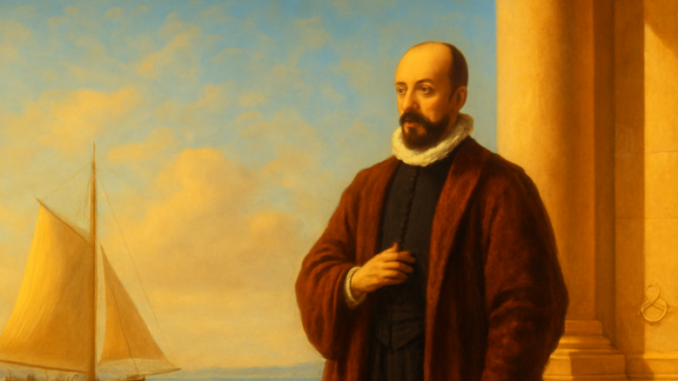
Why did a sixteenth-century French nobleman write an essay on the education of children that still provokes deep reflection more than four centuries later? And which thinkers whispered their insights to him as he sat writing in his famous tower? Michel de Montaigne drew from a rich philosophical tradition when he committed his thoughts on formation to paper. Let us explore the sources that nourished his vision — and discover why they still matter to anyone walking the path of self-improvement.
Which Philosophical Currents Shaped Montaigne’s Thinking?
Montaigne lived during an era of intellectual rebirth. Renaissance Humanism had rediscovered the classical texts and brought a fresh perspective on human nature and its possibilities. This humanism was characterized by a return to the sources: Greek and Roman thinkers were no longer filtered through medieval interpretations but read and questioned directly.
In his essay on the education of children, we see three major currents converge: Stoicism, with its emphasis on virtue and character; Skepticism, with its critical stance toward dogmatic knowledge; and the practical humanism of Plutarch, which viewed formation as the art of living. Montaigne blended these ingredients into his own recipe, rooted in personal experience rather than abstract theory.
What Did Seneca Teach Him About Education?
Seneca, the Roman Stoic philosopher, was one of Montaigne’s most beloved authors. In his letters to Lucilius, Seneca emphasized that true wisdom does not consist of accumulating facts but of developing sound judgment. Knowledge must be digested, not merely stored. This idea forms the backbone of Montaigne’s pedagogical vision.
Education is not about filling a vessel but about kindling a flame that burns for a lifetime.
Seneca warned against parroting the words of others without understanding. A child must learn to think independently, not mindlessly repeat what the teacher dictates. Montaigne took this to heart and fiercely opposed the educational practices of his day, which consisted largely of memorization and recitation. The true teacher, he argued following Seneca, guides the child toward independent insight rather than rote obedience.
How Did Plutarch Influence His Pedagogical Ideas?
Plutarch, the Greek biographer and moralist, wrote his own treatise on the education of children — a work Montaigne knew well. Plutarch advocated for a balanced formation in which body and mind were trained together. Athletics and philosophy belonged side by side, just as art and science complemented each other. This holistic approach reappears in Montaigne’s plea for a well-rounded education.
Moreover, Plutarch taught that examples are more powerful than precepts. His famous Parallel Lives showed how virtue and vice manifest themselves in concrete deeds. Montaigne applied this principle directly: a child learns not by hearing abstract rules but by observing living examples and following them. The teacher must embody what he teaches.
What Role Did Skepticism Play in His Thinking?
Montaigne’s personal motto was “Que sais-je?” — What do I know? This skeptical disposition was drawn from the Greek philosopher Pyrrho and his later followers. Skepticism taught that absolute certainty is unattainable and that wisdom begins with recognizing the limits of our own knowledge.
For education, this had far-reaching consequences. If no single doctrine possesses the complete truth, then a child must learn to judge independently rather than blindly follow authorities. Montaigne therefore criticized the scholastic education of his time, which trained students to parrot Aristotle without ever asking whether Aristotle was right. Doubt became a pedagogical tool — not an obstacle to learning but its very engine.
How Did Renaissance Humanism Fit into This Picture?
The humanism of Montaigne’s era placed the human being at the center — not as an abstract concept but as a living, learning creature. Thinkers like Erasmus and Juan Luis Vives had already advocated for educational reform, for the study of classical languages and texts, and for an education that formed the whole child. Montaigne aligned himself with this movement but pushed further.
Where many humanists still clung to a curriculum of classical texts as an end in itself, Montaigne viewed the classics as a means. His goal was not the ability to quote Cicero but the development of one’s own voice. The classical texts were conversation partners, not oracles. This shift from authority to authenticity is precisely what makes his essay enduringly relevant.
What Connects This Philosophical Background to Freemasonry?
Freemasonry emerged more than a century after Montaigne, yet it shares a remarkable amount with his philosophical heritage. In the Lodge, too, formation stands at the center: not the transmission of dogmas but the guiding of the seeking individual toward personal insight. The rough ashlar that is worked into a perfect cube symbolizes exactly what Montaigne envisioned — a process of self-development that is never truly complete.
The Stoic emphasis on virtue and character, the skeptical humility toward absolute truths, the humanistic conviction that every person can grow — these are pillars of both Montaigne’s pedagogy and the Masonic path. The Lodge is, in a sense, a school for adults, where Brothers and Sisters help one another discover their own inner light, just as Montaigne saw the ideal teacher as someone who fans the flame rather than fills the bucket.
Consider these four philosophical pillars and how they resonate with Masonic principles:
Stoicism: The formation of character takes precedence over the mere accumulation of knowledge. Skepticism: Critical thinking and intellectual humility about the limits of our own understanding. Plutarch’s Legacy: Learning through living examples and holistic development of the whole person. Humanism: The individual as the center and active agent of their own formation.
Montaigne’s essay on the education of children is not an isolated work but a crossroads where centuries of philosophical thought converge. Seneca, Plutarch, the Skeptics, and the Humanists provided him with the building blocks from which he constructed a vision that still inspires today. For those who walk the Masonic path, his thinking offers a powerful mirror: formation is not a destination but a lifelong journey. It is the perpetual work of shaping the rough stone — not through received dogma, but through the courage to think, to question, and to grow into one’s truest self.
Copyright text & image: devrijmetselaar.nl
Texts are based on the ideas and content of the author of devrijmetselaar.nl, reviewed, corrected, and supplemented with the assistance of OpenAI. Images are created based on the ideas of the author of devrijmetselaar.nl using OpenAI/DALL-E.
Frequently Asked Questions
What were the main philosophical influences on Montaigne's educational theories?
Montaigne drew from three major philosophical currents: Stoicism (emphasizing virtue and character), Skepticism (taking a critical stance toward dogmatic knowledge), and the practical humanism of Plutarch (viewing formation as the art of living). He blended these traditions into his own approach rooted in personal experience rather than abstract theory.
How did Seneca's ideas shape Montaigne's views on learning?
Seneca taught that true wisdom comes from developing sound judgment rather than accumulating facts, and that knowledge must be digested and understood deeply. Montaigne adopted Seneca's belief that education should kindle independent thinking rather than encourage mindless memorization and repetition, opposing the rote learning practices common in his era.
What did Montaigne learn from Plutarch about education?
Plutarch advocated for balanced formation that trained both body and mind together. Montaigne was familiar with Plutarch's treatise on the education of children and incorporated this holistic approach into his own pedagogical ideas, emphasizing the importance of physical and intellectual development working in concert.


Be the first to comment