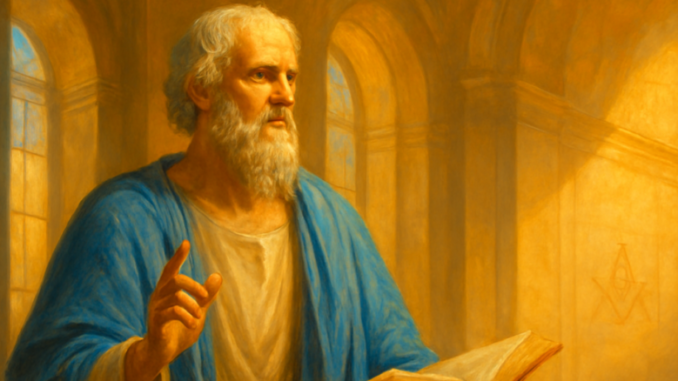
What is justice, really? Plato poses this question in the opening book of his masterwork The Republic, and it has echoed through the centuries with undiminished force. What makes this question especially compelling for Freemasons is that it lies at the very heart of their Craft. When a Brother enters the lodge, he embarks on a quest for truth and virtue — for right action in a complex world. Plato’s ancient inquiry and the Masonic tradition share far more common ground than one might expect at first glance.
Why Does Plato Begin With a Conversation About Justice?
The first book of The Republic takes place in the house of Cephalus, a wealthy old man who enters into conversation with Socrates. The setting may seem incidental, but nothing in Plato is accidental. He deliberately chooses a dialogue — a conversation among people with different backgrounds and perspectives. Socrates does not arrive to deliver answers; he comes to think together with others. This method of collectively seeking truth is precisely what Freemasons strive for in their meetings: not to claim wisdom, but to discover it together.
Cephalus suggests that justice simply means speaking the truth and repaying your debts. Socrates challenges this with a straightforward example. Suppose a friend lends you a weapon and later returns to claim it while in a state of madness. Would it be just to return it? This simple scenario reveals that justice is more than rule-following. It demands wisdom — the ability to understand a situation fully and act accordingly.
What Does This Mean for Masonic Practice?
Virtue stands at the center of Freemasonry. But virtue is not a simple checklist of dos and don’ts. It is a living practice that requires constant self-reflection. When a Freemason works the rough ashlar into a perfect cube, this symbolizes the inner labor of refining one’s own character. The goal is not perfection measured by external standards, but an honest examination of one’s shortcomings and a commitment to growth. Is this not exactly what Socrates is doing when he questions Cephalus’s definition?
Justice, seen through this lens, is not the blind adherence to rules. It is the continuous weighing of what is truly good — for oneself and for others. Every Brother who engages in this kind of moral deliberation is, whether he realizes it or not, walking in Socrates’ footsteps.
Thrasymachus and the Challenge to Our Assumptions
The dialogue takes a sharp turn when Thrasymachus enters the debate. He argues that justice is nothing more than the advantage of the stronger. Those in power determine what is just, and anyone who obeys merely serves another’s interests. It is a provocative thesis — and one that remains disturbingly recognizable today. How many societal structures are built on the advantage of the few at the expense of the many?
Socrates does not dismiss Thrasymachus outright. Instead, he invites him to think more deeply. If a ruler makes mistakes and enacts laws that actually harm himself, is the obedient citizen still serving the “advantage of the stronger”? This demonstrates the power of the dialectical method: by asking the right questions, hidden assumptions are brought to light. Freemasons will recognize this as the value of brotherly discourse — a space where disagreements do not lead to conflict but to deeper understanding.
How Brotherhood Relates to Justice
Plato shows that justice cannot exist in isolation. It arises in relation to others — in the polis, in the community. This resonates deeply with the Masonic ideal of brotherhood. A lodge is not a random collection of individuals who happen to share a room. It is a community working collectively toward moral refinement. When Brothers correct, support, and challenge one another, they practice a form of justice that transcends individual self-interest.
The symbolism of the square and compasses points directly to this endeavor. The square reminds us to measure our actions against a moral standard. The compasses keep us within the bounds of what is right and proper. Together, they form a compass for just action — not as abstract principles, but as practical tools for daily life.
What Plato Teaches Us About Being Unfinished
One of the most striking aspects of the first book of The Republic is that it offers no definitive answer to the question of justice. Socrates dismantles several definitions but does not propose a comprehensive theory of his own. This is not a weakness — it is a strength. It acknowledges that the search for truth is an ongoing process, not a final destination. Freemasons speak of the eternal journey of the seeking soul — a journey that ends only when life itself comes to a close.
This openness invites humility. Anyone who believes they possess the whole truth has closed themselves off to further growth. Plato and Freemasonry share this insight: wisdom begins with acknowledging one’s own ignorance. Socrates’ famous declaration — “I know that I know nothing” — is not a cynical remark. It is an invitation to keep searching with an open mind.
Where Do These Questions Lead Us?
The dialogues in The Republic are not historical curiosities. They are living texts that continue to interrogate us. What does justice mean to you, here and now? How do you relate to your fellow human beings, to the community of which you are a part? Freemasonry provides a framework for exploring these questions — not in isolation, but in brotherly connection.
Consider these guiding principles drawn from both Plato and the Craft:
- Self-reflection: Examine your own beliefs about justice and fairness.
- Virtue: Strive to act in ways that go beyond self-interest.
- Brotherhood: Seek truth in the company of others.
- Humility: Recognize that the search is never complete.
Plato’s opening book of The Republic invites us not to avoid these fundamental questions but to embrace them. In the lodge, in daily life, and in every encounter with another human being, there lies the opportunity to act justly. Not as a final achievement, but as a practice renewed each day — a labor as enduring and rewarding as the work of shaping the rough stone into something worthy of the Builder’s design.
Copyright text & image: devrijmetselaar.nl
Texts are based on the ideas and content of the author of devrijmetselaar.nl, reviewed, corrected, and supplemented with the assistance of OpenAI. Images are created based on the ideas of the author of devrijmetselaar.nl using OpenAI/DALL-E.
Frequently Asked Questions
What is the connection between Plato's Republic and Freemasonry?
Both Plato's inquiry into justice and Masonic tradition share a fundamental commitment to seeking truth and virtue through dialogue and collective inquiry. Freemasons, like Socrates in Plato's Republic, do not claim to possess wisdom but rather discover it together through thoughtful conversation and self-reflection. The quest for understanding justice and right action lies at the heart of both philosophies.
Why does Plato use dialogue as his method in The Republic?
Plato deliberately uses dialogue to show that truth is discovered through conversation among people with different perspectives, not through the delivery of answers by a single authority. This method mirrors Masonic practice, where Brothers gather to think and reflect together. Socrates questions assumptions—such as Cephalus's simple definition of justice—to reveal that true understanding requires deeper wisdom and consideration of complex situations.
How does the Masonic practice of character refinement relate to Plato's concept of justice?
In Freemasonry, the symbolism of working the rough ashlar into a perfect cube represents inner moral development and self-examination. Similarly, Plato's exploration of justice is not about blindly following rules but about continuous moral deliberation and understanding what is truly good. Both traditions recognize that virtue is a living practice requiring constant reflection and growth, rather than adherence to external standards or fixed definitions.


Be the first to comment