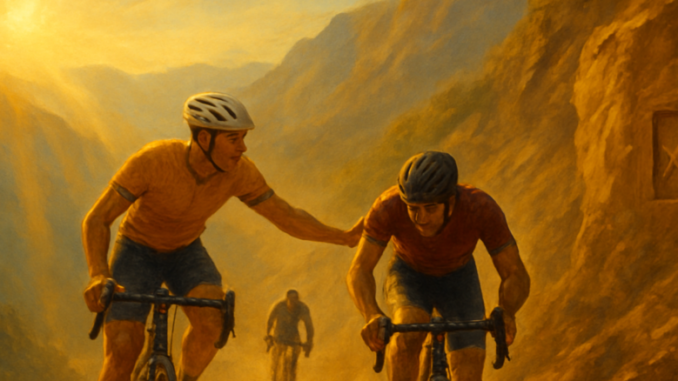
The sun beats down on the asphalt of the final mountain stage. A cyclist stares at the back of her rival, fifteen seconds up the road. Her legs scream for rest, her lungs burn, but somewhere deep inside a voice speaks: we never give up. Not for herself alone, but for the teammates who sacrificed themselves all day to bring her here. This moment of perseverance — carried by a collective — touches something Freemasons have known for centuries: the power of brotherhood in times of trial.
The Final Kilometers: When Giving Up Becomes Tempting
In professional cycling, the final kilometers of a grueling mountain stage are the moment of truth. All the training, all the preparation, all the strategy converge into a single question: do you hold on, or do you give in to the temptation to ease off the pace? The difference between victory and defeat can be measured in mere seconds. Fifteen seconds sounds like nothing, but on a gradient of ten percent, every meter feels like an eternity.
What keeps riders upright in those moments is rarely pure physical strength. It is the awareness that they are not riding alone. Behind them lie miles in which teammates caught the wind, handed up water bottles, and set the tempo. That collective effort creates a sense of responsibility that outweighs personal pain. To give up would mean not just individual failure, but letting down everyone who committed themselves to the shared goal.
Brotherhood as a Moral Backbone
In Freemasonry, a remarkably similar dynamic is at work. When a Brother or Sister struggles with personal challenges — when the road of life turns steep and strength begins to fade — it is the knowledge of fraternal connection that offers support. This goes beyond practical help. It is a moral backbone, the deep assurance that one does not stand alone in the world.
The eighteenth-century thinker Johann Wolfgang von Goethe, himself a Freemason, wrote extensively about the power of human connection. Throughout his works, he emphasized how individuals can rise above themselves through shared ideals. The lodge functions as a space where this bond is ritually affirmed and strengthened — not as an abstract principle, but as a lived reality.
Brotherhood in Freemasonry means knowing that your perseverance does not depend on yourself alone, but is sustained by a community that believes in you.
The Collective That Elevates the Individual
A cycling team operates on a clear principle: the whole is greater than the sum of its parts. Riders with different qualities complement one another. The climber is shielded by the sprinter; the time trialist sets the pace for the general classification leader. No one can do everything, but together they achieve more than any individual could alone.
In Freemasonry, we recognize this in the diversity of lodge membership. A lodge brings together people of different professions, backgrounds, and personalities. The philosopher learns from the craftsman, the young seeker from the experienced Master. This diversity is not an obstacle but a treasure. Just as different instruments in an orchestra together form a symphony, each member contributes to the greater whole.
Several key principles emerge from this parallel between team cycling and lodge life. First, there is complementarity — different qualities strengthening the collective. Second, mutual support ensures that moments of weakness are absorbed by stronger Brothers. Third, shared responsibility means that both success and failure belong to the group. And fourth, ritual reaffirmation regularly renews and deepens the fraternal bond.
Perseverance as a Shared Virtue
The phrase “we never give up” is revealing in its plural form. It is not “I never give up,” but “we.” This subtle linguistic distinction betrays a deeper insight: perseverance is not a solitary virtue but a collective endeavor. When the individual wavers, the collective holds the course.
Marcus Aurelius, the Stoic emperor and philosopher, wrote in his Meditations about the social nature of humanity. We are, he observed, like the limbs of a single body. What affects one part affects the whole. This vision resonates powerfully with the Masonic understanding of brotherhood. The Freemason does not see himself as an isolated individual, but as a link in a chain that stretches back through time and reaches forward into the future.
Lessons from the Road for the Lodge
What can Freemasons learn from the world of cycling? First, the value of preparation. A rider who shows up untrained at the start line lets down not just herself but her entire team. The same is true of the Freemason who enters the lodge without having done the inner work. Second, there is the importance of timing — knowing when to lead and when to follow, when to speak and when to listen.
But above all, cycling teaches us that the finest victories are not won by those who pedal the hardest, but by those who collaborate the best. The cyclist who needs to close a fifteen-second gap does not do it alone. Her teammates brought her to this point, and their effort gives her the moral strength to push through.
Brotherhood Beyond the Finish Line
After the race — whether it ends in victory or defeat — the team endures. The bond forged through shared effort outlasts the result. This may be the most important lesson of all: brotherhood is not a means to an end, but an end in itself. The Freemason does not strive for perfection in order to earn brotherhood; rather, he experiences brotherhood as the path toward personal growth.
In a world of performance and competition, Freemasonry offers a different perspective. The question here is not: did you win? But rather: did you give your best, and did you support your Brothers along the way? The fifteen seconds of deficit become far less important than the question of whether you stayed true to your ideals and to those who stood beside you in the struggle.
The cyclist who refuses to give up — sustained by the knowledge of collective purpose — embodies a truth that resonates far beyond the road. In the lodge, as on the mountain, we discover that our greatest strength lies not in solitary willpower but in the bonds we share. Fifteen seconds is a gap that can be closed. But the brotherhood that carries us through the effort? That endures long after we cross the finish line.
Copyright text & image: devrijmetselaar.nl
Texts are based on the ideas and content of the author of devrijmetselaar.nl, reviewed, corrected, and supplemented with the assistance of OpenAI. Images are created based on the ideas of the author of devrijmetselaar.nl using OpenAI/DALL-E.
Frequently Asked Questions
What is the connection between cycling and Freemasonry mentioned in this article?
The article uses professional cycling, specifically a cyclist pushing through the final mountain stage fifteen seconds behind her rival, as a metaphor for the Masonic concept of brotherhood. Both cycling teams and Freemasonry demonstrate how individual perseverance is sustained and elevated by collective support, where personal struggles are overcome through the knowledge that others believe in you and have invested in your success.
How does brotherhood function as a 'moral backbone' in Freemasonry?
According to the article, brotherhood in Freemasonry serves as more than just practical assistance. It provides a deep moral support system that assures individuals they do not stand alone during personal challenges. The lodge ritually affirms and strengthens this fraternal bond, creating a lived reality where members know their perseverance is sustained by a community that believes in them, rather than depending on themselves alone.
Why is the fifteen-second gap significant in the cycling example?
The article emphasizes that fifteen seconds represents a seemingly small margin that becomes immense under difficult conditions, such as climbing a steep gradient. This gap illustrates how the final moments of perseverance are the most critical. What enables a cyclist to close this gap is not individual physical strength alone, but the collective effort of teammates who have sacrificed throughout the race, creating a sense of responsibility that overcomes personal pain and temptation to give up.

Be the first to comment