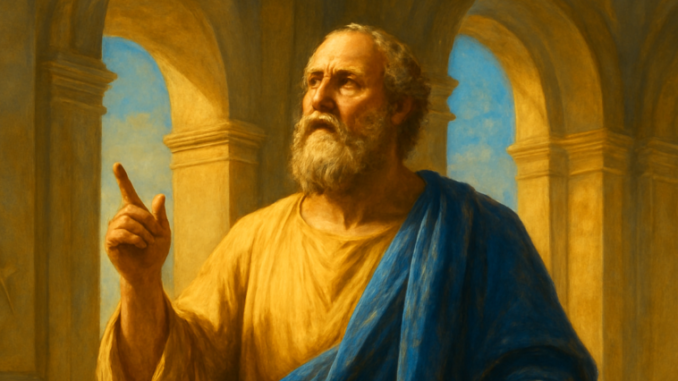
In 369 BC, Plato wrote a dialogue that continues to captivate philosophers and seekers to this day. The Theaetetus poses a deceptively simple question: what is knowledge? What unfolds is a masterful conversation between Socrates and the young mathematician Theaetetus, in which every proposed definition ultimately crumbles under the weight of critical inquiry. This dialogue not only demonstrates the power of Socratic questioning but also reveals a fundamental truth that Freemasons recognize in their own pursuit of light.
The Historical Context of the Dialogue
The Theaetetus is set in 399 BC, shortly before the trial of Socrates that would end with his death sentence. Plato deliberately chose this dramatic moment as the backdrop for the dialogue. The young Theaetetus, a brilliant mathematics student from Athens, meets Socrates in the palaestra — the training ground where Greek youth exercised both body and mind. The conversation begins when Theodorus, Theaetetus’s mathematics teacher, introduces the young man to Socrates as someone of exceptional talent.
What follows is one of the most systematic investigations into the nature of knowledge from antiquity. Plato likely composed this dialogue around 369 BC, during his more mature period as a philosopher. The text reflects a profound meditation on what it truly means to know something — a question that would occupy the Academy of Athens for generations to come.
The Three Definitions of Knowledge
At the heart of the dialogue lie three attempts to define knowledge. Theaetetus first proposes that knowledge is equivalent to perception. He draws upon the doctrine of Protagoras, who famously claimed that man is the measure of all things. Socrates subjects this thesis to rigorous examination and demonstrates that perception cannot provide the stable, objective knowledge we seek. What we perceive is in constant flux, while genuine knowledge must contain something enduring.
The second definition holds that knowledge is true belief. This sounds more plausible, but Socrates points out that someone can hold a true belief without actually possessing knowledge. A jury, for instance, might reach a correct verdict based on persuasive rhetoric without having witnessed the events themselves. The third and most refined definition describes knowledge as true belief accompanied by a rational account — or logos. Yet even this formulation proves problematic when Socrates asks what exactly constitutes an adequate account or explanation.
The Midwife Metaphor and the Birth of Insight
One of the most compelling images in the dialogue is the comparison Socrates draws between his own method and the profession of his mother, who was a midwife. Socrates describes himself as an intellectual midwife who assists others in giving birth to their own insights. He himself produces no knowledge but attends to others during their intellectual labor.
True knowledge is not transmitted — it is born from the individual’s own inquiry, from a mind that learns to see.
This metaphor resonates profoundly with Freemasonry, where the Master does not act as a teacher dispensing answers but as a guide who helps the candidate arrive at understanding on their own. The ritual work in the lodge is not a transfer of information — it is a process in which the candidate must personally discover what lies hidden. Just as Socrates’s midwifery brings forth what already exists within the student, the Masonic journey reveals truths that the initiate carries within himself.
The Wax Tablet and the Aviary
Plato employs two remarkable analogies to explain the workings of memory and the mind. The first is the image of a wax tablet within our soul, upon which impressions are left just as a signet ring leaves its mark in wax. In some people, the wax is pure and of the right consistency; in others, it is too hard or too soft — which explains why people differ in their ability to learn and remember.
The second image is that of an aviary filled with birds, where each bird represents a piece of knowledge. Possessing knowledge is compared to having birds in your aviary, while actively using knowledge is like catching a specific bird. This elegantly explains how we sometimes grasp the wrong piece of knowledge — as when we make an arithmetic error despite having the correct answer somewhere in our mind. These vivid images remind us that knowledge is not simply stored and retrieved mechanically; it is alive, dynamic, and sometimes elusive.
The Unfinished Quest
Perhaps the most striking aspect of the Theaetetus is that the dialogue ends without a definitive answer. Socrates and Theaetetus conclude that none of the proposed definitions holds up under scrutiny. At first glance, this might seem like a philosophical failure, but it is in reality a profound lesson. Recognizing our own ignorance is, according to Socrates, the beginning of wisdom — not the end.
For Freemasons, this is deeply familiar. The search for light is not directed toward a final destination but toward the ongoing process of refinement and deepening. The rough ashlar is never completely polished, for every layer that is removed reveals new imperfections that deserve attention. The Theaetetus teaches us that the question itself can be more valuable than a premature answer.
Relevance for the Modern Seeker
The questions Plato raises have not grown old. In an era of information overload and fleeting opinions, the question of what constitutes real knowledge is more relevant than ever. The dialogue invites humility: how much of what we think we know is genuinely grounded knowledge, and how much is merely opinion, habit, or the uncritical repetition of what others have said?
Consider the core insights that emerge from this ancient text:
- Perception alone does not yield lasting knowledge
- A true belief is not yet knowledge
- Even a rational explanation does not guarantee complete understanding
- Acknowledging ignorance opens the path to wisdom
The legacy of the Theaetetus extends far beyond antiquity. Philosophers such as Aristotle, René Descartes, and Baruch Spinoza all built upon the questions Plato posed here. The dialogue forms a cornerstone of epistemology — the branch of philosophy concerned with the nature and limits of knowledge. For those who walk the Masonic path, it serves as a powerful reminder that the tools we carry are not meant for building certainties, but for chiseling away at the boundaries of what we do not yet understand.
Plato’s Theaetetus remains an enduring invitation to question what we think we know. Its unresolved ending is not a defeat but a gift — a reminder that the honest pursuit of knowledge is itself a form of wisdom. For Freemasons, who dedicate themselves to the lifelong work of shaping the rough stone, this dialogue is more than a philosophical exercise. It is a mirror reflecting the very essence of the Craft: the understanding that light is not a destination to be reached but a journey to be walked, one question at a time.
Copyright text & image: devrijmetselaar.nl
Texts are based on the ideas and content of the author of devrijmetselaar.nl, reviewed, corrected, and supplemented with the assistance of OpenAI. Images are created based on the ideas of the author of devrijmetselaar.nl using OpenAI/DALL-E.

Be the first to comment