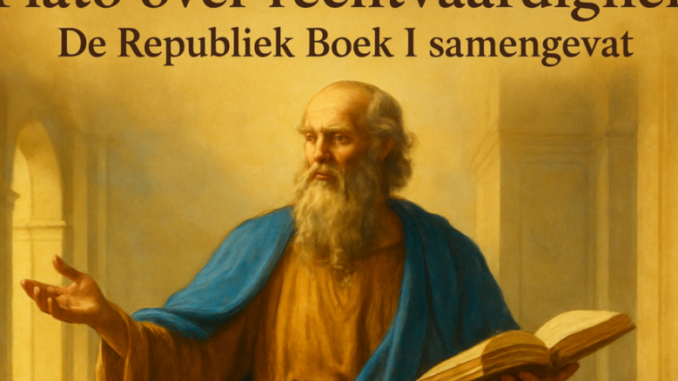
What does it mean to be just? This seemingly simple question opens one of the most influential philosophical works in the Western tradition. In the first book of The Republic, Plato sends his teacher Socrates into dialogue with three interlocutors, each defending a different definition of justice. None of them manages to convince Socrates — and yet this is no tale of intellectual defeat. It is a shared search for truth, the kind of quest that has inspired Freemasons for centuries.
The Setting: An Encounter at the Piraeus
The conversation takes place in the harbor of Athens, the Piraeus, where Socrates is stopped by Polemarchus after attending a religious festival. Polemarchus invites him to the home of his elderly father Cephalus, a wealthy arms dealer. What begins as a polite exchange about old age and wealth quickly transforms into a profound philosophical exploration.
Cephalus remarks that wealth allows him to be honest and pay his debts. In doing so, he implicitly suggests a definition of justice: speaking the truth and returning what you owe. Socrates immediately exposes the weakness of this definition with a striking example. Suppose you have borrowed a sword from a friend who has since gone mad. Would it be just to return that weapon? Cephalus silently acknowledges the problem and withdraws to attend to his religious offerings, while his son Polemarchus takes over the conversation.
Polemarchus: Justice as Loyalty
Polemarchus refines his father’s definition by proposing that justice means doing good to friends and harm to enemies. On the surface, this sounds intuitively plausible. We naturally feel inclined to help those close to us and resist those who threaten us. Yet Socrates unravels this position with surgical precision.
First, how do we truly know who our friends are? People are frequently mistaken in their judgments. Someone who appears friendly may be a hidden enemy, and vice versa. If justice depends on correctly identifying friends and enemies, it becomes contingent on knowledge we rarely possess.
Second — and more fundamentally — can it ever be just to harm someone? Socrates argues that whoever does harm to others makes them worse. But the just person, by definition, cannot make anyone more unjust. A horse is not improved through abuse; neither is a human being. Justice can never consist of harming others, for whoever inflicts damage sows injustice, not virtue.
Thrasymachus: Might Makes Right
At this point, the sophist Thrasymachus aggressively enters the debate. He dismisses all the preceding subtleties and proclaims that justice is nothing more than the advantage of the stronger. Rulers craft laws that serve their own interests, and subjects who obey those laws are therefore acting “justly.” In this view, justice is merely an instrument of power — not a noble ideal.
This cynical position still resonates today. We recognize it in political analyses that reduce all morality to power struggles. Yet Socrates identifies an internal contradiction. Rulers can make mistakes and enact laws that actually harm their own interests. If subjects obey such laws, are they acting justly by disadvantaging the ruler? Thrasymachus tries to salvage his argument by claiming that a true ruler never errs — but in doing so, he transforms his claim from a description of actual power into an idealized abstraction.
The Craftsman as Model
Socrates then introduces a powerful analogy that will echo throughout the entire Republic. Every art or craft, he argues, aims not at the advantage of the practitioner but at the well-being of those being served. The physician strives for the health of the patient, not personal wealth. The captain ensures the safety of ship and crew, not personal gain. If ruling is an art, then the ruler too must pursue the welfare of those governed.
This argument touches on a core principle that will feel deeply familiar to Freemasons. The true master is not the one who wields power but the one who serves. The square and compasses are not symbols of domination — they are tools for shaping oneself and the world for the benefit of a greater whole. The rough ashlar is not hewn for personal glory but to fit within the edifice of humanity.
An Unresolved Riddle
Book I ends in what the Greeks called aporia — a state of perplexity. Socrates has refuted every proposed definition of justice yet has offered no conclusive answer of his own. He compares himself to a greedy dinner guest who tastes every dish before finishing the last. We now know what justice is not, but the positive definition remains elusive.
Yet this apparent failure is deeply instructive. Plato shows us that genuine philosophical inquiry does not begin with answers but with the dismantling of false certainties. Before we can build, we must clear the ground. This resonates powerfully with the Masonic principle that the candidate must first be divested of metals — both literally and figuratively — before he can receive the light. The emptiness that arises when false convictions fall away is not the end of the journey but its true beginning.
Justice as Inner Harmony
Although Book I offers no definitive answer, the outlines of Plato’s ultimate vision are already becoming visible. The question gradually shifts from external behavior to inner disposition. Justice, it turns out, is not primarily a matter of performing the right actions toward others but of achieving a proper ordering within the soul.
In the later books of The Republic, Plato will develop this idea more fully: the just person is the one whose reason, spirit, and appetite exist in harmony, each fulfilling its proper role. This vision of justice as inner architecture — as the careful arrangement of the soul’s faculties — speaks directly to the Masonic endeavor of building one’s inner temple. Just as the operative mason shapes stone with intention and precision, the speculative Mason works to bring order to the raw material of the self.
Plato’s first book of The Republic does not hand us a neat definition of justice — and that is precisely the point. By stripping away comfortable assumptions, Socrates creates the intellectual space in which real understanding can grow. For Freemasons, this process holds a special resonance. The path from darkness to light, from rough ashlar to perfect ashlar, requires us to first confront what we do not know. In that shared willingness to question, to dismantle, and to rebuild on firmer ground, the ancient philosopher and the modern Mason walk the same timeless road.
Copyright text & image: devrijmetselaar.nl
Texts are based on the ideas and content of the author of devrijmetselaar.nl, reviewed, corrected, and supplemented with the assistance of OpenAI. Images are created based on the ideas of the author of devrijmetselaar.nl using OpenAI/DALL-E.
Frequently Asked Questions
What is Cephalus's definition of justice in Plato's Republic Book I?
Cephalus defines justice as speaking the truth and returning what you owe. However, Socrates challenges this definition by asking whether it would be just to return a borrowed sword to a friend who has gone mad, demonstrating that this simple definition fails to account for complex moral situations.
How does Polemarchus refine his father's definition of justice?
Polemarchus proposes that justice means doing good to friends and harm to enemies. Socrates refutes this by pointing out two flaws: first, we are often mistaken about who our true friends and enemies are, and second, it can never be just to harm someone because doing harm makes people more unjust, which contradicts the very nature of justice.
What is the connection between Plato's Republic Book I and Freemasonry?
The article suggests that Socrates's shared search for truth in The Republic—where different definitions of justice are explored through dialogue rather than dictated—has inspired Freemasons for centuries, as both emphasize collaborative philosophical inquiry and the pursuit of deeper understanding.



Be the first to comment