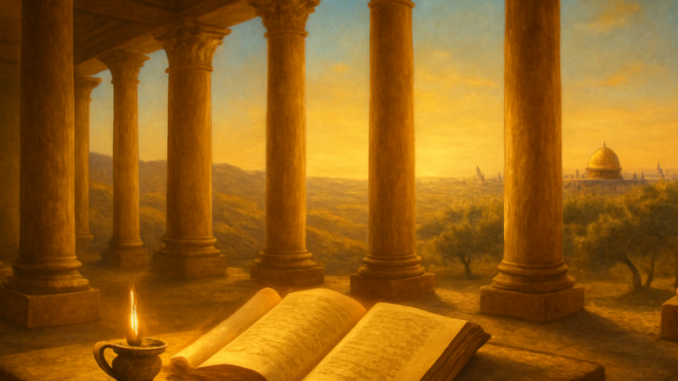
What if a sacred text was never primarily meant to be believed, but to be built? The Gospel according to Matthew — the opening book of the New Testament — presents itself on the surface as a historical account of a master and his disciples. But for those willing to look deeper, something else emerges: a layered blueprint for inner transformation, where words function as building stones and parables serve as tools for the spirit.
The Paradox of the Foundation
Matthew closes with an image that any builder will recognize immediately: the parable of the wise and the foolish builder. One constructs his house upon rock, the other upon sand. When the storms arrive, only the first house stands. There is a paradox here that demands reflection. What exactly is that foundation? Is it literal obedience to rules, or is it something subtler — something that arises only when one does not merely hear the words but truly integrates them?
In Freemasonry, we often speak of the importance of a solid foundation before the greater edifice can be raised. The rough stone must first be worked before it fits into the whole. Matthew seems to suggest precisely the same idea: the foundation is not an external construction but an inner disposition. It is the willingness to be transformed.
Light on the Mountain
The Sermon on the Mount, spanning chapters five through seven, forms the heart of Matthew’s Gospel. Here we find the Beatitudes, the discourse on salt and light, the teaching on the fulfillment of the law. It is tempting to read this passage moralistically, as a series of commandments. But perhaps another reading is possible.
“You are the light of the world. A city set on a hill cannot be hidden.”
This image of light that cannot remain concealed resonates deeply with the symbolism of illumination found across so many wisdom traditions. The light here is not a reward for good behavior — it is an inherent quality that becomes visible when one realizes one’s true nature. The mountain itself is significant: it is the elevated place where insight is received, away from the bustle of daily life, closer to the higher.
Parables as Working Tools
Matthew is rich with parables — short stories carrying hidden meaning. The Sower, the Mustard Seed, the Treasure in the Field, the Pearl of Great Price. Each of these stories operates as a riddle that cannot be solved by the intellect alone. They call for contemplation, for the slow unraveling of layers of meaning.
In the Lodge, we encounter comparable tools. The gavel that does not merely shape physical wood or stone but symbolizes the willpower with which we shape ourselves. The compasses that set boundaries and measure proportions. The parables of Matthew function in precisely the same way: they are tools for inner labor, instruments by which the seeker can work upon his own rough ashlar.
The Counterbalance of Strict Law
Yet there is a tension within Matthew that should not be overlooked. This Gospel emphasizes the continuity with the old law more strongly than the other Gospels. “Not one jot or one tittle shall pass away,” it declares. At first glance, this appears to contradict the idea of inner freedom and personal growth.
But perhaps this is precisely the dialectic that genuine transformation requires. Freedom without form becomes chaos — just as an edifice without a blueprint collapses under its own weight. The law, read in this way, is not the prison but the structure within which the spirit can develop. It is the framework that provides direction, not the cage that restricts. The Master Builder knows his rules, but applies them with wisdom and discernment.
The Twelve and the Brotherhood
The number twelve recurs throughout Matthew: the twelve tribes of Israel, the twelve disciples. This number carries universal symbolism — the twelve months, the twelve signs of the zodiac, the twelve hours of day and night. It suggests completeness, a rounded whole.
The disciples represent different temperaments and backgrounds. Together, they form a community greater than the sum of its parts. Their differences are not eliminated but integrated. Here we see a model of brotherhood based not on uniformity but on complementarity. Each member brings unique qualities, and it is precisely through collaboration that the greater edifice takes shape. This is a principle every Lodge will recognize.
Synthesis: The Temple That We Ourselves Are
When we read Matthew as a blueprint rather than a creed, a new interpretation opens before us. The temple that must be built is not made of stone but of consciousness. The enemies that must be overcome are not external forces but inner resistances. The law that must be fulfilled is not an external code but the deepest law of one’s own being.
This is no casual reading. It demands something of the reader: the willingness to step into the workshop, to take up the gavel, to accept that the work is never finished. Matthew does not end with a conclusion but with a commission: go and make. It is a charge that knows no endpoint.
And so the question lingers, like an unresolved chord calling for resolution: if each of us is both builder and building, then who — or what — is the Architect? Is there a design that precedes our efforts, or does the blueprint only emerge in the act of building itself? Matthew gives no answer, but invites further contemplation. Perhaps that is precisely the wisdom of this ancient text — not to supply the answers, but to pose the right questions.
Copyright text & image: devrijmetselaar.nl
Texts are based on the ideas and content of the author of devrijmetselaar.nl, reviewed, corrected, and supplemented with the assistance of OpenAI. Images are created based on the ideas of the author of devrijmetselaar.nl using OpenAI/DALL-E.
Frequently Asked Questions
How does Matthew's Gospel relate to Freemasonry?
Both Matthew's Gospel and Freemasonry use symbolic language and layered teachings to guide inner transformation rather than mere external compliance. The Gospel functions as a blueprint for spiritual development, much like the tools and rituals of the Lodge work upon the individual's character and consciousness. Matthew's emphasis on building a solid inner foundation parallels Freemasonry's focus on refining the rough stone of human nature into a perfected ashlar.
What does the parable of the wise and foolish builder teach in a Masonic context?
This parable illustrates that true strength comes from an inner foundation of integrated understanding rather than superficial obedience to rules. In Freemasonry, this reflects the principle that a Mason must work upon himself internally before he can contribute meaningfully to the greater edifice of the fraternity. The storms that test the house represent life's challenges, which only one who has built upon rock—inner wisdom and transformation—can withstand.
How are parables similar to Masonic working tools?
Both parables and Masonic tools like the gavel and compasses operate as instruments for inner labor rather than literal instruction. They cannot be understood by intellect alone but require contemplation, reflection, and gradual unraveling of deeper meaning. These tools and stories serve the same purpose: to help the seeker work upon themselves, refining their character and consciousness through symbolic and metaphorical understanding.
What does 'you are the light of the world' mean in relation to Masonic illumination?
This teaching suggests that light is not an external reward but an inherent quality that becomes visible when one realizes their true nature through spiritual work. In Freemasonry, illumination represents the progressive understanding and enlightenment gained through initiation and self-development. Both traditions teach that this light cannot remain hidden once it is realized—it naturally manifests in the individual's character and presence in the world.
Is Matthew's Gospel asking us to follow rules, or something deeper?
Matthew invites us to look beyond literal rule-following toward genuine inner transformation and integration of wisdom. Freemasonry similarly teaches that true progress comes not from blind obedience but from conscious work upon oneself, where teachings are internalized and become part of one's being. This deeper approach creates authentic change that withstands life's trials, rather than merely external compliance that crumbles under pressure.



Be the first to comment