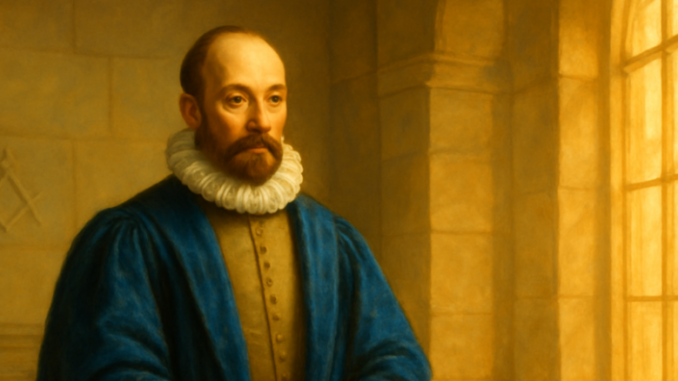
You probably know the feeling: you’re so convinced of a position that your voice grows louder, your arguments sharper. Or you throw yourself into a project with such devotion that the people around you barely see you anymore. Michel de Montaigne warned against exactly this kind of excess in his essay ‘On Moderation.’ His sixteenth-century insights turn out to be remarkably relevant for anyone pursuing personal growth and meaningful connections with others — and especially for Freemasons who strive to build brotherhood on a foundation of self-knowledge.
What Montaigne Actually Means by Moderation
For Montaigne, moderation is not lukewarmness or a lack of passion. It is the ability to consciously direct your passions so that they serve you rather than control you. In his essay, he describes how even virtues can derail when pushed too far. A just person can become a tyrant if their sense of justice knows no limits. A devout believer can justify cruelty in the name of a higher cause.
Montaigne draws on classical examples to make his point. He references Aristotle, who regarded the golden mean as the foundation of virtue. Not too much, not too little, but exactly enough. It sounds simple, but it demands daily practice and sharp self-observation — a discipline that will feel familiar to any Freemason who takes the work of self-improvement seriously.
The Trap of Excessive Devotion
Does this scenario ring true? You begin with a good intention — perhaps to invest more time in your personal development. At first, you feel energized and driven. But slowly, a certain tension creeps in. You become impatient with yourself and with others. You expect everyone around you to share the same level of commitment. Montaigne would say: your virtue has become a burden.
This applies within Masonic communities as well. When brethren defend their ideals with too much fire, it can disrupt the harmony of the lodge. Brotherhood requires space for different perspectives. Moderation is the oil that keeps convictions from colliding and relationships from being damaged.
Moderation is not weakness — it is the highest form of self-mastery: knowing when to stop, even when you are right.
Moderation as the Foundation for Brotherhood
In Freemasonry, brotherhood stands at the center of everything. But that sense of connection does not arise on its own — it requires conscious effort. This is where Montaigne’s lesson comes directly into play: genuine connection demands moderation in how you judge others. If you are too quick to pass judgment or too rigid in clinging to your own views, you close the door to real contact.
Imagine a lodge meeting where a brother shares an opinion you strongly disagree with. Your first impulse might be to respond, to correct. But moderation asks something different: listen, ask questions, and genuinely try to understand. Not because your own conviction is worth less, but because the relationship is more valuable than winning the argument.
Practical Steps to Cultivate Moderation
Moderation is not an abstract ideal — it is a skill you can practice. Here are concrete steps you can apply in the lodge and in daily life:
Pause before you react. When a statement triggers you, count to five. Ask yourself: what is truly important here? The brief pause creates space between stimulus and response, and in that space lies your freedom to choose wisely.
Ask questions instead of making statements. “What do you mean by that exactly?” opens more doors than “I disagree.” Curiosity disarms conflict and invites genuine dialogue — one of the great gifts of Masonic fellowship.
Reflect after every encounter. Take a moment to review your own conduct. Were you measured and deliberate, or did emotion carry you away? This practice of honest self-assessment mirrors the Masonic emphasis on examining the rough ashlar of one’s own character.
Accept that you do not always need to be right. Sometimes it is more important to understand the other person than to be understood yourself. This may be the hardest lesson of all, but it is also the most rewarding.
Self-Knowledge as a Prerequisite
Montaigne emphasizes that moderation begins with self-knowledge. You cannot master your impulses until you recognize them. This requires honest self-reflection — a process that occupies a central place both in Montaigne’s essays and in Freemasonry. The mirror you look into reveals not only your virtues but also your shadow side.
This is not a comfortable process. It takes courage to admit that you sometimes go too far, that your passion sometimes wounds others, that your conviction sometimes stands in the way of connection. But it is precisely in that acknowledgment that growth lies. Montaigne would say: know yourself, and you will know where your limits are. For Freemasons, this echoes the ancient charge inscribed at the Temple of Delphi — and repeated in every degree of the Craft — to know thyself.
Moderation in Everyday Life
Montaigne’s lessons are not reserved for the lodge room. They apply in every situation where you work or live alongside others — at your job, in your family, among your friends. Wherever people come together, tensions arise. Moderation is the tool that prevents those tensions from escalating.
Consider a dinner table discussion about a sensitive topic. You feel your blood pressure rising. This is the moment to apply Montaigne’s wisdom: step back briefly, recognize your emotion, and consciously choose how to proceed. Not to avoid the subject, but to engage with it in a manner worthy of the values you profess.
What Moderation Truly Yields
What do you gain from this practice? First, inner peace. You are no longer a slave to your impulses. Second, better relationships. People sense when you truly hear them, and they respond in kind. Third, a deeper understanding of yourself and the world around you. You begin to see nuance where before you saw only black and white.
Montaigne lived in an era of religious wars and social upheaval. His plea for moderation was not idle advice — it was a survival strategy. In a world that sometimes seems just as divided as his, his message is more relevant than ever. For Freemasons, who are called to be builders of a better world, this message carries special weight: the temple you build within yourself must rest on a foundation of balance.
Moderation is not a retreat from life. It is a conscious choice to engage fully without losing yourself or those around you. Montaigne teaches us that the highest virtue lies in knowing your limits. For everyone who strives for personal growth and deep connections with others — and especially for brethren who meet on the level — this is a daily exercise. Start today: in one conversation, consciously choose to listen rather than react. Notice what happens. That is moderation in action.
Copyright text & image: devrijmetselaar.nl
Texts are based on the ideas and content of the author of devrijmetselaar.nl, reviewed, corrected, and supplemented with the assistance of OpenAI. Images are created based on the ideas of the author of devrijmetselaar.nl using OpenAI/DALL-E.



Be the first to comment