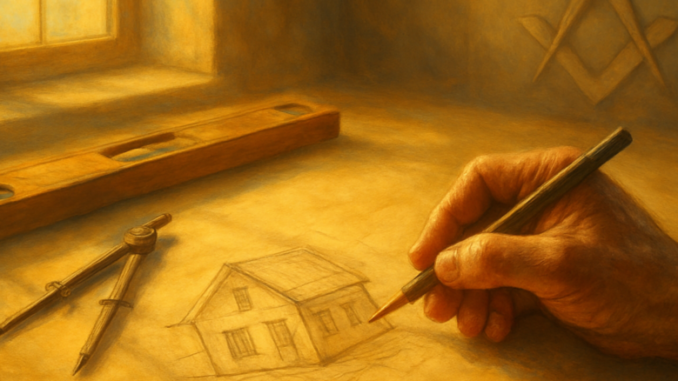
Housing prices may be cooling off, but for many people, owning a home remains a distant dream. Yet beyond the economics, there’s a far more compelling question worth asking: what does it actually mean to dwell somewhere? And what does the place you build or buy reveal — not just about who you are, but about who you are becoming?
Why Do We Long for a Home of Our Own?
On the surface, the desire to own a home looks like a purely financial matter — security, equity, the freedom to shape your own space. But if we’re honest with ourselves, something deeper is at work. A house is more than walls and a roof. It is an expression of identity, a physical manifestation of how we wish to be seen and how we experience ourselves.
In the Masonic tradition, each person is likened to a rough ashlar — an unfinished stone that must be shaped and refined. This metaphor extends beyond inner development. It also raises the question: what are you building with that stone once it’s been worked? What structure rises from the labor of your life? The home you inhabit, whether rented or owned, reflects something of that structure. Not in a material sense, but in the choices you make and the values you embody.
Does an Expensive Home Reflect a Well-Formed Character?
Here we must tread carefully. Today’s housing market makes it painfully clear that the price of a home says very little about the person living inside it. Young people with great ambitions and strong character may find homeownership completely out of reach, while others move effortlessly from one property to the next. The market does not measure inner worth.
But we can turn the question around. Instead of asking what kind of house you have, ask: how do you inhabit it? How do you receive guests? What atmosphere do you create? A Freemason would say that it’s not the size of the temple that matters, but the consecration that takes place within it. A modest room can become a sanctuary when its occupant lives there with attention and intention.
It is not the house that makes the person — it is the person who elevates a house into a home.
What Can We Learn From the Master Builder Within?
Freemasonry uses the metaphor of architecture to speak about personal development. The tools of the Mason — the square, the compasses, the level — are symbols for virtues such as justice, moderation, and balance. But there is also the Master Builder: the one who oversees the whole plan and knows where every stone belongs.
Apply this to today’s housing market and an interesting parallel emerges. Price growth may be flattening, but the pressure remains. What do you do when circumstances refuse to cooperate? The Master Builder within you doesn’t demand perfect conditions. He asks for adaptability, patience, and the ability to build with whatever materials are at hand. Perhaps the current housing situation is, above all, a lesson in humility.
How Does Our Living Space Shape Our Character?
There is also a reverse dynamic at play. We don’t just imprint our personality onto our living space — our living space also imprints itself on us. Someone who spends years in a cramped, dark room will be shaped by that experience differently than someone surrounded by light and open views. Environment forms us, sometimes subtly, sometimes forcefully.
In the Masonic lodge, the importance of environment for inner work is well understood. The temple is not arranged by accident. Every element carries meaning and contributes to the atmosphere needed for reflection and growth. We can look at our own homes the same way — not as finished products, but as workshops. What happens inside that workshop matters far more than the address or the price tag.
What If You Can’t Buy a Home?
This is the question weighing on many minds today. A slight easing of price increases offers little comfort when the starting point was already unattainable. Here, social reality touches a deeper truth: possession is not the same as purpose.
A Freemason learns that true wealth does not reside in stone, but in character. The question is not whether you own a house, but whether you have built an inner house strong enough to withstand life’s storms. That house requires no mortgage. It demands self-examination, the resilience to fall and rise again, and the courage to look honestly at yourself.
Think of it this way: patience forms the foundation. Flexibility serves as the load-bearing wall. Self-knowledge is the roof that shelters you. And connection to others — that is the window that opens you to the world.
The housing market will continue to fluctuate. Prices will rise, fall, and level off. But the need for inner space — a place where you can be yourself and grow — that need remains constant. And it is answered not with money, but with the choices we make in how we live.
Perhaps the most important lesson of this moment is that dwelling begins with inhabiting, and inhabiting begins with yourself. The Freemason does not build only temples of stone — above all, he builds the invisible architecture of character and integrity. And that structure belongs to you, regardless of what the housing market does.
Copyright text & image: devrijmetselaar.nl
Texts are based on the ideas and content of the author of devrijmetselaar.nl, reviewed, corrected, and supplemented with the assistance of OpenAI. Images are created based on the ideas of the author of devrijmetselaar.nl using OpenAI/DALL-E.
Frequently Asked Questions
What does Freemasonry teach about the connection between home and personal character?
Freemasonry uses the metaphor of the rough ashlar—an unfinished stone that must be shaped and refined—to represent personal development. This teaching extends beyond inner work to ask what we build with that refined stone in our lives, including the homes we inhabit and how we live within them. A Masonic perspective suggests that the home reflects not just material circumstances, but the choices and values we embody in how we inhabit our space.
Does a Freemason believe an expensive house indicates strong character?
No. Freemasonry teaches that it is not the size or cost of a structure that matters, but how it is consecrated and inhabited by its occupant. The market price of a home says little about inner worth, while a modest room can become a sanctuary when occupied with attention and intention. What truly matters is the person who elevates a house into a home through their values and how they receive others.
How do Masonic tools relate to building a home and character?
Masonic tools like the square, compasses, and level symbolize virtues such as justice, moderation, and balance that guide personal development. These same principles apply to creating a home: the Master Builder within uses adaptability, patience, and the ability to work with whatever materials are at hand. This teaches that strong character comes not from perfect conditions, but from building thoughtfully with the resources available to us.
What can renters learn from Freemasonry about their living space?
Freemasonry teaches that homeownership is not a prerequisite for creating a meaningful dwelling or developing strong character. Whether you rent or own, what matters is how intentionally you inhabit your space and the atmosphere you create within it. The principles of the craft apply equally to anyone seeking to build a sanctuary and express their values through how they live.




Be the first to comment