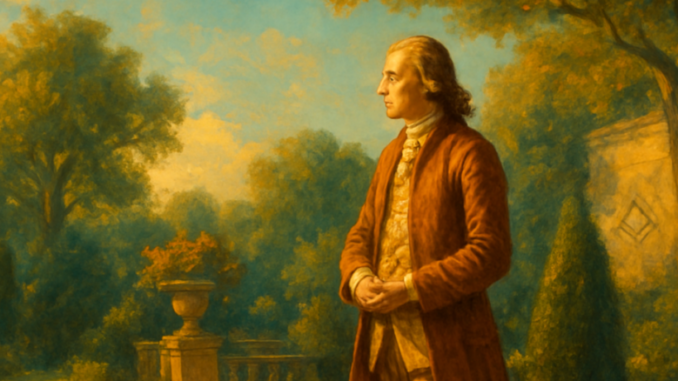
After an odyssey of disasters, wars, and bitter disillusionment, Candide finally arrives at a small garden. There he speaks the famous words: “We must cultivate our garden.” This deceptively simple conclusion to Voltaire’s satirical masterpiece contains a philosophy of life that is both profoundly practical and deeply meaningful. What does it truly mean to tend your own garden? And how can this insight be applied concretely in your life today?
Candide’s Journey: A Whirlwind Overview
Voltaire wrote Candide in 1759 as a razor-sharp attack on the philosophical optimism of his era — specifically the doctrine that we live in “the best of all possible worlds.” The protagonist, Candide, grows up under the tutelage of the philosopher Pangloss, who instills this optimism in him with unwavering conviction. Voltaire then proceeds to plunge his hero into a relentless cascade of misfortunes: war, earthquake, the Inquisition, slavery, and betrayal. Every time Candide believes things cannot possibly get worse, reality proves him wrong.
The story takes the reader from Lisbon to South America, from Paris to Constantinople. Along the way, Candide encounters a gallery of characters who each embody the absurdity of human existence in their own way. Cunégonde, his beloved, loses both her beauty and her illusions. Martin, a pessimistic traveling companion, provides a cynical counterweight to Pangloss. And an old woman recounts tales of suffering so extreme they seem to refute any notion of optimism.
The Encounter with the Turkish Farmer
The turning point of the story comes when Candide and his companions meet an old Turkish farmer. This man lives with his children on a modest plot of land. He knows nothing of politics, philosophy, or the grand questions that have consumed Candide for years. Yet he radiates a contentment none of the travelers have ever experienced. His secret is disarmingly simple: he works with his hands in his own garden and keeps the outside world at arm’s length.
This encounter leaves a profound impression on Candide. He comes to realize that all philosophical systems, all theories about good and evil, all attempts to make sense of the world, have not brought him a single step closer to happiness. The farmer, by contrast, has found something that actually works. He has limited his life to what he can genuinely influence — and found deep satisfaction within those boundaries.
The Garden as a Practical Philosophy of Life
When Candide finally settles on his own small farm, the group falls into a working rhythm. Each person contributes according to their ability: one bakes, another sews, yet another works the land. Pangloss still tries to expound his optimistic philosophy, but Candide cuts him short with the words: “That is well said, but we must cultivate our garden.”
To cultivate the garden means to direct your energy toward what you can actually improve, rather than losing yourself in theories about what you cannot change.
Voltaire is not advocating escapism or a naive withdrawal from the world. The garden represents the concrete, the tangible — the domain where your actions genuinely make a difference. It is a call to humility: acknowledge the limits of your influence and pour your soul into what lies within those limits. This is not passivity but purposeful action.
Three Lessons for Daily Life
How do you translate Voltaire’s insight into your own circumstances? Here are three concrete applications that flow directly from Candide’s conclusion:
Limit your information consumption. Just as Candide learns not to lose himself in grand world questions, you can choose which streams of news and opinion you allow into your life. Focus on what you can actually influence. The constant noise of global crises can paralyze rather than motivate — be intentional about what you let in.
Seek fulfillment in useful work. The characters in Candide find peace when they contribute to something tangible. Whether it is your profession, a craft, a hobby, or volunteer work, meaningful labor provides structure and purpose. There is a quiet dignity in work done well, regardless of its scale.
Invest in your immediate surroundings. Your garden can be a literal garden, but it can also be your family, your circle of friends, or your local community. Put your energy into relationships and places where your presence genuinely matters. Grand ambitions are fine, but lasting satisfaction often comes from the small, consistent acts of care closest to home.
The Garden in a Broader Perspective
Voltaire’s garden metaphor resonates with many traditions of thought. The Stoics — Marcus Aurelius and Seneca among them — likewise emphasized the importance of focusing on what lies within your power. The Epicureans sought happiness in a life of retreat among close friends. And in the practice of Freemasonry, the principle of working on yourself, of shaping your own “rough stone,” offers a strikingly similar starting point: begin with what you can form and improve.
In Masonic tradition, every Brother is encouraged to look inward before looking outward. The tools of the Craft — the gavel, the chisel, the square — are symbols of self-improvement and purposeful refinement. Voltaire’s garden, in this light, is not unlike the Lodge itself: a defined space where dedicated, patient effort leads to transformation. Both traditions understand that meaningful change does not begin with reforming the world at large, but with the disciplined cultivation of what is nearest to hand.
What Voltaire adds to this philosophical tradition is a layer of pragmatism and even humor. He mocks the grand systems, but his alternative is not nihilism. It is an invitation to live modestly yet purposefully. The garden demands daily attention, patience, and perseverance. The fruits do not come immediately — but they come.
Why This Work Still Matters Today
In an age of relentless news cycles, global crises, and overwhelming information, Candide delivers a surprisingly timely message. The temptation to lose yourself in worry over matters beyond your sphere of influence is greater than ever. Voltaire reminds us that our energy is finite and that the best use of it lies in the near, the concrete, the personal.
For Freemasons, this resonance is particularly strong. The Craft has always taught that the work begins within — within the Lodge, within the self. The temptation to philosophize endlessly about the state of the world is real, but the true labor lies in the daily practice of self-improvement and brotherly care. Voltaire’s garden and the Masonic workshop share this essential truth: transformation happens through consistent, humble effort in a space you have chosen to tend.
Voltaire’s Candide does not end with an answer to life’s great questions but with a method. The garden is not a final destination but a daily practice. By choosing the concrete over the abstract, the near over the distant, action over theorizing, you can build a life of genuine fulfillment. Like the Freemason who picks up his tools each day to work on his rough stone, Candide picks up his hoe and turns to the soil. The wisdom is the same: happiness is not found in understanding everything, but in caring for something. Whatever form your garden takes, begin cultivating it today.
Copyright text & image: devrijmetselaar.nl
Texts are based on the ideas and content of the author of devrijmetselaar.nl, reviewed, corrected, and supplemented with the assistance of OpenAI. Images are created based on the ideas of the author of devrijmetselaar.nl using OpenAI/DALL-E.
Frequently Asked Questions
What is the main message of Voltaire's Candide?
Voltaire's Candide is a satirical critique of philosophical optimism, particularly the idea that we live in 'the best of all possible worlds.' Through his protagonist's journey through countless disasters and misfortunes, Voltaire argues against naive optimism and ultimately suggests that true contentment comes from focusing on practical, personal endeavors—specifically, cultivating one's own garden—rather than attempting to understand grand philosophical theories.
Who is the Turkish farmer and why is he important to the story?
The Turkish farmer is a pivotal character who embodies the solution to Candide's lifelong struggles. Living a simple life on his modest plot of land with his children, he radiates contentment by working with his hands and avoiding political and philosophical concerns. His example teaches Candide that happiness comes not from understanding the world's complexities, but from focusing on what one can genuinely influence within one's own sphere.
What does 'cultivate your garden' mean in practical terms?
Cultivating your garden represents a philosophy of focusing your energy and attention on what you can directly control and influence in your own life, rather than getting lost in abstract theories or external circumstances beyond your power. It means limiting your concerns to achievable, tangible goals—whether literal gardening or metaphorical personal projects—and finding satisfaction and meaning in this focused, practical work rather than seeking happiness through grand philosophical systems or changing the world at large.



Be the first to comment