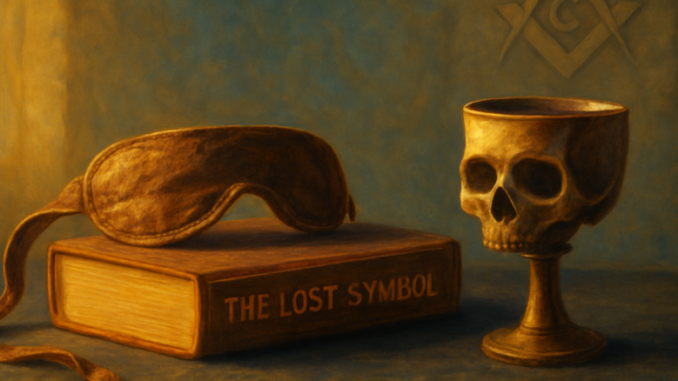
When Dan Brown published The Lost Symbol in 2009, it unleashed yet another wave of public curiosity about Freemasonry. Millions of readers found themselves wondering: are those mysterious rituals real? Are candidates actually blindfolded? Do Freemasons really drink wine from human skulls? It’s time for an honest fact-check, drawing on historical sources and the actual practices of lodges around the world.
What Does Dan Brown Actually Describe?
In The Lost Symbol, Dan Brown paints a dramatic picture of Freemasonry. The opening scene takes place in a temple room where an initiation ritual is underway. The candidate is blindfolded, wears specific ceremonial attire, and swears an oath. Later in the novel, higher degrees come into play, each with increasingly theatrical elements. But how much of this is actually rooted in real Masonic practice?
Is the Blindfold Historically Accurate?
Yes — this one checks out. The use of a blindfold during the initiation of an Entered Apprentice is a centuries-old tradition practiced in virtually every recognized lodge worldwide. Known in Masonic terminology as the “hoodwink,” the blindfold symbolizes the state of darkness in which the candidate exists before receiving light. This ritual element dates back to the eighteenth century and is referenced in Anderson’s Constitutions of 1723, the foundational document of modern Freemasonry compiled by James Anderson and Jean-Théophile Désaguliers.
What About the Skull and Drinking Wine?
This is where it gets more nuanced. In the regular Blue Lodge — the first three degrees of Freemasonry — no skull is used as a ritual drinking vessel. However, the skull as a memento mori is a recognized symbol within certain higher degrees, particularly in the Scottish Rite. In some traditions, a skull is displayed as a reminder of human mortality, a theme deeply rooted in Western philosophy stretching from the Stoics to Marcus Aurelius. But the dramatic image of drinking wine from a skull? That’s a strong literary exaggeration on Dan Brown’s part.
The rituals in The Lost Symbol contain a kernel of truth, but Brown amplifies and dramatizes them to build suspense. Real Freemasonry is far less theatrical and far more contemplative than what appears on the page.
Are Oaths Actually Taken?
Absolutely. Taking a solemn vow or obligation is a central part of every Masonic initiation. The candidate promises, among other things, to maintain secrecy regarding the rituals, loyalty to the brotherhood, and dedication to moral self-improvement. What Dan Brown didn’t mention, however, is that these oaths are never in conflict with the laws of the land or the candidate’s personal religious convictions. Freemasonry asks for loyalty, but never blind obedience.
Is the Temple Room Setting Accurate?
The description of the temple room in The Lost Symbol contains many recognizable elements. A Masonic lodge does indeed follow a fixed layout with specific positions for its various officers. The checkered floor pattern, the altar at the center, and the placement of the pillars are not inventions. These elements reference the Temple of Solomon, whose architect Hiram Abiff is a central figure in Masonic mythology. On this front, Dan Brown clearly did his homework.
What Is Pure Fiction?
Not everything in the novel holds up under scrutiny. The suggestion that Freemasons have access to lost ancient knowledge or magical powers is entirely fictional. Likewise, the implication that the organization pursues political power or exercises secret influence over the U.S. government belongs firmly in the realm of conspiracy theories. Real Freemasonry is a philosophical and ethical fraternity focused on personal development and mutual aid — not a shadow government.
So How Reliable Is the Book Overall?
With The Lost Symbol, Dan Brown wrote a page-turner that introduced millions of people to the world of Freemasonry. To his credit, he pulled the organization out of the realm of pure mystery and made it a topic of open conversation. At the same time, every reader should understand that a thriller is not a documentary. The blindfold is accurate. The oaths are accurate. The temple layout is largely accurate. But the dramatic effects, the alleged magical knowledge, and the sinister undertone are all literary embellishments.
Here’s a quick scorecard:
- Blindfold during initiation: Historically correct
- Taking of oaths: Historically correct
- Skull as a symbol: Partially correct — only in higher degrees
- Drinking wine from a skull: Heavily exaggerated
- Secret ancient knowledge: Pure fiction
Dan Brown’s The Lost Symbol is entertainment built on a foundation of historical facts. Anyone who truly wants to understand what Freemasonry is about would do well to look beyond the thriller. The real rituals are not sensational but symbolic, not secret but discreet, not magical but deeply meaningful. And perhaps, in the end, that is more fascinating than any fiction could ever be.
Copyright text & image: devrijmetselaar.nl
Texts are based on the ideas and content of the author of devrijmetselaar.nl, reviewed, corrected, and supplemented with the assistance of OpenAI. Images are created based on the ideas of the author of devrijmetselaar.nl using OpenAI/DALL-E.
Frequently Asked Questions
Are the blindfolding rituals in The Lost Symbol actually used in real Freemasonry?
Yes, the use of a blindfold during initiation is historically accurate. Known as the "hoodwink" in Masonic terminology, this centuries-old tradition is practiced in virtually every recognized lodge worldwide. It symbolizes the candidate's state of darkness before receiving light and dates back to the eighteenth century, referenced in Anderson's Constitutions of 1723.
Do Freemasons really drink wine from human skulls as depicted in The Lost Symbol?
This is largely a literary exaggeration. While skulls do appear as memento mori symbols in certain higher degrees of Scottish Rite Freemasonry to remind initiates of human mortality, drinking wine from a skull is not a standard practice in regular Blue Lodge rituals. Dan Brown dramatized this element for theatrical effect.
Are solemn oaths and obligations a real part of Masonic initiation?
Yes, absolutely. Taking a solemn vow or obligation is a central part of every Masonic initiation. Candidates promise to maintain secrecy regarding rituals, demonstrate loyalty to the brotherhood, and dedicate themselves to the organization's principles.

Be the first to comment