You probably recognize the moment: you say or do something without thinking, and only afterward does it dawn on you how hurtful or inappropriate it was. That painful flash of recognition, followed by the inevitable question — what now? A recent news story about a well-known actor who publicly apologized for mocking a sign language interpreter touches on this deeply universal human theme. The celebrity himself isn’t what matters here. What matters is the question his behavior raises: what does it truly mean to acknowledge your mistakes, and how does doing so shape you into a better person?
The Rough Ashlar We All Are
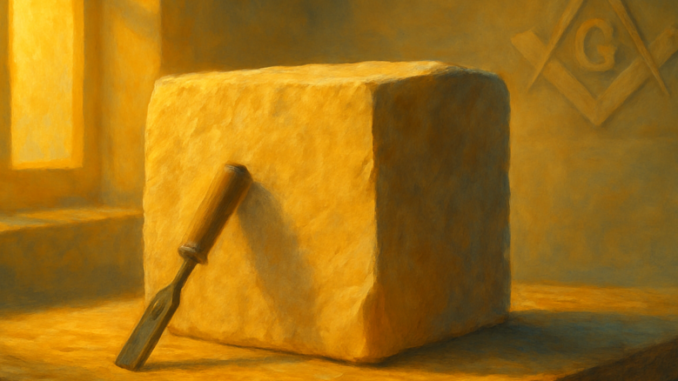
In Freemasonry, the rough ashlar plays a central role as a symbol for the individual at the beginning of their inner journey. You enter the lodge as unworked material — full of irregularities, sharp edges, and hidden flaws. The goal is never to deny or conceal these imperfections, but to recognize them and patiently work on them. Every mistake, every thoughtless action, every moment of weakness is like an imperfection in that stone.
When someone publicly mocks another person — especially someone performing an essential service for deaf and hard-of-hearing members of the community — it reveals a rough edge of their character. This is not about condemning that person. It’s about recognition. Because which of us has never acted without thinking? Who among us has never hurt someone without realizing it beforehand?
Self-Reflection as a Daily Practice
Freemasonry has a tradition stretching back to the eighteenth century and the Constitutions of James Anderson: the practice of daily self-reflection. At the end of each day, you ask yourself honest questions about your conduct. Did I do good today? Did I wrong anyone? What could I have done better? This practice is not about self-punishment — it’s a compassionate form of self-examination.
Marcus Aurelius, the Roman emperor and Stoic philosopher, described in his Meditations how he held himself accountable every evening. He asked which of his actions had fallen short of his principles. This attitude of honest introspection also lies at the heart of Masonic character building. The point is not to be perfect, but to be honest with yourself.
True strength of character is not revealed by avoiding mistakes, but by having the courage to acknowledge them and genuinely learn from them.
The Difference Between Regret and Transformation
There is a fundamental difference between expressing regret and actually transforming. Regret can be superficial — a social ritual to save face. Transformation, on the other hand, demands deep and genuine change. In Masonic terms, it’s not enough to simply acknowledge that the stone is rough. You must actually pick up the hammer and chisel.
Johann Wolfgang von Goethe, himself a Freemason, wrote extensively about the human tendency toward self-deception. He warned that we often believe we have changed when, in reality, we have merely learned to hide our flaws more skillfully. Real growth requires more than words. It demands a fundamental shift in how we see others and how we move through the world.
Respect as the Foundation of Brotherhood
Mocking a sign language interpreter touches on something deeper than bad humor. It raises the question of how we treat people who are different — people with different abilities who communicate in different ways. In Freemasonry, the principle of brotherly equality is paramount. Every person, regardless of background or ability, deserves to be treated with respect and dignity.
This doesn’t mean we are all the same. It means we recognize each other’s inherent worth. A sign language interpreter serves as an essential bridge between two worlds. Mocking that role is not only hurtful to the individual — it is disrespectful to an entire community that depends on that service. Here lies a crucial lesson about awareness: your actions carry consequences far beyond your immediate line of sight.
The Practice of Becoming Better
How do you translate this into your own life? Freemasonry offers no quick fixes, but it does provide a methodology. It begins with awareness — daring to look at your own behavior without immediately condemning or excusing yourself. Then comes analysis: why did I do this? What thought or emotion was driving me? And finally, intention: what will I do differently next time?
Take five minutes at the end of each day for quiet reflection. Ask yourself honest questions without falling into self-condemnation. Acknowledge your mistakes to those you’ve hurt. Look for the underlying patterns in your thoughtless actions. And celebrate your progress too, no matter how small it may seem.
From Incident to Insight
A public incident like mocking a sign language interpreter can go one of two ways: it can be forgotten as soon as the news cycle moves on, or it can serve as a catalyst for deeper thinking. For you as a reader, the celebrity is beside the point. What matters is the mirror the story holds up. When did you last hurt someone without realizing it? And more importantly — what did you do about it?
Freemasonry invites us on a lifelong journey of self-improvement. Not because we are bad and need to become good, but because growth is the natural state of a consciously living human being. Every day offers fresh opportunities to smooth that rough ashlar a little more — not by pursuing perfection, but by embracing honesty.
Acknowledging a mistake is not a sign of weakness — it is the beginning of real strength. Whether it’s a public figure issuing an apology or your own quiet moment of self-awareness, the willingness to look honestly at yourself forms the bedrock of character growth. In Freemasonry, we call this working the rough ashlar. It is not a one-time act but a lifelong practice. And perhaps that is the most beautiful invitation there is: you don’t have to be perfect. You simply have to keep trying, again and again, to become a little better than you were yesterday.
Copyright text & image: devrijmetselaar.nl
Texts are based on the ideas and content of the author of devrijmetselaar.nl, reviewed, corrected, and supplemented with the assistance of OpenAI. Images are created based on the ideas of the author of devrijmetselaar.nl using OpenAI/DALL-E.
Frequently Asked Questions
What does the 'rough ashlar' symbol mean in Freemasonry?
In Freemasonry, the rough ashlar is a central symbol representing an individual at the beginning of their inner journey. It symbolizes that we all enter with imperfections, irregularities, and sharp edges. The goal is not to deny or hide these flaws, but to recognize them and patiently work on self-improvement. Every mistake and thoughtless action is viewed as an imperfection in the stone that can be refined through conscious effort.
What is the Masonic practice of daily self-reflection?
Freemasonry has a tradition dating back to the eighteenth century and James Anderson's Constitutions that emphasizes daily self-reflection. At the end of each day, practitioners ask themselves honest questions: Did I do good today? Did I wrong anyone? What could I have done better? This practice is not about self-punishment, but rather a compassionate form of self-examination designed to build character through honest introspection and accountability.
How does Freemasonry view mistakes and personal growth?
Freemasonry teaches that true strength of character is not revealed by avoiding mistakes, but by having the courage to acknowledge them and genuinely learn from them. The organization emphasizes that everyone makes thoughtless errors and hurts others unintentionally. Rather than condemning people for their mistakes, Freemasonry encourages recognition of these imperfections as opportunities for transformation and self-improvement, distinguishing between merely expressing regret and actually achieving meaningful change.

Be the first to comment