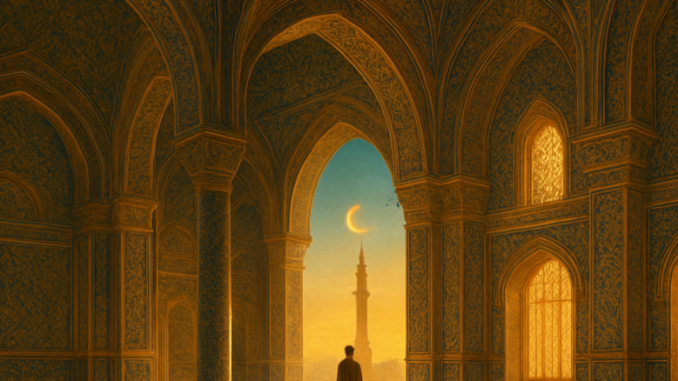
Perhaps you know the feeling: you know what the right thing to do is, but the world around you seems to be pulling in a different direction. You stand alone with your conviction, wondering whether your voice will ever be heard. This very human dilemma lies at the heart of Surah Hud, the eleventh chapter of the Quran. It tells the stories of prophets who swam against the tide, who kept speaking when no one wanted to listen. Their stories are timeless and touch on themes that also hold a central place in Freemasonry: steadfastness, truth, and the courage to follow your inner compass.
The Heart of Surah Hud
Surah Hud takes its name from the prophet Hud, a figure in the Arabian tradition who was sent to the people of Aad. But the surah reaches far beyond a single prophet. It contains the stories of Noah, Salih, Abraham, Lot, Shu’ayb, and Moses. Each of them confronts a people who refuse to listen — a people clinging to old habits and material certainties. The common thread is unmistakable: the prophets call for justice and spiritual purity, but are met with resistance, mockery, and sometimes outright violence.
What makes this surah so powerful is not so much the eventual downfall of the disbelieving nations, but the inner struggle of the messengers themselves. They know their task is thankless. They experience loneliness and frustration. And yet they carry on — not because success is guaranteed, but because speaking the truth is a duty that transcends personal gain.
Steadfastness as a Spiritual Calling
In Freemasonry, we know the concept of the rough ashlar that must be shaped into a perfect cube. This is not a one-time act but a lifelong process of self-development. Surah Hud underscores this idea from a different angle: the prophets are like craftsmen who are not building their surroundings, but building their own integrity. They refuse to be swept along by the prevailing opinions of their time. They remain faithful to their inner light, even when that light is ignored or ridiculed by others.
Spiritual growth does not require the world’s applause — it requires faithfulness to your own inner truth.
This message resonates deeply with the Masonic experience in the temple. You do not work for external recognition. You work on yourself, in silence, with patience. The prophets in Surah Hud are, in that sense, brothers in spirit: they understand that the true reward lies not in convincing others, but in keeping one’s own soul pure.
Noah’s Ark: A Structure Built on Trust
One of the most evocative passages in Surah Hud is the story of Noah and the ark. We know this story from the biblical tradition as well, but the Quranic version places particular emphasis on the building process itself. Noah constructs his ark while his people laugh at him. Every plank he hammers into place is an act of faith. He does not know for certain whether the flood will come. He acts out of trust, not certainty.
For Freemasons, this image is rich with meaning. We too are builders. We build an inner temple, a brotherhood, a better world. That structure is not always visible to others. Sometimes it seems pointless or old-fashioned. But like Noah, we keep building — because we believe the work itself is valuable, regardless of how the outside world responds.
Warning and Grace: Two Sides of the Same Coin
Surah Hud also contains a serious warning. The nations that refuse to listen face dramatic consequences. But a careful reading reveals that these stories are not about punishment as an end in itself. They show what happens when people completely shut themselves off from self-reflection and from the voice of conscience. The prophets offer the opportunity for repentance time and again. Grace always precedes consequence.
This is a subtle but important point. In Freemasonry, we do not believe in a punishing force outside of ourselves, but we do recognize the natural consequences of our choices. Those who refuse to work on themselves, who leave their rough stone untouched, will eventually reap the results — not as punishment from above, but as the logical outcome of neglect. Surah Hud illustrates this principle with powerful images that invite deep reflection.
The Universal Language of Spiritual Traditions
What makes Surah Hud so valuable for anyone interested in spirituality is the universality of its themes. You do not need to be Muslim to be moved by the image of a lonely messenger who stays faithful to his mission. You do not need to believe in a specific God to recognize the value of steadfastness, integrity, and self-examination.
Freemasonry is open to people of all religious and philosophical backgrounds. We read each other’s sacred texts not to convert, but to learn. We search for the shared wisdom that flows beneath the surface of different traditions. In Surah Hud, we find that wisdom in abundance: the courage to speak, the strength to build, and the trust that goodness will ultimately find its way.
What Surah Hud Can Teach You
Ask yourself: where in your life are you calling out something that goes unheard? Where are you building something that others may not understand? Surah Hud invites you to see that loneliness not as failure, but as a sign that you are walking your own path. The prophets were not loved by everyone. But they remained true to themselves. And perhaps that is ultimately the only measure that truly counts.
Surah Hud reminds us that spiritual growth rarely comes with ease or approval. The prophets in this surah were not popular figures. They were builders, speakers of uncomfortable truths, and bearers of an inner light they could not ignore. As a Freemason, you may recognize something of that posture: the quiet work on yourself, the relentless search for truth, and the deep conviction that every stone laid with integrity contributes to something far greater than yourself.
Copyright text & image: devrijmetselaar.nl
Texts are based on the ideas and content of the author of devrijmetselaar.nl, reviewed, corrected, and supplemented with the assistance of OpenAI. Images are created based on the ideas of the author of devrijmetselaar.nl using OpenAI/DALL-E.
Frequently Asked Questions
What is the main theme of Surah Hud and how does it relate to Freemasonry?
Surah Hud tells the stories of prophets who maintained their integrity and spoke truth despite facing resistance and ridicule from their communities. This connects to Freemasonry through shared values of steadfastness, truth, and following one's inner compass. Both traditions emphasize that spiritual growth comes from faithfulness to inner truth rather than external recognition or approval.
Which prophets are featured in Surah Hud and what do their stories have in common?
Surah Hud contains the stories of Noah, Hud, Salih, Abraham, Lot, Shu'ayb, and Moses. The common thread among their narratives is that each prophet called their people toward justice and spiritual purity, but was met with resistance, mockery, and sometimes violence. Despite knowing their task was thankless, they continued speaking truth as a spiritual duty that transcended personal gain or guaranteed success.
How does the concept of the rough ashlar in Freemasonry relate to the prophets' journey in Surah Hud?
Both represent a lifelong process of self-development and building inner integrity. Just as the rough ashlar must be shaped into a perfect cube through continuous work, the prophets in Surah Hud shaped their own integrity by refusing to be swept along by prevailing opinions. This illustrates that true spiritual growth is an internal process of faithfulness to one's principles, conducted in patience and silence, regardless of external validation or applause.




Be the first to comment