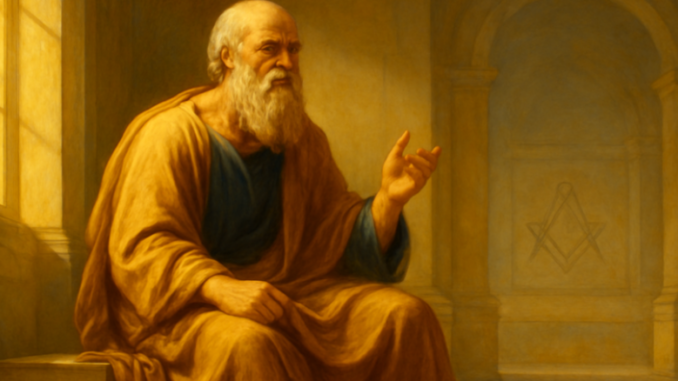
It is late in the evening. The candles in the lodge burn low as a Brother, still in his work attire, rises to speak. He does not talk about great deeds or heroic battles. Instead, he recounts a moment earlier that day when he stayed silent while a colleague was treated unjustly. The question lingers in the room: was that cowardice, or was it wisdom? It is precisely this struggle that Plato captured more than two thousand years ago in his dialogue Laches — a conversation about the true nature of courage that remains strikingly relevant for anyone who has ever wondered what it truly means to be brave.
The Search for a Definition of Courage
In the Laches, Plato stages a conversation between Socrates and two Athenian generals: Laches and Nicias. Both men have proven their courage on the battlefield, yet when Socrates asks them to define what courage actually is, their answers fall short. Laches initially proposes that courage simply means holding your ground in battle and refusing to flee from the enemy. Socrates dismantles this definition effortlessly by pointing to situations where retreat is actually the braver choice.
This search for a definitive answer is far from an academic exercise. It strikes at the heart of how we evaluate and justify our own behavior. Plato shows us that even seasoned warriors do not automatically understand what drives them. This realization is the first step toward genuine self-reflection — a value that stands equally central in Freemasonry.
Courage as Knowledge: The Turn of Nicias
Where Laches describes courage as a physical stance, Nicias offers a more philosophical perspective. He proposes that courage is the knowledge of what is truly to be feared and what is not. This intellectual answer seems more elegant, but it raises new questions. If courage is a form of knowledge, how does it differ from wisdom in general? And can someone who possesses this knowledge still act in a cowardly way?
Socrates drives the conversation to an impasse. Neither definition withstands critical examination. Yet this apparent failure is precisely the heart of Plato’s message. The dialogue does not end with an answer but with the awareness that the search itself is valuable. Whoever has the courage to question their own convictions is already on the path toward wisdom.
True courage does not begin with deeds, but with the willingness to honestly examine yourself and your beliefs.
Freemasonry and the Inner Battle
Freemasonry knows no battlefields, but it speaks very much about struggle — the inner struggle between lower impulses and higher aspirations, between complacency and the will to improve. The rough ashlar that must be shaped into a perfect cube symbolizes this process. It takes courage to pick up the gavel and acknowledge your own imperfections.
In the lodge, Brethren are invited to engage in self-reflection without external judgment. This safe space paradoxically makes it harder to be truly honest. When no one compels you, the courage must come from within. This aligns seamlessly with Plato’s vision: courage is not the absence of fear, but the ability to ask the right questions despite uncertainty.
Brotherhood as a Source of Courage
What the Laches does not explicitly address but strongly suggests is the role of community in cultivating virtue. Socrates does not conduct his inquiry alone — he engages with others. Freemasonry institutionalizes this collective search. In the chain of union, when Brethren clasp each other’s hands, a collective bond is formed that can compensate for individual weakness.
Several principles connect Plato’s method to Masonic practice. Dialogue as a method: like Socrates, Freemasons seek truth through conversation and exchange. The acknowledgment of ignorance: the first step toward wisdom is admitting that you do not know everything. Courage as a process: neither Plato nor Freemasonry presents courage as a destination, but as an ongoing exercise.
This shared pursuit strengthens individual courage. It is easier to face your own shadow when you know that others are doing the same. Brotherhood does not grant exemption from personal work, but it provides the support to sustain that work over time.
The Question That Lingers
Plato deliberately leaves the definition of courage open. This is not a weakness of the dialogue but its greatest strength. By offering no conclusive answer, he invites every reader to answer the question personally. Freemasonry employs a similar pedagogy. Symbols are not explained but offered. It is up to each individual Brother to find meaning.
This openness creates space for growth. Someone who defines courage today as standing firm may discover tomorrow that letting go is sometimes braver. The rough ashlar is never fully shaped. There is always a new angle, a hidden imperfection that demands attention. In this continuous labor lies the true connection between Plato’s philosophy and the practice of Freemasonry.
The Brother who spoke that evening in the lodge about his silence found no ready-made answer. But by raising the question — by examining his actions in the light of the values he holds dear — he demonstrated precisely the kind of courage Plato described. Not the courage of the battlefield, but the courage of a mind that refuses to settle for easy answers. In that refusal, in that relentless quest, philosophy and Freemasonry meet as two paths leading toward the same light.
Copyright text & image: devrijmetselaar.nl
Texts are based on the ideas and content of the author of devrijmetselaar.nl, reviewed, corrected, and supplemented with the assistance of OpenAI. Images are created based on the ideas of the author of devrijmetselaar.nl using OpenAI/DALL-E.
Frequently Asked Questions
How does Plato's definition of courage in the Laches apply to modern Freemasonry?
Plato's Laches explores courage beyond physical bravery, showing that true courage involves self-reflection and the willingness to question one's own beliefs. In Freemasonry, this translates to an inner battle rather than physical conflict. The article suggests that Masonic courage means having the honesty to examine yourself and your convictions, which aligns with Platonic philosophy's emphasis on self-knowledge as the foundation of virtue.
What did Socrates find wrong with Laches' definition of courage?
Laches proposed that courage simply means holding your ground in battle and refusing to flee from the enemy. Socrates dismantled this definition by pointing out that retreat can sometimes be the braver choice than standing firm. This demonstrates that physical stance alone cannot define courage, and that context and wisdom must inform what truly constitutes brave action.
Why does Plato's dialogue end without providing a final answer about courage?
Plato intentionally concludes the Laches at an impasse where neither Laches' nor Nicias' definition withstands scrutiny. The article explains that this apparent failure is the heart of Plato's message: the dialogue's value lies not in the answer itself, but in the awareness that the search for truth is valuable. True courage begins with the willingness to honestly examine yourself and your beliefs, making the questioning process itself the path toward wisdom.

Be the first to comment