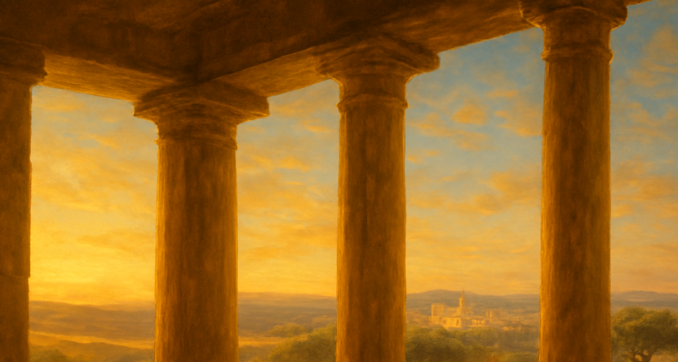
A candle flickers softly in the dim light of the lodge room. A Freemason turns the worn pages of a Bible, open to the Fourth Gospel. His finger rests on the opening words: “In the beginning was the Word.” A quiet smile crosses his face, because he recognizes something — the same search for light, the same longing for truth that once led him to Freemasonry. What is it about this ancient text that continues to stir the imagination across centuries?
An Opening That Says Everything
The Gospel of John sets itself apart from the other three Gospels right from the start with its mystical opening lines. Where the other evangelists begin with genealogies or birth narratives, John opens with a cosmic vision. The Word — in Greek, “Logos” — existed before anything else. This Word brought light into the darkness, and the darkness could not overcome it. For anyone familiar with initiation rituals, this echoes a deeply recognizable journey: the passage from ignorance to knowledge, from blindness to sight.
This prologue is no incidental literary flourish. John frames his entire narrative within a cosmic architecture in which light and darkness are not merely physical phenomena but symbols for the state of the human soul. The question he implicitly poses is one that every seeker knows intimately: how do we find the light when we are surrounded by shadow?
The Seven Signs as an Inner Journey
The Gospel of John is remarkably structured around seven miraculous signs, from the turning of water into wine to the raising of Lazarus. These signs are not a random collection of wonders — together, they trace a path of transformation. Water becomes wine, sickness becomes health, blindness becomes sight, and ultimately life conquers death itself. The number seven, which symbolizes completion and perfection in countless traditions, signals that something essential is being revealed about the human capacity for growth.
For those who know Freemasonry, this structure is unmistakably familiar. The degrees of initiation likewise form a carefully designed journey, where each step brings new insights and draws the candidate closer to inner light. John is not describing external magic but an internal process — one in which a person learns to see what was previously imperceptible.
The Conversation with Nicodemus: Rebirth as a Central Theme
One of the most frequently cited passages in this Gospel is the nighttime conversation between the Teacher and Nicodemus, the Pharisee. “Unless one is born again, he cannot see the Kingdom,” we are told. Nicodemus takes this literally and asks in bewilderment how a person can re-enter his mother’s womb. But the meaning is symbolic: what is required is a spiritual rebirth, a fundamental shift in perspective.
“The wind blows where it wishes; you hear its sound, but you do not know where it comes from or where it goes. So it is with everyone who is born of the Spirit.”
This image of invisible yet palpable transformation resonates profoundly with the Masonic concept of the rough ashlar being gradually shaped into a perfect cube. The change may not always be visible to the outward eye, but it is real and essential. Nicodemus comes in the night — in the darkness of his own misunderstanding — and receives words that invite him to step into the light.
The Vine and the Branches: Brotherhood as a Process of Growth
In the fifteenth chapter, John speaks of the vine and the branches. The branches that remain connected to the stem bear fruit; those that are cut off wither and die. This image is a powerful metaphor for connection and community. No branch can exist by itself — it needs the nourishing strength of the whole.
For Freemasons, this is a deeply recognizable principle. The lodge is not a collection of isolated individuals but an organic whole in which every member contributes to collective growth. The brotherhood is not merely social — it is essential: we need each other to become who we are capable of being. John invites reflection on which connections nourish us and which ones hinder our development.
Truth That Sets You Free
Another central idea in this Gospel is the declaration that the truth will set you free. This is not freedom in the sense of casting off external chains, but an inner liberation from the prison of illusion and self-deception. John suggests that true freedom begins with acknowledging what is real — even when that truth proves uncomfortable.
Taken together, the Gospel of John weaves several interconnected themes that speak directly to the Masonic experience: light as a symbol of insight and awareness; rebirth as inner transformation; connectedness as a condition for growth; and truth as the path toward inner freedom. These themes do not form a dogmatic system but rather an invitation to personal exploration. John writes not to convince but to unveil — to lift the veil for those willing to look. This is what makes his Gospel a timeless document that speaks to anyone who wonders what it truly means to live.
The Relevance of an Ancient Text
In an age when information is abundant but wisdom seems scarce, the Gospel of John offers a counterbalance. It does not invite quick answers but slow, deliberate understanding. It does not demand blind faith but inner sight. The symbolism of light and darkness, of rebirth and connectedness, speaks to universal human experiences that transcend every cultural and religious boundary.
For Freemasons, this Gospel is not a holy book in the sense of an exclusive claim to truth, but a source of contemplation alongside many others. It rests on the altar of the lodge as a symbol of humanity’s striving toward light, together with the writings of other traditions. In this way, John reminds us that the quest for truth is older than any organization — and that we all share in the same timeless movement toward the light.
The Gospel of John endures not because it provides definitive answers, but because it asks the right questions — the same questions that draw seekers to Freemasonry. Its language of light and darkness, transformation and brotherhood, transcends any single tradition or era. Whether read in a lodge room by candlelight or studied in quiet solitude, it reminds us that the search for truth is both deeply personal and profoundly universal. We are all, in our own way, walking from darkness toward light.
Copyright text & image: devrijmetselaar.nl
Texts are based on the ideas and content of the author of devrijmetselaar.nl, reviewed, corrected, and supplemented with the assistance of OpenAI. Images are created based on the ideas of the author of devrijmetselaar.nl using OpenAI/DALL-E.
Frequently Asked Questions
What does the Gospel of John have to do with Freemasonry?
The Gospel of John uses symbolism of light overcoming darkness and spiritual transformation that mirrors the journey of initiation in Freemasonry. Both traditions emphasize the passage from ignorance to knowledge and the discovery of inner truth through careful, progressive steps. This parallel symbolism has made John's Gospel particularly meaningful to Freemasons throughout history.
Why are the seven signs in John's Gospel significant to Masonic teaching?
The seven signs in John's Gospel represent a complete journey of spiritual transformation, much like the degrees of Masonic initiation. Each sign demonstrates growth and enlightenment — from physical healing to ultimate spiritual victory — reflecting the Masonic principle that initiation is an internal process of personal development. The number seven itself symbolizes completion and perfection in many traditions, including Freemasonry.
What does 'being born again' mean in the context of the Gospel and Freemasonry?
Being 'born again' refers to a spiritual rebirth and fundamental shift in perspective, not a literal physical rebirth. This concept aligns with Masonic initiation, where candidates undergo a symbolic death and rebirth to gain new understanding and enlightenment. Both traditions recognize that true transformation requires an internal change in how one perceives and understands the world.
Is Freemasonry based on the Bible or Christian teachings?
While Freemasonry respects and draws symbolic meaning from the Bible, including the Gospel of John, it is not exclusively based on Christian doctrine. Freemasonry welcomes men of all faiths and uses universal principles of light, truth, and spiritual growth that appear across many religious traditions. The Gospel of John resonates with Masonic symbolism because both explore timeless themes of enlightenment and inner transformation.

Be the first to comment