The 33rd degree fascinates and confounds in equal measure. How can a brotherhood that preaches equality simultaneously maintain a system of thirty-three ascending steps? It’s a question that occupies outsiders and initiates alike — and perhaps that is exactly the point. Because within this tension between hierarchy and equality lies a deeper insight into what human connection truly means.
The Paradox of the 33rd Degree Explained
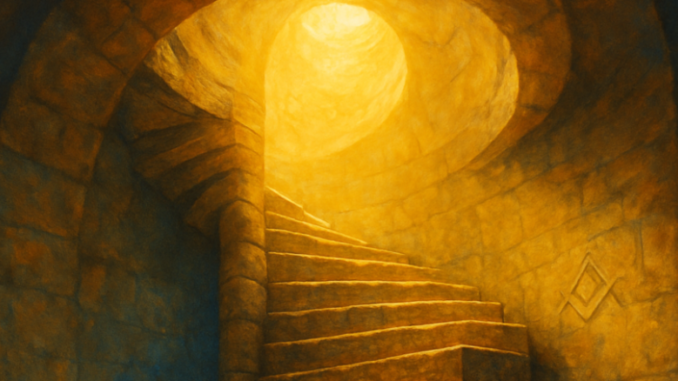
Let’s begin with a provocative proposition: the highest degrees of Freemasonry exist not to elevate people, but to make them smaller. Not in the sense of humiliation, but in the original meaning of the word humilitas — derived from humus, the earth. The higher one climbs on the symbolic ladder, the sharper the awareness of one’s own limitations becomes. The thirty-third step is not a throne but a vantage point from which the horizon remains infinite.
This may sound like a contradiction. We live in an age in which hierarchy has become suspect, in which every form of rank is automatically associated with power and oppression. Yet the structure of degrees within Masonic traditions operates in a fundamentally different way. It is not a ladder upward, but a spiral inward. Each degree reveals not so much new secrets as new questions about the self.
Brotherhood Beyond the Illusion of Equality
Here we touch on something essential. True brotherhood does not require everyone to be identical. In fact, the notion that brotherhood means everyone must be exactly the same may be the greatest misconception of our modern era. Brothers are by definition different — born at different moments, with different talents and shortcomings. What binds them is not their sameness, but their shared origin and destination.
The degrees of the Scottish Rite, of which the 33rd forms the culmination, reflect this insight. They acknowledge that people find themselves at different points along their inner journey. An Entered Apprentice is not worth less than a Master Mason, just as a child is not worth less than an adult. The difference lies in maturation — in the accumulation of experience and reflection. The brotherhood exists precisely by virtue of this diversity.
The Counterweight: When Degrees Turn to Stone
Of course, we must also face the counterargument. Every system of degrees carries within it the risk of ossification — of people confusing their position with their identity. An eighteenth-century philosopher already warned that distinctions intended as milestones can harden into fortresses. The question is not whether this danger exists — it undeniably does — but how to deal with it.
The wise man wears his distinctions as a cloak he can set aside at any moment — not as a skin that has grown inseparable from his being.
Within the Masonic tradition, ritual serves as the antidote to this ossification. Every meeting reminds those present that, regardless of their degree, they labor together on the same edifice. The Master Mason kneels beside the Apprentice during the same symbolic acts. The bearer of the 33rd degree speaks the same obligations as the one who has just been initiated. The ritual does not level the differences, but places them in perspective.
The 33rd Degree as a Synthesis of Serving and Leading
Perhaps we can arrive at a synthesis. The highest degrees of Freemasonry represent not so much a reward for services rendered, but rather an intensification of the obligation to serve. The more one has received in insight and experience, the greater the responsibility to pass it on. The 33rd degree, in this sense, is the mark of someone who places himself entirely in service of the brotherhood.
This casts a different light on the apparent contradiction with which we began. A hierarchy based on service functions fundamentally differently from a hierarchy based on power. In the first case, one ascends by bowing; in the second, by pressing others down. The Masonic tradition, at its best, represents the first model. Each degree is a deepening of the question: how can I contribute?
The Apprentice asks: What must I learn?
The Fellow Craft asks: What can I build?
The Master Mason asks: What can I pass on?
The highest degrees ask: How can I serve the tradition itself?
An Open Question About the 33rd Degree
And yet, something nags. Isn’t it true that every system of distinctions, no matter how pure its intent, ultimately drives people toward competition rather than cooperation? Can brotherhood truly flourish within a structure that places some above others, even if only symbolically? Freemasonry has no definitive answer to these questions — and perhaps that is its greatest strength. It keeps the tension alive, refusing to choose between the ideal of complete equality and the reality of human diversity.
The 33rd degree thus remains what it has always been: an invitation to contemplation, not a destination. Whoever believes they have arrived at the highest step may have missed the essence of the journey entirely. For the question that lingers is this: if brotherhood means we are all traveling together, does it truly matter which step someone stands on — so long as he is willing to reach out his hand to the one walking behind him?
Copyright text & image: devrijmetselaar.nl
Texts are based on the ideas and content of the author of devrijmetselaar.nl, reviewed, corrected, and supplemented with the assistance of OpenAI. Images are created based on the ideas of the author of devrijmetselaar.nl using OpenAI/DALL-E.
Frequently Asked Questions
How can Freemasonry claim to promote equality while maintaining 33 different degrees?
The degrees in Freemasonry don't create hierarchy in the traditional sense of power or worth, but rather reflect different stages of personal and spiritual development. True brotherhood acknowledges that members are at different points in their inner journey, much like how a child isn't worth less than an adult—they're simply at different stages of maturation. The degrees serve as milestones for self-reflection and growth, not as markers of superiority.
What is the purpose of advancing through the degrees in Freemasonry?
Advancement through the degrees is designed to deepen self-awareness and understanding rather than to gain power or status. Each degree poses new questions about oneself and reveals personal limitations, creating a spiral inward of reflection rather than a climb upward of dominance. The ultimate goal is wisdom and enlightenment, symbolized by the 33rd degree as an infinite horizon rather than a final destination.
Does achieving a higher degree in Freemasonry make someone more valuable as a brother?
No—an Entered Apprentice holds equal worth and dignity as a Master Mason or 33rd-degree member within the brotherhood. The difference lies in experience and spiritual maturation, not in human value or importance. Masonic ritual continually reinforces this principle by reminding all members, regardless of degree, that they labor together on the same shared purpose.
How does Freemasonry prevent people from using their degree as a source of pride or superiority?
The Masonic tradition uses ritual as a safeguard against this danger, ensuring that meetings remind members of their common purpose and equal standing. The teaching that 'the wise man wears his distinctions as a cloak he can set aside at any moment' encourages members to view degrees as temporary markers of progress rather than permanent identities. This prevents distinctions from hardening into barriers between brothers.

Be the first to comment