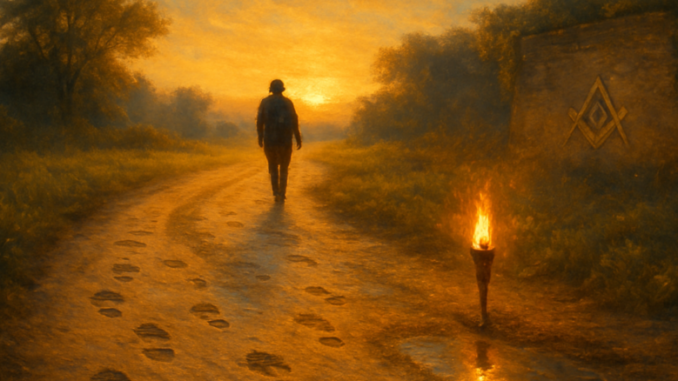
Here is a paradox worth contemplating: can a four-day walking march achieve the same thing as an initiatory journey that has survived centuries? Recent stories about younger participants shattering the traditional image of the Nijmegen Four Days Marches as an older person’s event raise a deeper question. What exactly happens when generations ignite each other’s enthusiasm for a shared ordeal? And why does that process feel so familiar to anyone acquainted with Freemasonry?
The Road as Teacher
There is something remarkable about the simple act of walking. Unlike running, which propels us forward with urgency, or standing still, which holds us in place, walking occupies an in-between space. It creates a rhythm that allows reflection without coming to a halt. The Four Days Marches — the famous Vierdaagse held annually in Nijmegen, the Netherlands — compels participants to sustain this rhythm for four consecutive days, pushing through fatigue, past the point where quitting becomes deeply appealing. This is no accident. It is precisely the mechanism that makes transformation possible.
Freemasonry recognizes a remarkably similar principle. The journey from Entered Apprentice to Fellow Craft to Master Mason is not a matter of accumulating knowledge. It is a process of undergoing — of being physically and mentally present through successive experiences that set something in motion within. Just as the foot strikes the ground again and again, the seeker returns to the same fundamental questions, yet each time subtly changed by what came before.
Generations Igniting Each Other
The word young Vierdaagse participants are using to describe what happens between them — that they “ignite” each other — deserves closer examination. To ignite is a word with multiple layers. It suggests fire, contagion, but also the passing of a flame. In that last meaning, it touches one of the oldest images in human imagination: the torch handed from one person to another, from one generation to the next.
The flame does not die when it is shared. It multiplies.
This image is deeply embedded in Masonic tradition. The passing of light, of insight, of enthusiasm is not a transaction where the giver loses something. On the contrary — in the sharing, both are strengthened. When young walkers inspire older participants and vice versa, we see this principle in action. The rejuvenation of the Four Days Marches is not a displacement of the old but a mutual illumination.
Ordeal as the Great Equalizer
Why does a sense of deep connection emerge so quickly between people who endure an ordeal together? Psychology offers explanations involving shared stress responses and oxytocin, but something more profound is at work. In the ordeal, masks fall away. The blisters on a CEO’s feet hurt just as much as those on a student’s. A veteran’s thirst is no different from a newcomer’s. In the shared endurance of discomfort, social distinctions are temporarily dissolved.
The Masonic lodge deliberately creates a comparable space. Within the temple, social ranks and titles become irrelevant. The banker stands beside the carpenter — not as equals in the outside world, but as equals in their search. The Four Days Marches achieves something strikingly similar, perhaps without even intending to. The route makes no distinctions.
The Inverted Perspective
Let us flip the opening paradox on its head. Perhaps the question is not whether the Four Days Marches can accomplish the same thing as an initiatory journey. Perhaps the real question is whether we still recognize what an initiatory journey actually is. In an age when transformation is routinely promised through quick fixes, weekend courses, and apps guaranteeing enlightenment in ten minutes a day, the Vierdaagse offers something stubbornly countercultural. Four days. A hundred and fifty kilometers or more. No shortcuts available.
Freemasonry has always understood that genuine change takes time. The degrees are not rushed through in a single weekend. There is space between them — time to let things settle, to live with what has been experienced before taking the next step. The young participants of the Four Days Marches are rediscovering this truth, not because someone taught it to them, but because the road itself is the teacher.
The Return as the True Journey
In virtually every tradition that involves initiation, a central emphasis is placed on the return. The hero who comes back from the adventure, the traveler who arrives home after the pilgrimage, the apprentice who leaves the temple after the ceremony — they all face the same question: how will they integrate what they have experienced into daily life?
For the marchers, that question arrives on the fifth day. The city is quiet, the gladioli have wilted, the blisters are slowly healing. What remains? Is it merely a memory of shared pain and relief? Or has the march set something in motion that continues to shape how one meets the world?
A Freemason would say: that depends on the attention with which you walked. It is not the kilometers that count, but the awareness with which they were covered. Not the crossing of the finish line, but what was noticed along the way — about yourself, about others, about the boundary between what you thought you could endure and what you actually could.
An Open Question
If young and old participants truly ignite each other — if generations are set in motion by each other’s fire — then a larger question emerges. Where are the other paths on which we can meet, not despite our differences but precisely through a shared ordeal? Freemasonry offers such a path. The Four Days Marches, it turns out, does too. What other roads remain undiscovered?
Perhaps the deepest lesson of the rejuvenated Four Days Marches is not that young people are saving the tradition, but that traditions stay alive when they continue to invite genuine experience. It does not matter whether that experience takes place in a lodge or on a country road through the Dutch heartland. What matters is the willingness to walk, to persevere, and along the way, to pass the flame to whoever walks beside you. That is not a phenomenon of the young or the old. It is timelessly human.
Copyright text & image: devrijmetselaar.nl
Texts are based on the ideas and content of the author of devrijmetselaar.nl, reviewed, corrected, and supplemented with the assistance of OpenAI. Images are created based on the ideas of the author of devrijmetselaar.nl using OpenAI/DALL-E.
Frequently Asked Questions
How is the Four Days Marches similar to Freemasonry?
Both the Four Days Marches and Freemasonry function as transformative journeys that rely on sustained effort and reflection rather than quick achievement. Like the Masonic degrees, the four-day walking ordeal creates a rhythm that allows participants to be physically and mentally present through successive experiences that gradually change them. In both traditions, the journey itself—not just the destination—is what matters, and this process fosters deep personal growth.
What does 'igniting each other' mean in the context of Freemasonry?
The concept of igniting refers to the passing of enthusiasm, insight, and light from one person to another, particularly across generations. In Freemasonry, this principle recognizes that shared knowledge and inspiration don't diminish when passed along—they multiply and strengthen both the giver and receiver. This mutual illumination is central to how Masonic lodges maintain vitality and relevance across centuries.
Why does Freemasonry emphasize undergoing experiences rather than just learning?
Freemasonry recognizes that genuine transformation comes through being physically and mentally present during meaningful experiences, not simply accumulating information. Like the repeated footfalls of a long walk that gradually change the walker, returning to fundamental questions through ritual and practice allows each seeker to be subtly changed by what came before. This experiential approach ensures that Masonic degrees create lasting personal development and deeper understanding.
How does an ordeal create equality among people?
When people endure a shared ordeal together, their social distinctions temporarily dissolve as everyone faces the same physical and mental challenges. In both the Four Days Marches and the Masonic lodge, a CEO's blisters hurt like a student's, and a veteran's thirst matches a newcomer's, creating authentic connection. This leveling effect helps participants recognize their common humanity and builds the strong bonds that characterize both traditions.


Be the first to comment