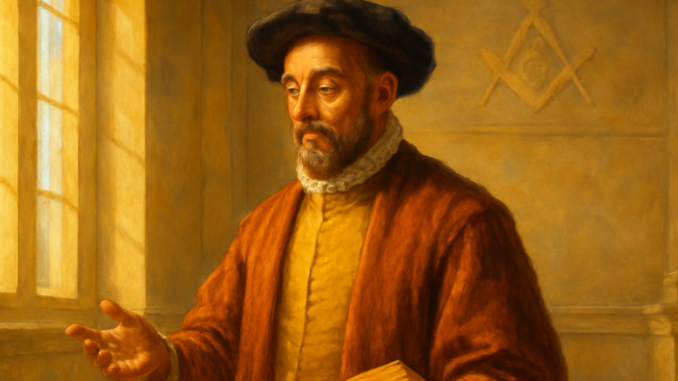
Can words come too quickly? Michel de Montaigne, the sixteenth-century French philosopher, posed this very question in his tenth essay. In an era when rhetoric was considered the highest art, he dared to question whether fluent eloquence truly reflects wisdom. This short but powerful essay invites us to pause and consider a fundamental paradox: is the fastest speaker also the wisest, or does slowness in speech actually conceal greater depth?
The Core Idea of the Essay
In this tenth essay from his first book, Montaigne examines the relationship between eloquence and the speed at which someone speaks. He begins with a seemingly simple observation: some people speak slowly and searchingly, while others let words flow effortlessly. Yet Montaigne refuses to render a simple verdict on which is better. Instead, he shows that both ways of speaking have their own value and their own limitations.
The philosopher candidly acknowledges that he himself belongs to the slower speakers. He needs time to organize his thoughts and find the right words. By his own admission, this makes him less suited to the courtroom or the political debate, where speed and improvisation are rewarded. But is that a shortcoming, he wonders, or rather a sign of care and deliberation?
Classical Examples and the Tradition of Rhetoric
Montaigne draws freely from classical antiquity to support his argument. He references famous orators who were renowned for their fluency, but immediately adds a caveat. The Roman statesman Cicero was considered a master of eloquence, yet even he warned against empty words that impress without carrying any real substance. Montaigne reminds his readers that the Spartans, known for their terse and concise manner of speaking, often carried more weight than long-winded orators.
It is not the abundance of words that persuades, but the truth contained within them.
This idea forms the thread running through the entire essay. Montaigne suggests that true eloquence is not about speed or fluency, but about the authenticity of what is said. A slow, searching speaker may dig deeper into the substance of the matter, while a fluent speaker sometimes remains on the surface.
Personal Reflection and Radical Honesty
What makes this essay truly remarkable is Montaigne’s characteristic honesty about his own limitations. He does not hide behind abstract philosophy but openly shares that he struggles with public speaking. When under pressure, he confesses, his thoughts freeze. Words refuse to come, or they arrive in the wrong order. This vulnerability makes him not weaker as a writer, but far more credible.
This personal touch elevates the essay above a dry treatise on rhetoric. Montaigne does not speak from an ivory tower but from lived experience. He invites his readers to examine their own speaking habits without shame. Slowness is not failure — it may well be the mark of a mind that refuses to remain shallow.
The Symbolic Value of the Deliberate Word in Freemasonry
For those familiar with the traditions of Freemasonry, Montaigne’s argument resonates on a deeper level. In Masonic ritual practice, great value is placed on the spoken word. Words are not uttered carelessly; they carry meaning that extends far beyond their literal content. The silence that precedes the word is just as significant as the word itself.
This touches upon a broader symbolism: the word as a building stone. Just as a mason does not simply stack stones haphazardly but places each element with care, so too should a speaker choose words deliberately. Hasty speech can lead to cracks in the edifice of understanding. A well-considered word, on the other hand, contributes to a solid foundation of truth and trust.
In the lodge, Brethren learn that silence is not emptiness — it is a sacred space for contemplation. The moment before speaking is not wasted time but an opportunity to weigh the impact of what is about to be said. Montaigne, though writing centuries before the modern Masonic tradition fully developed, captures this same spirit perfectly.
Relevance for Today’s World
In an age that glorifies speed, Montaigne’s essay offers a powerful counterpoint. Social media rewards the quick reaction; meetings favor whoever can formulate the fastest. But what is lost in this rush? Montaigne would likely argue that we trade depth for superficial cleverness.
Consider these principles that emerge from his thinking:
Speed does not automatically imply competence. Slowness may indicate thoroughness and genuine respect for the subject at hand. And silence is not a void — it is space for reflection and meaning.
The essay challenges us to reconsider our own habits of speech. When do we speak to impress, and when do we speak to truly convey something of value? The answer to that question determines whether our words build or break.
An Invitation to Reflection
Montaigne’s tenth essay is not a manual for better rhetoric. It is an invitation to rethink the spoken word entirely. In a culture that equates speed with ability, he reminds us that the value of words lies not in their tempo but in their truthfulness. The slow speaker who searches for the right expression deserves just as much respect as the fluent orator who proceeds effortlessly.
This brief essay contains a timeless lesson: eloquence is not a matter of speed but of integrity. Montaigne teaches us that slowness need not be a weakness and that silence offers room for meaning. For anyone who values the spoken word as a means of connection and truth — whether in the lodge or in daily life — this essay provides rich material for contemplation.
Perhaps the most important question is not how fast we speak, but whether we truly have something to say. In Freemasonry, as in Montaigne’s philosophy, the deliberate word carries more weight than a torrent of empty rhetoric. Let us take his lesson to heart: choose words with care, honor the silence that precedes them, and build meaning with every sentence we speak.
Copyright text & image: devrijmetselaar.nl
Texts are based on the ideas and content of the author of devrijmetselaar.nl, reviewed, corrected, and supplemented with the assistance of OpenAI. Images are created based on the ideas of the author of devrijmetselaar.nl using OpenAI/DALL-E.
Frequently Asked Questions
What is the connection between Montaigne's philosophy and Freemasonry?
Montaigne's emphasis on deliberate speech and authentic wisdom aligns deeply with Masonic principles of thoughtful reflection and genuine knowledge. Freemasons value the careful, measured word over empty rhetoric, seeing in Montaigne's philosophy a mirror of their own commitment to truth and substance over superficial display.
How does the concept of 'the deliberate word' apply to Masonic teaching?
In Freemasonry, the deliberate word represents the principle that meaningful communication requires thoughtfulness and authenticity. Masonic rituals and teachings emphasize the power of carefully chosen words to convey profound truths, reflecting Montaigne's belief that true eloquence comes from depth rather than speed.
Why would Freemasons appreciate Montaigne's admission of his own limitations?
Freemasonry values humble self-awareness and personal growth, making Montaigne's candid confession about his speaking difficulties deeply relatable to the fraternity's members. His vulnerability demonstrates that wisdom and credibility come not from perfection, but from honest self-reflection and the pursuit of truth—core Masonic virtues.
Is eloquence important in Freemasonry?
While eloquence has its place in Masonic communication, Freemasonry prioritizes sincere substance over flowery words, much like Montaigne's philosophy. The fraternity teaches that the most powerful messages come from authentic intention and careful consideration, not from rapid or impressive speech.

Be the first to comment