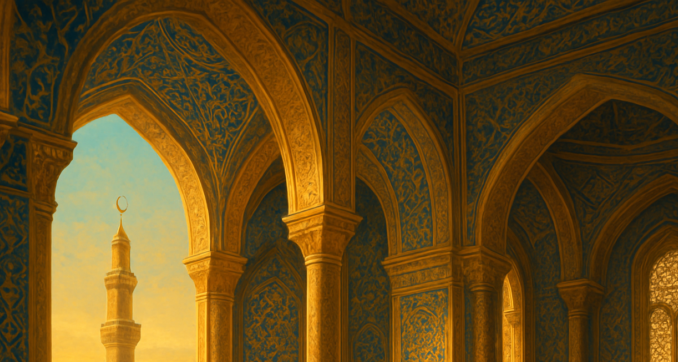
There are moments when life takes an unexpected turn — an encounter, an insight, an experience you never planned for, yet one that changes everything. Surah Ta-Ha, the twentieth chapter of the Quran, tells the story of just such a turning point in the life of the prophet Moses. And remarkably, this ancient narrative touches on the very themes that Freemasons have contemplated for centuries: the calling that finds you when you are not looking for it, the fire that illuminates without consuming, and the courage to embark on a journey whose destination remains unknown.
The Mysterious Opening Letters
Ta-Ha. Two Arabic letters that give the surah its name, yet whose meaning no one knows with certainty. Some scholars interpret them as a form of address, others as a reference to hidden wisdom. It is precisely this mystery that makes the opening so powerful. From the very first syllables, you are invited to look beyond the surface, to search for meaning that is not immediately visible.
For Freemasons, this is a familiar principle. In the lodge, we work with symbols that carry no single fixed meaning — symbols that, through their very ambiguity, invite reflection. Just as the rough ashlar is not merely a stone but a reference to our own unrefined state, the opening letters of Ta-Ha serve as a gateway to deeper contemplation. They remind us that true wisdom often begins with acknowledging what we do not know.
The Burning Bush: Light Without Destruction
The central narrative in Surah Ta-Ha describes how Moses, traveling through the desert with his family, sees a fire burning in the distance. He approaches it, hoping to find warmth or directions. What he encounters is something else entirely: a fire that burns without consuming, and a voice that calls him by name.
The fire that illuminates without burning is a profound symbol of spiritual knowledge that transforms without destroying. This image of the burning bush resonates deeply within the Masonic tradition. In our rituals, light plays a central role — not as ordinary light, but as a symbol of insight and truth. When a candidate is initiated, the transition from darkness to light is a fundamental moment. Like Moses approaching the fire, the seeker enters a space where ordinary rules no longer apply, where the sacred reveals itself to those willing to listen.
The Calling You Do Not Choose
What stands out in the story of Moses is that he was not searching for a divine mission. He was a shepherd, traveling with his family, occupied with the practical concerns of daily life. The calling came to him. This is a pattern found across many spiritual traditions and one that is also recognized within Freemasonry.
Freemasonry requires that you knock on the door yourself, that you come of your own free will. But once inside, you often discover that the real transformation does not happen because you seize knowledge — it happens because insight reveals itself to you when you are ready for it. It is as though the light had been burning all along, waiting for you to come close enough to see it.
The Staff and the Hand: Tools of Transformation
In Surah Ta-Ha, Moses is given two signs: his staff, which transforms into a serpent, and his hand, which glows white when he places it beneath his garment. These symbols are not mere miracles — they are tools that Moses must learn to wield. The staff, an ordinary shepherd’s implement, becomes an instrument of the divine. The hand, with which he performs his daily work, becomes a bearer of light.
Freemasons likewise work with tools that carry a dual meaning. The gavel, the compasses, the square — these are practical instruments that simultaneously point toward moral and spiritual principles. Just as Moses learns that his ordinary staff can carry extraordinary power, the Freemason discovers that everyday actions can be bearers of deeper values. The profane and the sacred are not separate worlds; they flow into one another when you live with the right intention.
Brotherhood in the Mission
One of the most moving details in Surah Ta-Ha is the moment when Moses asks whether his brother Aaron may accompany him. He acknowledges his own limitations — his difficulty with speech — and requests a companion who can support him. The request is granted. The mission becomes a shared journey.
Moses recognizes that he cannot undertake the journey alone. Aaron becomes his spokesman and his support. The divine mission is carried by brotherhood. This touches on a core value of Freemasonry: we do not build alone. The lodge is a brotherhood in which we support, correct, and encourage one another. No one is expected to work on their rough ashlar in isolation. Just as Moses and Aaron fulfill their mission together, Freemasons work collectively toward personal and shared growth. Acknowledging your own limitations is not weakness — it is the first step toward real strength.
The Desert as an Inner Landscape
The story of Moses unfolds in the desert — a vast emptiness that is both threatening and liberating. In that barren space, stripped of the distractions of cities and social life, the voice of something higher becomes audible. The desert is not merely a geographical location; it is an inner landscape, the silence necessary to truly listen.
Freemasonry, too, knows moments of silence and reflection. The Chamber of Reflection before initiation, the meditation before the work begins — these are desert moments in which you are brought back to essentials. Only when you allow the noise of daily life to fall silent can you hear what truly matters.
Surah Ta-Ha invites you to recognize your own burning bush — those moments when life calls you toward something greater than yourself, when the ordinary lights up with unexpected meaning. As a Freemason, you recognize in the story of Moses the same journey you walk within the lodge: from darkness to light, from ignorance to insight, from solitude to brotherhood. The fire still burns. The question is whether you are willing to approach it, to set aside your sandals on holy ground, and to begin the journey — not because you know where it leads, but because you trust the light enough to follow it.
Copyright text & image: devrijmetselaar.nl
Texts are based on the ideas and content of the author of devrijmetselaar.nl, reviewed, corrected, and supplemented with the assistance of OpenAI. Images are created based on the ideas of the author of devrijmetselaar.nl using OpenAI/DALL-E.
Frequently Asked Questions
What is the significance of the mysterious opening letters 'Ta-Ha' in Surah Ta-Ha?
Ta-Ha are two Arabic letters whose meaning remains uncertain to scholars. Some interpret them as a form of address while others see them as references to hidden wisdom. Their mystery is intentional, inviting readers to look beyond the surface and search for deeper meaning. This principle parallels Masonic practice, where symbols carry multiple layers of significance that encourage reflection and contemplation rather than offering single fixed interpretations.
How does the burning bush symbol relate to Freemasonry?
The burning bush in Surah Ta-Ha represents fire that illuminates without consuming, symbolizing spiritual knowledge that transforms without destruction. This resonates deeply with Masonic tradition, where light is central to rituals as a symbol of insight and truth. When candidates are initiated in Freemasonry, the transition from darkness to light mirrors Moses approaching the sacred fire—both represent entering a sacred space where ordinary rules no longer apply and truth reveals itself to willing seekers.
What is significant about Moses receiving his calling unexpectedly in Surah Ta-Ha?
Moses was not actively searching for a divine mission—he was simply a shepherd traveling with his family when he encountered the burning bush and received his calling. This theme of an unexpected turning point that changes everything resonates with Masonic contemplation about callings that find you when you are not looking for them. It emphasizes that transformative spiritual experiences often arrive unbidden, requiring courage to embark on a journey whose final destination remains unknown.

Be the first to comment