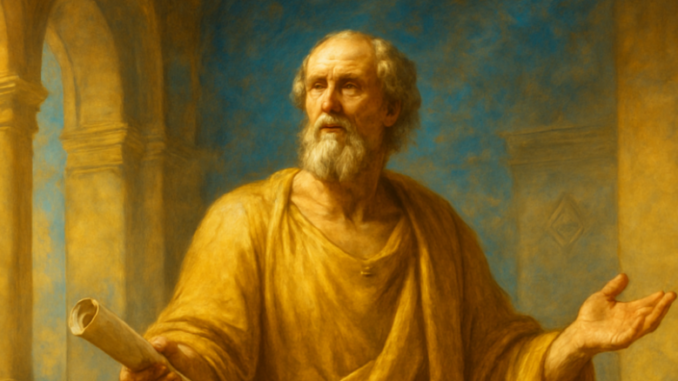
What is the difference between superficial happiness and deep, unshakable joy? In his twenty-third letter to his friend Lucilius, the Roman philosopher Lucius Annaeus Seneca confronts this fundamental question head-on. He examines why most people spend their entire lives chasing fleeting pleasures, while the only source of genuine fulfillment lies within themselves. Nearly two thousand years later, this letter still holds up a timeless mirror for anyone wondering where lasting happiness truly comes from.
The Heart of Letter XXIII
Seneca opens this letter with a deceptively simple question: are you truly happy, or are you merely playing the part of someone who is? He urges Lucilius to look honestly into the mirror. Roman society of Seneca’s day — much like our own — offered endless distractions and superficial pleasures: banquets, fame, possessions. But Seneca warns that this kind of joy is as fleeting as morning mist. The moment circumstances change, happiness evaporates along with them.
The philosopher draws a sharp distinction between laetitia — exuberant cheerfulness — and gaudium — deep, inner joy. The former depends on external factors and shifts with fortune. The latter springs from the soul itself and cannot be taken away by circumstance. This distinction forms the backbone of the entire essay and resonates powerfully with anyone engaged in serious self-examination.
The Outsider and the Wise
Consider two perspectives side by side. On one hand stands the average person — whether in Seneca’s Rome or in our modern world. This individual seeks happiness in what the world offers: a new car, a promotion, the approval of others. Each day becomes a fresh adventure of hope and disappointment, entirely dependent on what fortune brings. When life goes well, they shine. When it doesn’t, they crumble.
On the other hand stands the wise person, as Seneca envisions them. This individual has discovered that the source of joy lies not outside, but within. They appreciate the beauty of life, but they do not panic when that beauty temporarily fades. Their happiness is not built on the shifting sands of possessions or status, but on the bedrock of self-knowledge and inner strength. Both figures may experience the same circumstances, yet their inner lives are radically different.
The Vivid Examples Seneca Uses
Seneca illustrates his argument with striking imagery. He compares people who seek happiness in externals to children amusing themselves with toys. The pleasure is intense but short-lived. The moment the novelty wears off, they are already searching for the next shiny object. The wise person, by contrast, is like someone who has discovered an inexhaustible spring. No matter what happens, the water keeps flowing.
Another powerful image is that of the traveler who never arrives. Many people, Seneca observes, live as though real life begins tomorrow. When I get that job. When my children are grown. When I finally retire. They postpone joy to a moment that may never come. The wise person lives now. They do not wait for perfect conditions but find joy in the present moment.
True joy is not a reward for favorable circumstances — it is an inner disposition that remains independent of what fortune delivers.
What Both Worlds Share
Despite the differences between the outsider and the wise, Seneca acknowledges that both are human. Even the wise person knows moments of doubt, grief, and uncertainty. The difference lies not in the absence of difficulty, but in how one responds to it. The wise have learned not to grasp at what lies beyond their control. Instead, they cultivate what is within their reach: their thoughts, their attitude, their character.
Both the ordinary person and the wise desire happiness. Both want a meaningful life. What separates them is insight. The outsider searches in the wrong place. The wise have discovered that the treasure is buried in their own house. This discovery is not the privilege of the few — it is a possibility open to everyone willing to turn their gaze inward.
What We Can Learn
Letter XXIII is not an abstract philosophical treatise — it is a practical guide. Seneca calls on Lucilius, and by extension every reader, to begin today. Stop postponing happiness. Stop searching for joy in things you cannot control. Start cultivating inner peace.
This essay reminds us that the pursuit of outward success often carries us further from genuine fulfillment. The paradox is that those who chase happiness the hardest find it the least. And those who quietly turn inward discover a wellspring that never runs dry. Seneca’s message rings as clearly today as it did nearly two thousand years ago: the good life is not something that happens to you — it is something you build from within.
Key Takeaways
There is a crucial distinction between superficial cheerfulness and deep inner joy. External factors create a dependent, fluctuating kind of happiness that can vanish in an instant. True joy arises from self-knowledge and inner strength — qualities that no outside force can strip away. The habit of deferring happiness to some future moment prevents us from experiencing joy in the here and now. And perhaps most importantly, everyone possesses the capacity to discover the source of lasting fulfillment within themselves.
Seneca’s Letter XXIII on true joy remains strikingly relevant after nearly two millennia. In a world saturated with distractions and superficial stimulation, this essay serves as a compass for anyone seeking lasting fulfillment. The contrast between the restless outsider and the tranquil wise person reveals that the difference lies not in circumstances, but in perspective. The question Seneca ultimately poses is deeply personal: where do you seek your joy, and are you willing to look within?
Copyright text & image: devrijmetselaar.nl
Texts are based on the ideas and content of the author of devrijmetselaar.nl, reviewed, corrected, and supplemented with the assistance of OpenAI. Images are created based on the ideas of the author of devrijmetselaar.nl using OpenAI/DALL-E.
Frequently Asked Questions
What is the main difference between laetitia and gaudium according to Seneca?
Laetitia refers to exuberant cheerfulness that depends on external factors and shifts with fortune, while gaudium is deep, inner joy that springs from the soul itself and cannot be taken away by circumstance. Seneca argues that true fulfillment comes from gaudium, not the fleeting pleasures of laetitia.
Why does Seneca believe that seeking happiness through external possessions and status is ultimately futile?
Seneca contends that external sources of happiness—such as wealth, possessions, fame, and approval—are as fleeting as morning mist. When circumstances change, the happiness evaporates along with them. This makes external-based joy unstable and unreliable, whereas genuine fulfillment must come from within oneself.
How does Seneca's philosophy in Letter XXIII remain relevant to modern life?
Although written nearly two thousand years ago, Seneca's letter addresses timeless human struggles that persist in modern society. Just as Roman society offered endless distractions and superficial pleasures, contemporary life is filled with similar temptations. His teaching that lasting happiness comes from inner strength and self-knowledge continues to provide guidance for anyone seeking genuine fulfillment beyond material success.




Be the first to comment