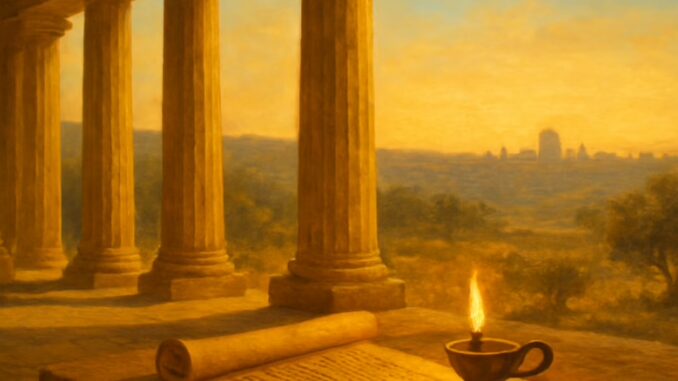
The Book of Proverbs has spoken to seekers of wisdom for millennia. For some, it is a collection of practical rules for living from an ancient world. For others, it is a timeless mirror reflecting moral principles that remain as relevant today as when they were first written. But how does a Freemason approach these ancient texts? And what does someone discovering the symbolic richness of this book for the first time see in its pages? In this exploration, we examine two perspectives on wisdom as raw material for the inner life.
The Perspective of the Traditional Reader
For many readers, Proverbs is primarily a collection of practical advice attributed to wise kings and teachers of ancient Israel. The book belongs to what scholars call wisdom literature, and it contains short, pithy statements about honesty, diligence, humility, and justice. The tone is direct, sometimes stern, and always oriented toward daily life. A father speaks to his son, a teacher to his student. The wisdom conveyed is concrete: avoid the foolish, seek the righteous, guard your tongue.
From this perspective, the book is essentially a manual for right conduct. The reader is encouraged to listen, to learn, and to improve their ways. It centers on moral self-discipline — on building a character resilient enough to withstand life’s temptations. Wisdom here is not an abstract concept but a skill acquired through experience and attentive living.
The Perspective of the Freemason
For the Freemason, Proverbs opens a deeper layer of meaning. Where the traditional reader finds practical advice, the Mason recognizes symbolic tools for inner work. The central metaphor of the book — the building of a path through life — resonates directly with the Masonic ideal of the rough ashlar being shaped into a perfect cube. Wisdom, in this view, is not merely knowledge but the capacity to consciously shape one’s life.
“The fear of the Lord is the beginning of wisdom, and the knowledge of the Holy One is understanding.”
This well-known verse from Proverbs points to an attitude of reverence and wonder before the unknowable. In Freemasonry, this is understood as openness to the transcendent without dogmatic prescription. It speaks to the willingness to keep learning, to acknowledge one’s own limitations, and to strive toward enlightenment simultaneously. The wisdom of Proverbs thus becomes a guiding thread for the initiatory journey every Brother undertakes.
Symbols That Bridge Both Worlds
Despite the different angles of approach, both perspectives share remarkable common ground. The traditional reader and the Freemason alike recognize in Proverbs the power of the word as a shaper of reality. The book repeatedly emphasizes that whoever masters their tongue masters their life. In the lodge, this is reflected in the importance of silence and of speaking only at the appropriate moment.
Several key symbols appear in Proverbs that resonate powerfully within Masonic thought: light as a metaphor for insight and truth; the path as a symbol of life’s journey and moral development; the master builder as an archetype of conscious creation; and gold and silver as images of purified wisdom.
One particularly compelling symbol in Proverbs is the personification of Wisdom as a feminine figure who calls out at the crossroads and public squares. She invites passersby to enter her house, which rests on seven pillars. For symbolically minded readers, this image is deeply evocative: the house of wisdom is a temple, built upon firm foundational principles. The seven pillars call to mind the seven liberal arts, planetary correspondences, and the layered nature of creation itself.
The Contrast Between Wisdom and Folly
Proverbs continually places two paths before the reader: the way of the wise and the way of the fool. This dualism is not intended as condemnation but as a mirror. The reader is invited to recognize themselves in both extremes. Who among us has not at times been reckless, hasty, or blind to their own shortcomings? The strength of Proverbs lies in its gentle yet urgent call to self-knowledge.
In Freemasonry, this contrast translates directly to the work on the rough ashlar. Every Brother carries both wisdom and folly within. The ritual work consists of becoming conscious of this inner tension and gradually creating harmony. The square and compasses serve as tools to measure and correct behavior, just as the proverbs themselves do with words.
What Both Perspectives Teach Us
Comparing these two approaches reveals that Proverbs can be read on multiple levels, and both are valuable. They complement rather than contradict each other. The practical reader finds guidance for everyday life. The symbolically inclined reader discovers an architecture of meaning that reaches far beneath the surface.
What both perspectives share is the understanding that wisdom does not come of its own accord. It must be sought, cherished, and applied. Proverbs invites us to actively build our character — stone by stone, day by day. In this sense, the book is a timeless document on the art of living, a blueprint for anyone willing to listen to the voice of wisdom at the crossroads of existence.
Whether one reads from a place of religious conviction, philosophical curiosity, or symbolic interest, Proverbs offers a treasury of insights into the human search for meaning. These ancient texts continue to speak to us because they touch on universal themes. For the Freemason, they affirm the value of inner work. For every reader, they extend an invitation — not merely to admire wisdom from a distance, but to make it a genuine building block of one’s own life.
Copyright text & image: devrijmetselaar.nl
Texts are based on the ideas and content of the author of devrijmetselaar.nl, reviewed, corrected, and supplemented with the assistance of OpenAI. Images are created based on the ideas of the author of devrijmetselaar.nl using OpenAI/DALL-E.
Frequently Asked Questions
How do Freemasons interpret the Book of Proverbs differently than traditional readers?
While traditional readers see Proverbs as practical advice for daily conduct, Freemasons recognize symbolic layers that relate to their initiatory journey. For Masons, the building metaphor in Proverbs mirrors the Masonic ideal of shaping oneself from a rough stone into a perfect cube through conscious inner work. This deeper symbolic approach enriches the Mason's understanding of wisdom as a tool for personal transformation and spiritual development.
What does Freemasonry teach about wisdom?
In Freemasonry, wisdom is understood not as abstract knowledge but as the practical capacity to consciously shape one's life and character. Masons view wisdom as an openness to the transcendent, a willingness to keep learning, and an acknowledgment of one's limitations while striving toward enlightenment. This living wisdom guides each Mason's initiatory journey and personal development throughout their membership.
How does the concept of 'the fear of the Lord' relate to Freemasonry?
In Masonic interpretation, 'the fear of the Lord' represents reverence and wonder before the unknowable, rather than fear in the literal sense. Freemasonry understands this as openness to the transcendent without requiring dogmatic religious beliefs. This attitude of humble reverence and continuous seeking reflects Masonry's commitment to spiritual growth and enlightenment for all its members, regardless of their individual faith backgrounds.
What role does the mastery of speech play in Freemasonry?
Freemasonry emphasizes, like the Book of Proverbs, that mastering one's tongue is essential to mastering one's life. In the lodge, this principle is reflected through the importance of silence and speaking only at appropriate moments. This discipline of speech develops character, demonstrates respect, and supports the sacred nature of Masonic work and fellowship.
Can Freemasons of different faiths find meaning in Proverbs?
Yes, the Masonic approach to Proverbs transcends specific religious doctrines, allowing Masons of diverse faith traditions to appreciate its wisdom. Freemasonry's universal symbols and principles align with the timeless moral teachings in Proverbs—such as honesty, diligence, humility, and justice—making it a shared text for character development across the fraternity. This inclusive perspective strengthens the bond among Masons of all beliefs.



Be the first to comment