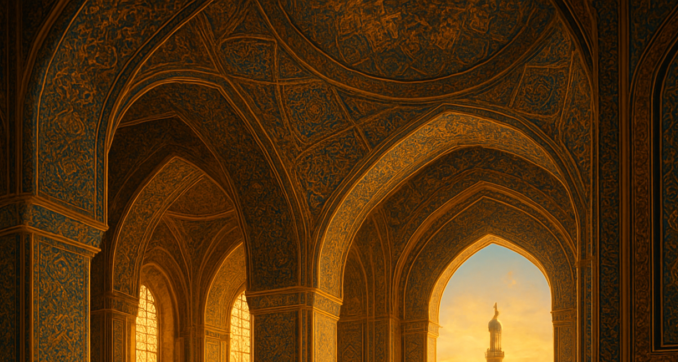
What is a word truly worth? And when does poetry transcend mere sound and rhythm to touch something deeper within us? These are questions that have occupied poets and seekers of truth for centuries. In the twenty-sixth surah of the Quran, known as The Poets, this very tension is explored with striking clarity. The text invites reflection on the responsibility we carry when we speak, write, or create. For Freemasons — who place the spoken word and inner growth at the heart of their practice — this surah opens a remarkable window onto spirituality.
What Does This Surah Actually Tell Us?
Surah 26, Ash-Shu’ara (The Poets), is one of the longer chapters in the Quran. It recounts the stories of prophets who were tasked with delivering their message to unwilling peoples. Moses, Abraham, Noah, and other figures each appear in turn. The pattern is always the same: a messenger speaks truth, only to be rejected by people clinging to their old ways and inherited patterns. It is only at the very end of the surah that the text turns its attention specifically to the poets themselves — and this is where a fascinating tension arises.
The Quran warns against poets who “wander in every valley” of imagination, who say what they do not do. But a crucial exception is made: poets who believe, perform good deeds, and remember God are praised. This is not a condemnation of poetry itself, but rather a call to authenticity. Words must be carried by action and sincerity. A poem without truth behind it is nothing more than beautiful noise.
Why Does This Resonate So Deeply with Freemasons?
In Freemasonry, the word holds a central and sacred place. Consider the Lost Word — a powerful symbol representing the search for deeper truth. Or think of the obligation of silence, which teaches us that not everything that can be said should be said. The poet described in this surah serves as a mirror: Do you use your words to build or to destroy? Do you speak from the heart or from vanity?
True spirituality demands that words and deeds reflect each other; without that harmony, every ritual remains an empty form.
This idea connects the message of The Poets directly to the Masonic tradition. In the lodge, brethren practice the art of speaking with intention. Every word in the ritual carries meaning; every symbol calls for genuine understanding and lived experience. The poet who says what he does not do is like a Mason who speaks eloquently about the builder’s art but never lays a single stone.
Can Words Truly Build?
Yes — and history proves it. Consider how the Enlightenment philosophers transformed entire societies with their pens. Voltaire wrote his passionate arguments for tolerance and shifted the course of European thought. Johann Wolfgang von Goethe, himself a Freemason, used poetry to articulate humanity’s striving toward the higher and the noble. Their words were not idle sounds but genuine building blocks for new worlds.
Surah 26 reminds us that creative power comes with responsibility. Those who possess the ability to move hearts with words also bear the duty not to misuse that gift. This resonates powerfully with the Masonic ideal of the rough ashlar — the unworked stone that must be shaped and refined. It is not only our actions that can be rough or polished; our words carry the same potential for transformation or harm.
What Does This Mean for Your Own Inner Journey?
Perhaps you recognize the experience: moments when you said something you did not mean, or made promises you could not keep. This surah invites self-reflection — not as a voice of condemnation, but as a gentle encouragement. Can you take one step closer to authenticity today? Can you align your words more fully with your deepest convictions?
In Freemasonry, this is called working on the inner temple. It is not a one-time achievement but a lifelong process. The poet who remembers God and performs good works stands as a symbol for the seeker who devotes their talents to something greater than themselves — not for fame or recognition, but out of an inner calling to contribute to the good.
How Does Spirituality Connect Different Traditions?
What stands out when reading The Poets is how universal the message sounds. The stories of the prophets in this surah also appear in Jewish and Christian traditions. The warning against hollow words can be found in the writings of Greek philosophers like Plato, who criticized rhetoricians for placing persuasion above truth. And the call for harmony between word and deed echoes through the Stoic writings of Marcus Aurelius.
The prophetic narratives connect the Quran, the Bible, and the Torah. The critique of empty rhetoric aligns with Plato’s dialogues. The emphasis on deeds alongside words mirrors Stoic wisdom. And the Masonic ritual unites all these currents in living practice.
Freemasonry is not a religion, but a brotherhood that unites people of all faiths around shared values. Reading texts such as The Poets is therefore not an exercise in conversion, but an exercise in openness. By studying other traditions, we deepen our understanding of universal themes: truth, creative power, and moral responsibility.
What Can You Take Away from This Reflection?
Surah 26 is far more than an ancient religious document. It is an invitation to self-examination that has lost none of its power over fourteen centuries. For Freemasons, it offers a mirror: Am I a builder with my words, or do I wander through valleys of vain imagination? The answer is found not in books alone, but in the daily practice of our lives.
The poets in the Quran remind us of a timeless truth: words carry power, and with power comes responsibility. Whether you are a person of faith or not, the call to authenticity touches something essential in the human experience. In Freemasonry, we encounter this wisdom in every ritual, every symbol, and every brotherly exchange. Perhaps that is the most beautiful form of poetry there is — a life in which words and deeds together tell a single, coherent story.
Copyright text & image: devrijmetselaar.nl
Texts are based on the ideas and content of the author of devrijmetselaar.nl, reviewed, corrected, and supplemented with the assistance of OpenAI. Images are created based on the ideas of the author of devrijmetselaar.nl using OpenAI/DALL-E.

Be the first to comment