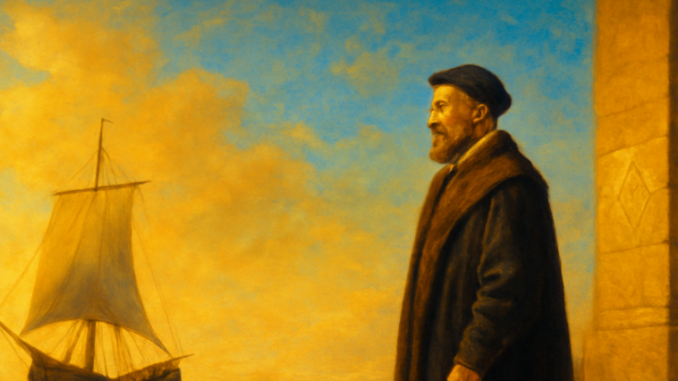
Imagine standing at a crossroads. To your left, someone whispers that the stars determine your fate. To your right, another promises that dreams reveal your future. And straight ahead lies a path with no signposts, illuminated only by your own inner light. Michel de Montaigne stood at precisely this crossroads centuries ago. His essay on prophecy is far more than a historical document — it is an invitation to reflect on how we relate to uncertainty, to truth, and to our own capacity to discern what truly matters.
The Skepticism of a Searching Mind
In his eleventh essay of the first book, Montaigne examines the phenomenon of prophecy with the curiosity that defines his entire body of work. He discusses divination, dream interpretation, and omens — not to condemn or embrace them, but to investigate. He quotes Cicero, who observed that out of a thousand predictions, perhaps two come true, and that people conveniently forget the failures. Montaigne wonders why humans are so eager to believe in a predetermined fate when daily experience teaches them, again and again, that the future refuses to be captured.
This attitude of critical inquiry without prejudgment feels remarkably modern. Montaigne does not reject the possibility of higher insights. He simply asks that we be honest about what we truly know and what we merely wish to believe. That honesty with oneself may well be the first step on any path toward wisdom.
Seeking Truth Without Self-Deception
In Freemasonry, the search for truth stands at the very center of the Craft. Not a truth that is imposed from above, but one you discover for yourself through study, reflection, and experience. This aligns remarkably with Montaigne’s approach. He did not write to tell others what to think. He wrote to order his own thoughts, to know himself more fully. “Que sais-je?” — What do I actually know? — was his personal motto.
That question is not an expression of despair but of intellectual courage. It is easy to claim you possess the truth. It is far harder to admit that you are still searching, that your understanding is incomplete, that tomorrow you may think differently than you do today. Yet it is precisely this openness that makes genuine growth possible. Anyone who believes they already know everything has no reason left to learn.
Today’s truth was yesterday’s heresy, and tomorrow’s certainty may be the day after tomorrow’s error.
Self-Reflection as Foundation
What sets Montaigne apart from many of his contemporaries is his willingness to turn the mirror on himself. When he analyzes prophecy, he simultaneously examines his own tendency to see patterns where none exist, to seek meaning in coincidence. This self-reflection is not weakness — it is a strength that enables him to be honest about the limits of human understanding.
In the lodge, this attitude is recognized and valued. The rough ashlar that must be shaped is not merely a metaphor for moral improvement. It is also an invitation to confront your own prejudices, fears, and illusions. Only when you know where the rough edges lie can you begin to polish. Montaigne does precisely this when he admits that even he is not immune to the temptation of superstition — but that he chooses to examine that temptation rather than follow it blindly.
Brotherhood in Uncertainty
Perhaps the most striking aspect of Montaigne’s essay is the humility it radiates. He claims no definitive answers. He invites the reader to think alongside him, to take the questions seriously without expecting simple solutions. That invitation to dialogue is deeply fraternal in nature.
In Freemasonry, brotherhood is more than camaraderie. It is the recognition that we are all seekers, that no one holds a monopoly on wisdom, that we can learn from one another. Montaigne embodies this attitude when he presents his own opinions as exactly that — opinions. Not as irrefutable truths, but as contributions to a conversation larger than himself.
The Masonic and Montaignean path share several guiding principles: acknowledge the limits of your own knowledge; examine your convictions with honesty; remain open to other perspectives; and seek truth together, not in isolation.
The Light of Discernment
Freemasons speak of the journey from darkness to light. That light is not an external revelation that simply happens to you. It is the inner capacity to discern — to separate the real from the apparent, to look beneath the surface at what lies underneath. Montaigne practices exactly this kind of discernment when he examines prophecy.
He sees that people crave certainty, that the future inspires fear, that the promise of foreknowledge offers comfort. He understands those needs. But he refuses to let his desire for comfort triumph over his desire for truth. That choice demands courage. It is far easier to surrender to the illusion of control than to accept the inherent uncertainty of existence.
An Enduring Invitation
What makes this centuries-old essay still relevant today? Perhaps it is the recognition that the human condition has not fundamentally changed. We still search for something solid to hold onto in a world that defies prediction. We are still seduced by promises of certainty. And we still face the choice to critically examine those seductions or to be swept away by them.
Montaigne chooses inquiry, reflection, and honesty. That choice connects him across the centuries to everyone who walks the same path. Whether you sit in a lodge or in your own study, the question remains the same: What do you truly know? And do you have the courage to face that question honestly?
Montaigne’s essay on prophecy is ultimately not a treatise on divination. It is a mirror held up to the human longing for certainty — and a gentle reminder that the most meaningful light we will ever find is the one we kindle within ourselves. For Freemasons and seekers of every kind, his message endures: the path to wisdom begins not with answers, but with the courage to keep asking questions.
Copyright text & image: devrijmetselaar.nl
Texts are based on the ideas and content of the author of devrijmetselaar.nl, reviewed, corrected, and supplemented with the assistance of OpenAI. Images are created based on the ideas of the author of devrijmetselaar.nl using OpenAI/DALL-E.
Frequently Asked Questions
What does Montaigne's skepticism about prophecy have to do with Freemasonry?
Montaigne's critical inquiry into truth without prejudgment mirrors Freemasonry's core principle that members must discover truth through personal study and reflection rather than having it imposed upon them. Both emphasize intellectual honesty and the courage to admit what we don't know, which is essential to genuine spiritual and intellectual growth. This alignment shows that Freemasonry values the same rigorous, open-minded approach to understanding the world that Montaigne championed centuries ago.
Is Freemasonry asking me to believe in prophecy or predetermined fate?
No. Like Montaigne, Freemasonry does not require belief in prophecy or fate; instead, it encourages you to think critically and form your own conclusions about such matters. The Craft teaches that you have the capacity to discern truth through reason, experience, and self-reflection rather than blindly accepting what others claim to know. Freemasonry respects your intellectual independence and invites you to question, investigate, and grow in understanding.
What does 'Que sais-je?' (What do I actually know?) mean in the context of Masonic learning?
This question expresses intellectual humility and the recognition that genuine wisdom begins with admitting the limits of our current understanding. In Freemasonry, this attitude is foundational—it means approaching the degrees and teachings with openness rather than assuming you already possess all answers. This openness keeps a Mason engaged in lifelong learning and self-improvement, which are central to the Masonic journey.
How does self-reflection strengthen a Freemason's path?
Self-reflection allows you to examine your own biases, assumptions, and tendencies—just as Montaigne examined his own susceptibility to seeing patterns where none exist. In Freemasonry, this honest self-examination, symbolized by the rough ashlar that must be shaped, enables genuine moral and spiritual development rather than merely superficial progress. By turning the mirror inward, you become better equipped to live the principles the Craft teaches and to help others do the same.

Be the first to comment