A pair of bronze scales, joined at a central pivot point. When one side descends, the other rises. This everyday object — once found in every market hall and apothecary shop — became for Michel de Montaigne the symbol of a disturbing truth about human exchange. In his short but powerful essay ‘That the Profit of One Man Is the Damage of Another,’ the sixteenth-century philosopher forces us to ask whether human dealings can ever be truly reciprocal. For Freemasons, who place brotherhood and connection at the heart of their craft, this essay opens a profound reflection on the nature of genuine community.
The Scales as a Mirror of Existence
Montaigne opens his essay by referencing the Athenian lawgiver Solon, who — according to Demades — argued that no profit is possible without a corresponding loss elsewhere. The scales serve here not merely as a measuring device but as a metaphor for the human condition. Every transaction, every exchange, every acquisition seems inevitably tied to a loss on the other side. Montaigne cites the Roman poet Lucretius, who described how nature itself operates on this very principle: what grows does so at the expense of something else that perishes.
This is not a cynical observation. It is an invitation to honesty. The scales ask us to look — truly look — at what we take and what we give. In the stillness of contemplation, this symbol reveals something about our daily choices that we would rather not see. Every purchase, every career move, every victory has a shadow side we tend to ignore.
The Shadow Side of Possession
Montaigne extends his analysis far beyond economic transactions. He points to the inheritance we receive upon another’s death, to the soldier’s victory that is inseparable from his opponent’s defeat. Even in nature, he sees the same principle at work: the growth of one organism occurs through the decomposition of another. This is not a moral judgment but a phenomenological observation. The philosopher describes what is, not what ought to be.
Yet hidden within this description lies an implicit question: if this is how things are, how can we live ethically? How can we possess without dispossessing others? This question resonates deeply with the Masonic pursuit of moral perfection. The recognition that our prosperity does not exist in a vacuum — that it always stands in relation to others — forms the very foundation of genuine brotherhood.
Brotherhood as the Answer to Zero-Sum Thinking
Freemasonry offers a perspective that acknowledges Montaigne’s observation but also transcends it. In the lodge, brethren meet not as competitors fighting over scarce resources, but as fellow travelers on a shared journey of discovery. The ritual of Freemasonry creates a space where the logic of profit and loss is temporarily suspended. Here, nothing is taken — knowledge, experience, and wisdom are shared freely.
Where the marketplace asks who wins and who loses, the brotherhood asks who we can become together.
This is not naive idealism. Freemasons acknowledge the world as Montaigne describes it, but they refuse to accept it as the final destination. The building symbolism of Freemasonry speaks volumes here: where the scales divide, construction unites. Stone upon stone, brother beside brother, something greater than the sum of its parts takes shape. This is not a zero-sum game — it is creation.
From Scales to Building
The contrast between the scales and the building reveals two fundamentally different ways of being in the world. The scales measure and divide, forever asking: how much for you, how much for me? The building asks a different question entirely: what can we create together? The Freemason consciously chooses the second perspective — not because the first is untrue, but because the second is far more fruitful.
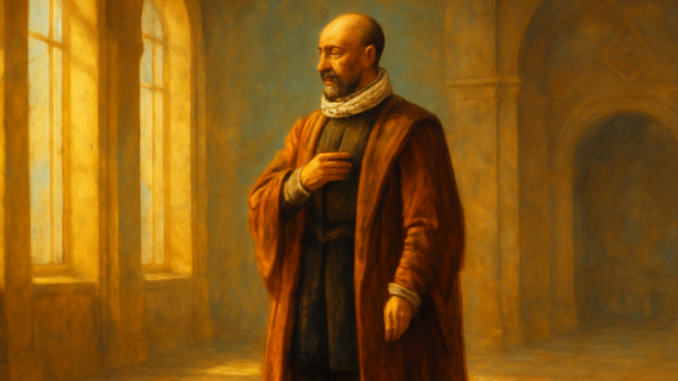
Montaigne himself seems to have understood this intuitively. While he never denied the hard truth of zero-sum dynamics, he devoted his life to sharing insights through his essays. He did not take; he gave. His work is a gift to future generations, a building block in the temple of human wisdom. In that sense, Montaigne — without ever knowing it — was a mason of ideas.
Self-Reflection as Daily Practice
What does all this mean for our daily lives? Montaigne’s essay invites honest self-reflection. When we win, what does someone else lose? When we receive, who is giving? These questions are not intended to provoke guilt but to expand awareness. The Freemason who asks these questions begins the essential work of shaping the rough ashlar of his character.
In every transaction: ask about reciprocity. In every success: acknowledge the contribution of others. In every acquisition: consider what you can share. This practice transforms the scales from an instrument of division into an instrument of conscience — not to condemn, but to remind us of our interconnectedness. In that remembrance lies the seed of true brotherhood.
Light Beyond the Shadows
Montaigne’s essay ends without a resolution — as is so often the case with this great thinker. He observes, he reflects, and he leaves the question open. For the Freemason, this is not a weakness but an invitation. The lodge is the space where such questions are allowed to reverberate, where brethren search together for light amid the shadows of existence.
The answer to Montaigne’s uncomfortable truth lies not in denial but in transcendence. Yes, the world knows profit and loss. But above that duality rises the possibility of community, of sharing, of building. The scales remain, but they do not have the final word. That final word is connection.
Michel de Montaigne held up a mirror that most of us would prefer to avoid. In that mirror, we see the scales of existence — the unavoidable link between one person’s gain and another’s loss. But the same mirror reveals something else as well: the possibility of moving beyond the zero-sum equation. Freemasonry does not deny the reality of the scales. Instead, it offers the trowel and the square — tools not for dividing, but for building. In choosing to build together, we do not eliminate the tension Montaigne described. We transform it into something richer: a shared temple, stone by stone, where the light of brotherhood outshines the shadows of mere transaction.
Copyright text & image: devrijmetselaar.nl
Texts are based on the ideas and content of the author of devrijmetselaar.nl, reviewed, corrected, and supplemented with the assistance of OpenAI. Images are created based on the ideas of the author of devrijmetselaar.nl using OpenAI/DALL-E.
Frequently Asked Questions
What is Montaigne's main argument in 'That the Profit of One Man Is the Damage of Another'?
Montaigne argues that human exchange and transactions inherently involve a zero-sum dynamic, where one person's gain corresponds to another's loss. Using the bronze scales as a metaphor, he illustrates this principle through examples ranging from economic dealings to natural processes, suggesting that every acquisition or victory has a corresponding loss elsewhere. This is presented not as a cynical judgment but as an honest observation about the human condition.
How do the bronze scales function as a symbol in Montaigne's essay?
The bronze scales serve as both a practical measuring device and a philosophical metaphor for human existence. When one side descends, the other rises, representing the balance between profit and loss in all human dealings. For Montaigne, this everyday object becomes a mirror that forces us to honestly confront what we take and what we give, revealing the shadow side of possession that we typically ignore in daily life.
What is the connection between Montaigne's philosophy and Freemasonry?
Montaigne's analysis directly challenges Freemasons to reflect deeply on their commitment to brotherhood and moral perfection. By recognizing that prosperity never exists in a vacuum and always stands in relation to others, Masons are invited to consider how genuine community can be built. The essay suggests that true brotherhood requires acknowledging the interconnectedness of human welfare and moving beyond zero-sum thinking to create authentic, reciprocal relationships.


Be the first to comment